The Seller Who Joined the Platform and Never Made a Sale
Adoption — not technology — is the real bottleneck keeping SMB sellers from generating revenue on B2B platforms
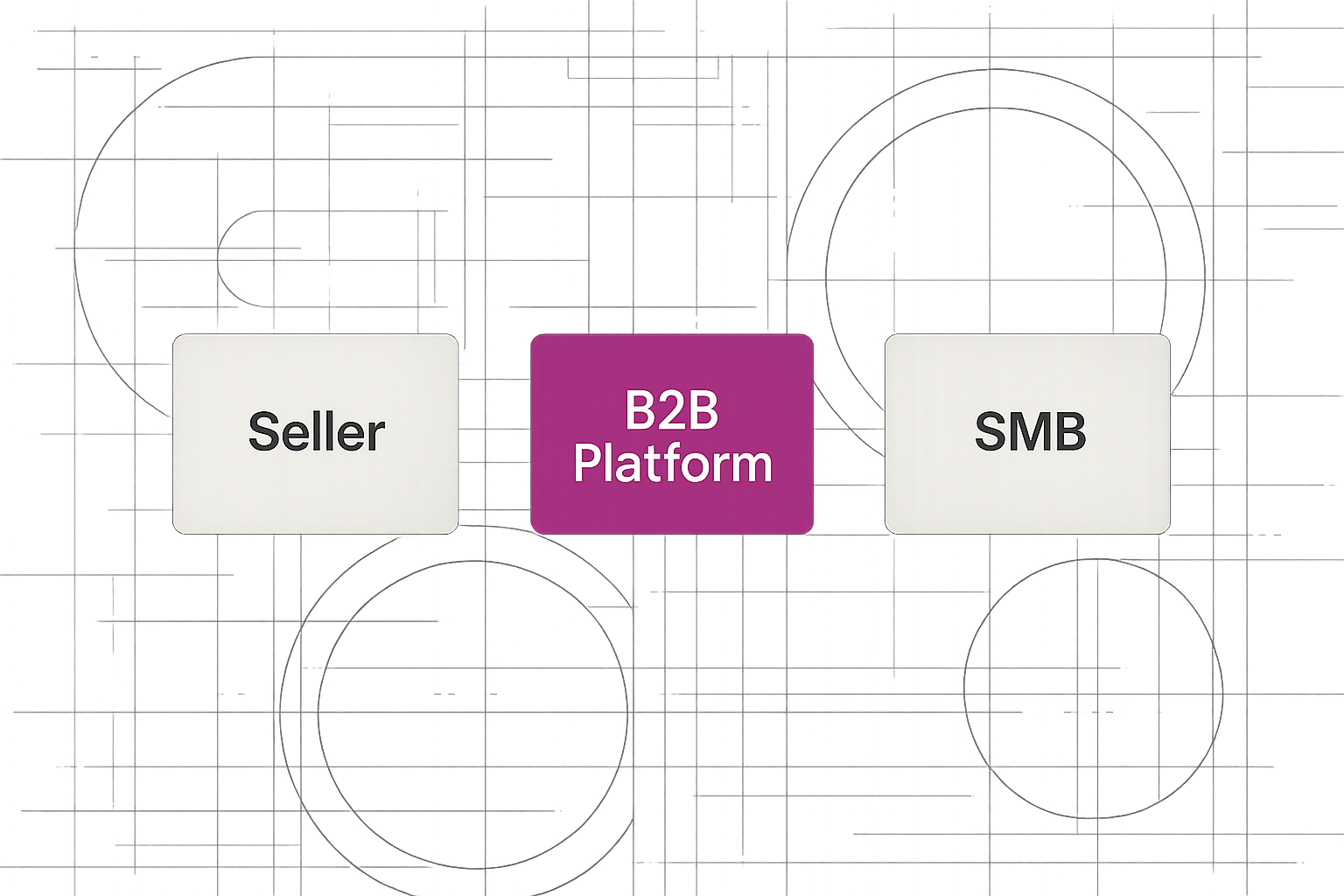
The Seller Who Joined the Platform and Never Made a Single Sale
TL;DR
- The main activation barrier for SMB sellers on B2B platforms is not a lack of technology: it is a lack of real process adoption.
- Resistance to catalog loading, expectations of automatic traffic, and low operational maturity are the most common drivers of stagnation.
- Without active presence and an updated catalog, the seller exists in the system but is invisible to the buyer.
- The problem is recurring, silent, and rarely shows up in network expansion reports.
Why do so many "onboarded" B2B sellers never reach their first sale?
There is a metric that few B2B operations track with any rigor: the distance between the seller who signed the contract and the seller who generated revenue. The number of registered partners grows. The number of active partners, not so much.
The pattern is well documented across marketplace operations and B2B distribution platforms. An SMB seller, typically a regional distributor, an auto parts supplier, or a mid-size manufacturer, completes the credentialing process. Gets access. And stops there.
It is not sabotage. It is not bad faith. It is a combination of three mutually reinforcing factors.
First: resistance to the catalog loading process. Spreadsheets with hundreds of SKUs, channel-specific pricing rules, required fields that the sales team never mapped. For a company with 20 to 200 employees and no dedicated e-commerce or IT structure, this initial step can take weeks, when it gets finished at all. Most of the time it does not. The catalog stays incomplete, outdated, or simply empty.
Second: the expectation that the platform generates traffic on its own. This is the most costly misconception. The seller joins the platform imagining that digital presence works like a passive storefront: just being there is enough. But in B2B markets, supplier discovery still depends on active relationship-building, on negotiating with specific buyers, on commercial terms that need to be configured, not just listed. The platform is infrastructure, not an autonomous marketing channel.
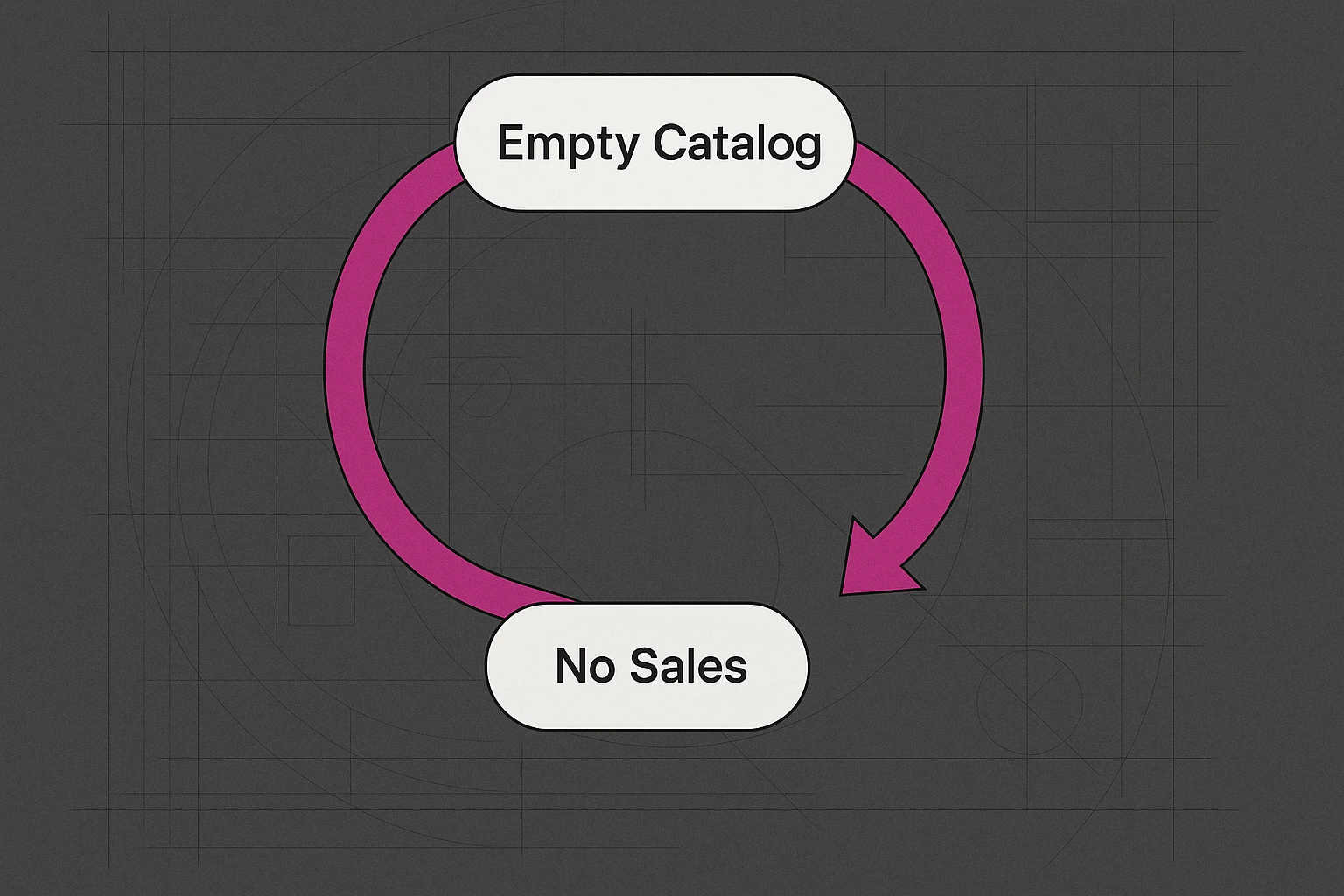
Third: low operational maturity to sustain a digital presence. Outdated pricing, unsynchronized inventory, delivery lead times left blank. A buyer arrives, finds inconsistent data, and bounces. The seller does not notice because they are not monitoring anything. The cycle closes: no sales, no motivation to maintain the catalog; no catalog, no sales.
The result is a wasted asset on both sides. The platform bears the acquisition and onboarding cost of a partner who contributes nothing to GMV. The seller loses the channel without ever having tested its potential.
What this actually costs
Inaction here carries at least two direct costs that rarely make it into anyone's spreadsheet.
The first is wasted customer acquisition cost. Credentialing an SMB seller has a real price: sales, legal, technical, and operational resources. When that seller never activates, the investment becomes a write-off. In networks with dozens or hundreds of sellers, even a 30% inactivation rate represents a meaningful volume of capital deployed with no return.
The second is the opportunity cost on the buyer side. A B2B buyer who enters the platform, searches for a product, finds an incomplete catalog or stale pricing, and leaves will rarely return with the same expectations. The perception of network quality falls on the platform operator, not on the individual seller who left the data inconsistent.
There is also a third cost, less visible: the manual follow-up the operator must do to compensate for the seller's low maturity. Phone calls, site visits, spreadsheets sent back and forth, catalog update follow-ups. It is pure transaction cost, absorbed by the operation without being priced anywhere.
Principles for anyone operating or building an SMB seller network
- Separate onboarding from activation: credentialing is not the same as activating. Define distinct metrics and treat the gap between them as a network health indicator.
- Reduce catalog friction without eliminating governance: the loading process needs to be simple enough for the SMB to execute independently, but structured enough to produce data that is actually usable by the buyer.
- Correct the traffic expectation upfront: the seller needs to understand, before signing, what their role is in demand generation and what the platform's role is. Confusion between the two is a recurring source of frustration and inactivity.
- Monitor active presence, not just registration: catalog quality, update frequency, order response rate. These indicators say more about network health than the raw count of registered sellers.
- Build a scalable support cadence: SMB sellers rarely self-manage in the early stages. Some level of structured support is necessary, but it needs to be designed to scale without growing linearly in headcount cost.
Frequently asked questions
Is this problem exclusive to small sellers? No, but it is more concentrated there. Larger sellers tend to have dedicated channel management resources. The SMB operates with the same team doing everything, and the B2B platform frequently does not make the daily priority list.
Is the solution to simplify the technology? Partially. A simpler interface helps, but it does not fix the mistaken expectation of automatic traffic or the absence of an internal process on the seller's side. Simpler technology with no underlying process still results in an empty catalog.
How long does it take an SMB seller to close their first sale? It depends on the seller's maturity and the support available. The pattern observed in well-structured B2B operations is that sellers with a complete catalog and active presence reach their first transaction in weeks, not months. The bottleneck is almost always the time it takes to get the catalog into a usable state, not the time spent negotiating with the buyer.
From someone who has lived it
"We had been trying to implement a B2B solution for almost 2 years. With CWS, we deployed in 60 days."
Edivaldo C., verified reviewer, automotive sector, company with 201–500 employees. Source: Software Advice
The quote is less remarkable for the 60-day timeline than for what it reveals: two years of prior attempts. The problem was not that technology was unavailable. It was adoption. The barrier was in the process, not the tool.
A case that illustrates the point
In B2B operations, productivity bottlenecks are rarely about human capacity: they are about the absence of formalized rules in the system. When pricing policy, credit terms, and exception handling move out of a rep's head and into a digital workflow, response time stops depending on someone's availability. The same principle applies to the SMB seller: as long as the catalog update process depends on the individual discipline of someone who is already overloaded, it will not happen consistently. When it becomes a structured workflow, with automated validation and visibility for the network operator, active presence stops being the exception.
What CWS brings to this equation
CWS Platform operates as commercial governance infrastructure for B2B, not as a demand generation channel. That distinction matters because it resolves exactly the expectation mismatch described above: the platform structures the negotiation process, pricing and credit rules, and the order workflow, but active presence in the channel remains the responsibility of the seller and the network operator.
For operators running networks with SMB sellers, this means the technology can formalize the catalog loading process, reduce manual follow-up costs, and make active presence data visible, without requiring a support team that scales at the same rate as the network. The transaction cost of onboarding and network maintenance drops when the process lives in the system rather than on someone's calendar.
About this publication
The Cost of the Sale is CWS Platform's publication on B2B commercial operations: negotiation governance, transaction cost, and data-driven decision-making. Written for CEOs, sales leaders, and operations owners who sell to businesses.
Sources
Recurring SMB pain in B2B platforms (proprietary thesis, derived from operational observation across B2B operations): analysis of SMB seller inactivation patterns following onboarding, focusing on resistance to catalog loading, automatic traffic expectations, and low operational maturity. Anonymized and recurring data from marketplace and B2B distribution platform operations.
Software Advice, verified review by Edivaldo C. (automotive sector, company with 201–500 employees): public testimonial on B2B implementation experience with CWS Platform. Available at: https://www.softwareadvice.com/product/546664-CWS-Platform/
"The support model is differentiated — the project team actually understands B2B complexity and stays close throughout implementation."
Want to see this in your operation?
Real B2B operations already run on it.