The Next Margin Frontier Is in the Decision
Digital revenue makes headlines. I went to the CVM to check the margin.
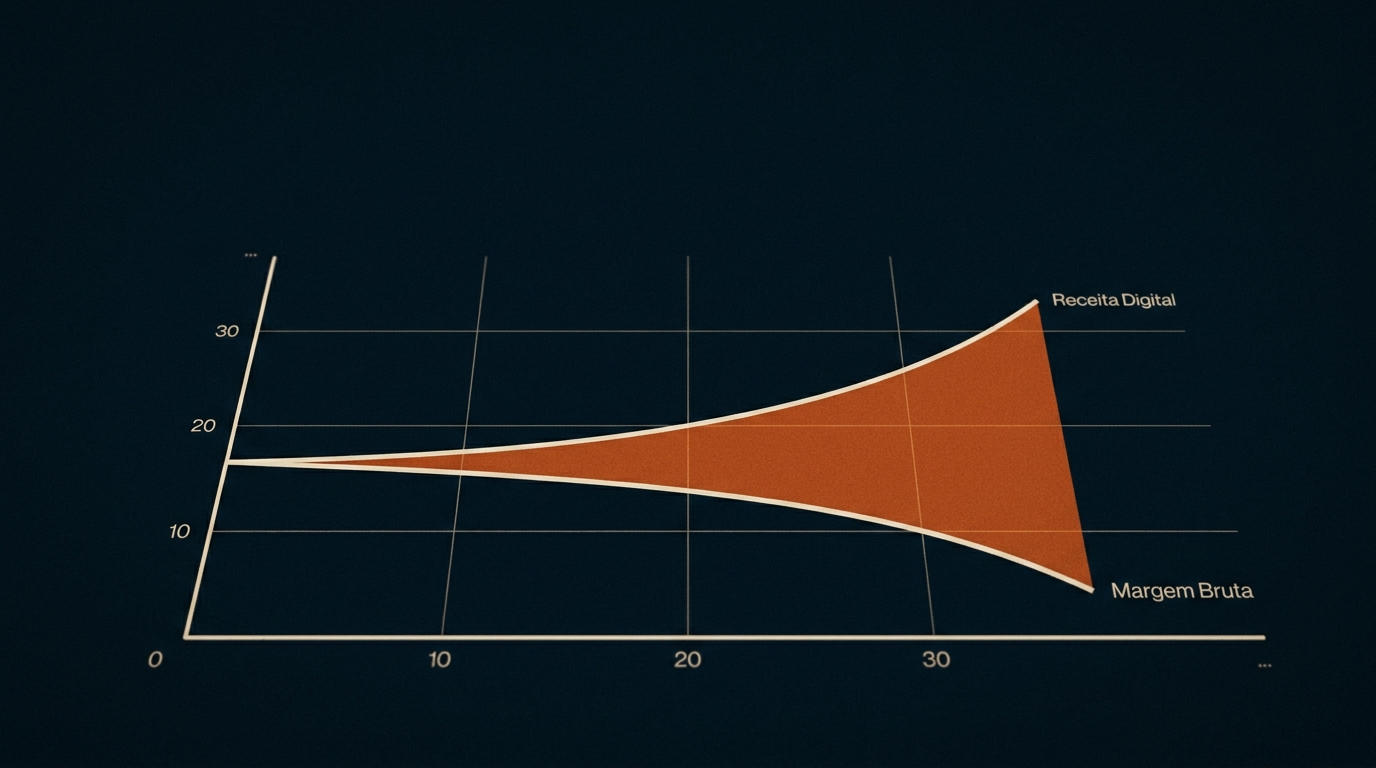
Every digital transformation is born from the same gesture: replacing a human friction with an interface. For years, that was enough to make headlines. The catalog became an app. The order became a checkout. Support became a bot. Each of those gestures generated digital revenue. Few defended margin.
I went to see where the truth of this story actually lives: in the CVM filings — Brazil's SEC.
Allied Tecnologia (CVM 25330), Q3 2025. Digital Retail jumped from R$ 187.2M to R$ 260.6M — +39.2%. On the same page of the release, retail gross margin collapsed 4.9 points: from 28.4% to 23.5%. Retail gross profit barely moved (R$ 88.6M vs. R$ 89.4M, -0.8%). Digital revenue grew almost 40%; retail gross profit, zero. Grade A — realized and quantified. It's the audited definition of "vanity": Allied's Q3 2025 Earnings Release on CVM/RAD.
Profarma (CVM 20346), Q3 2025. Group gross revenue R$ 3.3B (+9.1%); Adjusted EBITDA margin 4.0% (-0.1pp); Adjusted Net Income margin 1.8% (-0.2pp). In retail (d1000), the "digital strategy grew 73.7% in the period and represented 10.3% of gross revenue." And one sentence that reveals where the sector stands today: "more than 80 AI agents are in operation… aimed at improving productivity, decision-making, and performance" — with gains "we expect to make more tangible in the coming periods." Grade A for channel digital; Grade C for agentic AI. Profarma's Q3 2025 Results Release on CVM/RAD.
Read together, the two releases describe the entire cycle of Brazilian digital: channel is already a number (A); decision is still a promise (C); margin is what paid the bill.
The Missing Lens
Coase explained in 1937 why firms exist: because the market has costs — finding a supplier, negotiating price, policing a contract. Williamson deepened the governance of those costs. North showed that institutions (rules, contracts, norms) determine who captures value and who merely transports it. Digital, in its first decade and a half, attacked the search cost — catalog, marketplace, app. It shrank the friction of finding and ordering. It did not attack the cost of deciding well: at what price to sell, to whom to extend credit, which mix to deliver to defend margin. The decision cost stayed human — expensive, slow, erratic.
That's why margin didn't follow. The digital channel amplified the speed of the wrong sale. Selling more didn't mean earning more.
The Next Frontier: Digitalizing the Decision
Putting a catalog on the buyer's phone isn't enough. Price has to form in real time, accounting for inventory, cost of capital, customer elasticity, credit risk, and product mix. Credit has to be approved with a guardrail, not a human bottleneck. Mix has to be recommended looking at margin, not just conversion.
This is agentic AI under governance: the system monitors, decides, and acts — with a human in the loop when the decision matters. It is not passive automation (fixed rule, linear flow). It is the next generation of private economic institution: financial rails that govern transaction costs inside the firm itself.
At Tracbel (Volvo, 40 branches), this path moved from thesis to channel scale: the operation reached over R$122 million in digital channel revenue in 2025, serving 3,500 customers. The defensible asset isn't the storefront; it's the layer that decides price, credit, and mix under an auditable rule.
What Changes for Decision-Makers
CEO: the next batch of releases will separate those who grew channel from those who grew margin. The board question is no longer "what % of sales is digital?" — it's "how much of the margin is digital?"
CFO: digital revenue without margin is a discount with UX. The number that matters isn't channel GMV; it's gross profit per channel and per automated decision.
Commerce Director: stop buying platform; start buying governance. The defensible asset isn't the storefront; it's the layer that decides price, credit, and mix under an auditable rule.
Where We're Headed
The first decade of Brazilian digital digitalized the gesture. The next digitalizes the decision. Whoever delivers that first — with primary sources on the CVM, not on a deck — defends margin and captures scale without mass. The transaction cost didn't disappear; it changed address. It came back as an invisible tax embedded in slow decisions. Whoever charges that tax to their own company loses. Whoever automates it under governance wins.
Born in Brazil. Built for the world. Let's build.
FAQ
What does "digital without margin is vanity" mean? Digital revenue growing at the top, without gross margin following, signals the channel is selling cheaper — not creating more value. Channel growth is not the same as profit growth.
Why look at the CVM? Because it's a primary source. Releases filed with the CVM are audited, public, with verbatim excerpts, dates, and traceable links. It's the opposite of a vendor slide.
What does digitalizing the decision mean in practice? It's moving price, credit, and mix intelligence into an agentic system — with guardrails, an audit log, and a human in the loop where the decision is critical. It's not passive flow automation; it's AI that monitors, decides, and acts under governance.
What is the A/B/C grading? An honest way to classify evidence when talking about a company: A = realized and quantified impact; B = realized, no number; C = only prospective/strategy. It separates what happened from what's still a promise.
Primary sources (CVM/RAD):
Allied Tecnologia — Earnings Release Q3 2025 (IPE, Nov 12, 2025): https://www.rad.cvm.gov.br/ENET/frmDownloadDocumento.aspx?Tela=ext&descTipo=IPE&CodigoInstituicao=1&numProtocolo=1444227&numSequencia=968939&numVersao=1
Profarma — Q3 2025 Results Release (IPE, Oct 29, 2025): https://www.rad.cvm.gov.br/ENET/frmDownloadDocumento.aspx?Tela=ext&descTipo=IPE&CodigoInstituicao=1&numProtocolo=1437206&numSequencia=961918&numVersao=1
Register: Visionary. Grounding: Coase (1937), Williamson, North.
"The support model is differentiated — the project team actually understands B2B complexity and stays close throughout implementation."
Want to see this in your operation?
Real B2B operations already run on it.