Two-Phase Digital Transformation: Sales as the Adoption Engine
Digitize the revenue-producing sales workflow first, then expand autonomy for buyers and AI agents.
Your Digital Transformation Stalls When Sales Reps Are Treated as Victims, Not Adoption Drivers
TL;DR
- Digital transformation should not work around sales reps. They can be its primary adoption drivers.
- The first phase should digitize the sales operation that already generates revenue, reducing spreadsheets, manual lookups, and rework.
- The second phase should expand autonomy for buyers and AI agents—but only after pricing, credit, inventory, and approval thresholds are governed.
- The relevant metric is not just channel adoption. It is how much selling time has been returned to reps and how many negotiations now follow traceable rules.
Why Do Sales Reps Keep Taking Orders by Text and Email After the Company Invests in Digital?
You lead a B2B sales organization, approve a new channel, integrate systems, and launch a digital buying journey. Months later, transaction volume remains negligible. Sales reps still receive orders through text messages and email, look up terms in spreadsheets, and rely on manual approvals.
The most immediate interpretation is that the sales team is resisting change. The next conclusion is often that reps feel threatened by technology.
That explanation is convenient, but incomplete.
If the digital process does not reflect the actual conditions of the deal, the sales rep is not simply resisting. The rep is preserving the company’s ability to close the order. When pricing, payment terms, discounts, credit, inventory, or customer segmentation remain outside the system, the digital channel functions as a storefront—not as a decision environment.
The problem, therefore, does not begin with the rep’s willingness to adopt technology. It begins with the sequence the company chose for digitizing the operation.
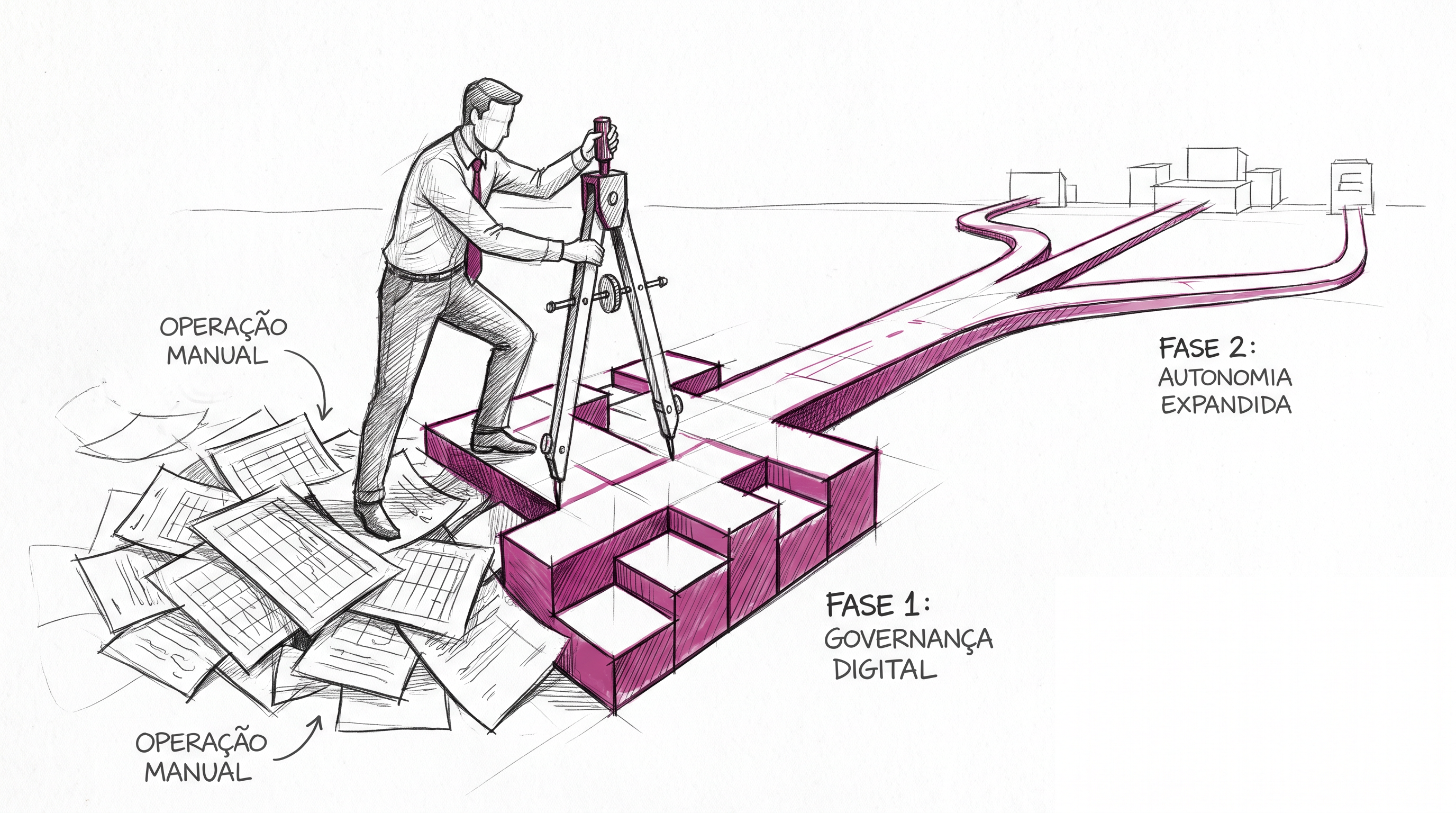
The thesis is simple: the sales rep is a driver of digital adoption, not its victim. To make that happen, digital transformation must proceed in two phases.
Phase 1: Digitize the Operation That Already Generates Revenue
The first phase does not try to displace the sales rep. It turns the rep’s existing workflow into a structured process.
That means digitally recording the elements that currently depend on memory, conversations, spreadsheets, or informal lookups:
- Who the buyer is and which terms apply to that account
- What price is permitted in that context
- What inventory is available
- Which discounts and payment terms are authorized
- When credit review or human approval is required
- Which business unit, branch, or sales rep owns the account
The goal is not to make the sales rep less commercially relevant. It is to remove work that does not require commercial judgment.
A public case identified as LI-966729 illustrates the difference. According to the published account, a large agricultural quote took five to ten days because regional and crop-specific pricing, credit tied to crop-input barter, and other commercial terms were managed in spreadsheets.
After the workflow was structured, a quote that previously took five days was completed in eight minutes. In the same case, a R$1 million CPR—a Brazilian agricultural financing instrument known as a Rural Product Note—was processed through a barter transaction at checkout.
The meaningful gain was not speed alone. The field sales agronomist stopped acting as a data-entry clerk and recovered time to serve as a technical advisor to the grower.
This is a more useful standard for evaluating digital transformation: how much high-value selling time was returned to the sales organization?
When reps see that the system prepares the deal correctly, reduces manual lookups, and preserves their relationship with the account, they gain an economic incentive to drive adoption. Every order completed through the digital workflow also generates more structured data for the next decision.
The sales rep stops being the endpoint for disorganized processes and becomes the person who spreads a new way of operating.
Phase 2: Expand Autonomy Without Losing Control
Only after the first phase is working does it make sense to expand autonomy for buyers, digital channels, and AI agents.
Without that foundation, the company simply moves its exceptions into a new interface. The customer sees a price they do not recognize, cannot confirm the promised delivery date, or has to call someone to obtain the terms that were actually negotiated. The sales rep returns to the center of the process—this time to correct the digital channel.
The CWS Platform article “Marketplace Is an Output, Not an Objective” describes this sequencing problem: when a company starts with the storefront, without establishing digital recordkeeping habits and integrating the workflow with real orders, transaction volume tends to remain negligible. The proposed path is to digitize the existing network of customers, sales reps, and suppliers that already supports revenue.
The same logic applies to AI.
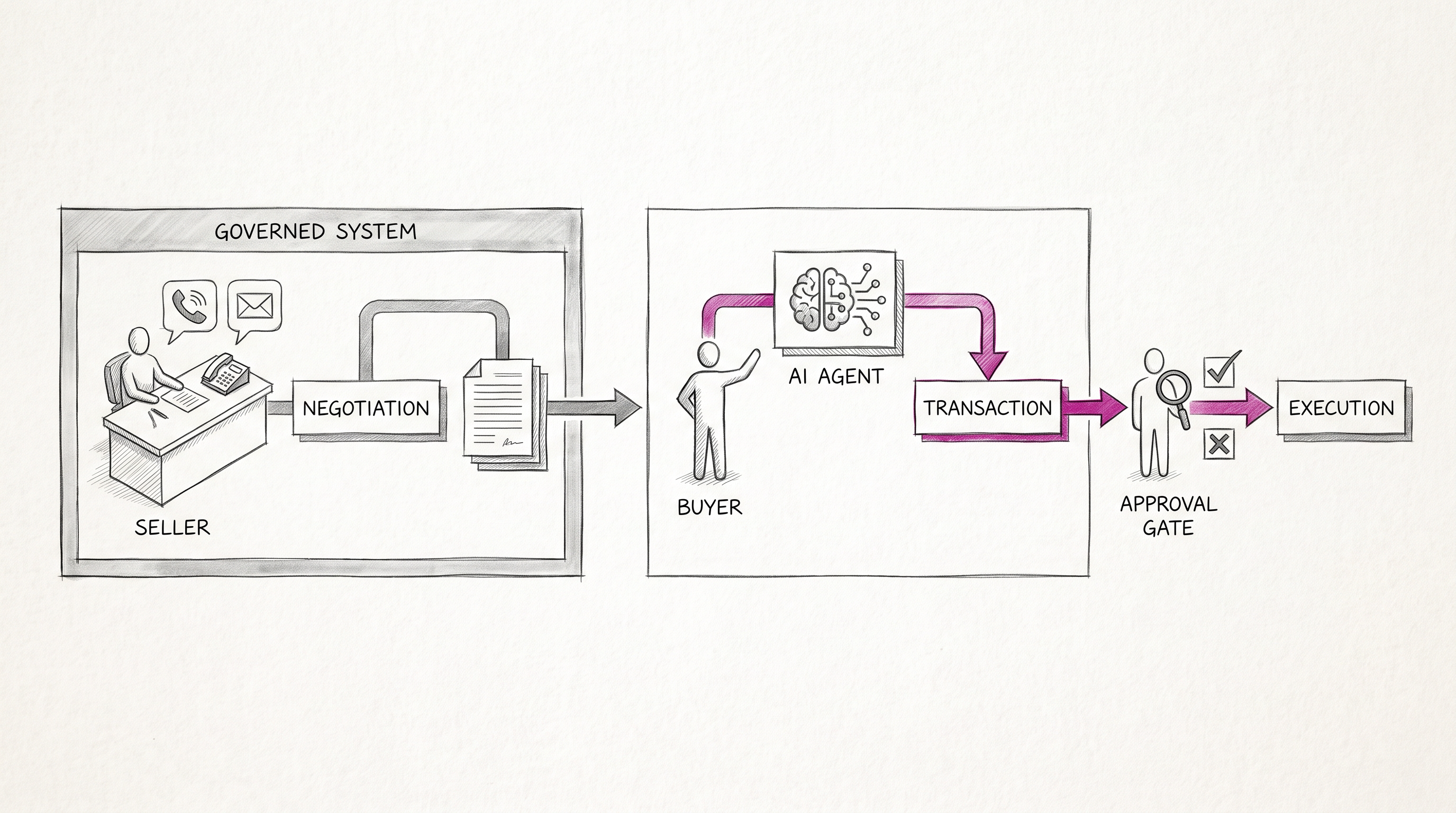
Lianlian DigiTech and UnionPay International announced a partnership to develop AI-agent payments for international commerce. In the first use case, focused on global procurement, an agent can find suppliers, refine the available options, and generate payment orders, while the actual movement of funds remains subject to human approval.
The example demonstrates the correct sequence: first establish fixed, deterministic, and auditable limits; then give the agent authority to execute.
The second phase, therefore, does not eliminate the sales rep. It allocates work more effectively. Buyers and agents can resolve transactions that comply with recorded rules. Sales reps can focus on decisions that require context, negotiation, trust, or intervention.
The Cost of Inaction
Delaying this reorganization does not preserve the operation as it is. It preserves costs that rarely appear as a consolidated line item on the financial statements.
The company continues paying sales reps to manage spreadsheets, recreate quotes, and look up commercial terms. It also pays for a digital channel that cannot complete the decision, approval processes that interrupt the sales cycle, and the difficulty of reactivating dormant customers without compromising service to active accounts.
The paper “Trading Desk: Incremental Revenue Through Dormant-Customer Reactivation” summarizes another consequence: identifying customers who stopped buying is not enough. The company must turn historical data into a valid offer today, accounting for current pricing, inventory, terms, and account ownership.
Without structured data, the opportunity exists—but executing on it creates another queue for the sales rep.
There is also a strategic cost. If negotiation rules remain in employees’ memories and local spreadsheets, the company does not build a reusable record of how it makes decisions. Its negotiation DNA still exists, but it cannot be applied consistently through other channels or by AI.
Principles for a Two-Phase Digital Transformation
- Start with the actual negotiation, not the interface the buyer will see.
- Keep the sales rep responsible for the relationship, but remove tasks that do not require commercial judgment.
- Record pricing, credit, inventory, payment terms, discounts, and approval thresholds before automating.
- Measure time returned to the sales team, reductions in manual lookups, and decisions completed within established rules.
- Treat recurring exceptions as evidence of incomplete governance.
- Expand buyer and agent autonomy only after establishing auditable limits.
- Use the data generated through execution to prepare the next commercial decision.
- Do not replace the company’s negotiation DNA. Turn that knowledge into a governed process.
FAQ
Won’t Sales Reps See the Digital Channel as a Competitor?
They may—if the channel receives demand without respecting account ownership, negotiated terms, and commercial responsibility. When the workflow preserves the customer relationship and reduces operational work, the incentive changes: sales reps begin driving digital adoption because they also benefit from the productivity gains.
Does the Second Phase Require Every Sale to Be Autonomous?
No. Autonomy should match the predictability of the decision. Transactions that fall within recorded rules can move forward digitally. Negotiations that require context, exceptions, or advice should continue to involve a person.
Where Does a Governed Negotiation Platform Fit?
At the end of this evolution, the architectural requirement becomes clearer. A B2B Commerce Platform for Governed Negotiation can record commercial rules, coordinate existing systems, and provide each participant with only the terms authorized for that specific context.
This architecture helps reduce transaction costs without removing the sales rep from the customer relationship. In the CWS Platform approach, governance comes before automation: AI prepares or executes decisions within defined limits, while the organization’s negotiation knowledge becomes a traceable, scalable asset.
What Customers Are Saying
“Delivering consistent, scalable progress with agile course corrections.”
Paulo Renan S., in a review published on Software Advice.
A Case That Illustrates the Point
The public case LI-966729 supports the thesis by showing that low digital penetration in agribusiness was not caused only by a lack of digital channels. The negotiation depended on contextual pricing, credit, crop-input barter, and spreadsheets.
Once those elements were structured in an integrated workflow, a quote that had taken five days was completed in eight minutes.
"The support model is differentiated — the project team actually understands B2B complexity and stays close throughout implementation."
Want to see this in your operation?
Real B2B operations already run on it.