When an AI Agent Negotiates on Your Behalf, Who Sets the Limits?
The push toward agentic commerce is real — but automating sales negotiation without prior margin governance isn't scaling: it's systemic risk.
When an AI Agent Negotiates on Your Behalf, Who Sets the Limits?
TL;DR
- AI agents are already being deployed to make buying and selling decisions without human intervention at each transaction; the movement is real and accelerating.
- The risk is not the technology: it is the governance vacuum that precedes automation, when margins, conditions, and negotiation rules are not codified before the agent goes live.
- In B2B, where every transaction carries context around channel, customer, region, and time window, delegating without structure is very different from scaling with intelligence.
- The right question is not "when to deploy agents," but "what can the agent promise on my behalf, and within what limits."
Do You Know Exactly What Your AI Agent Can Agree To in a Negotiation?
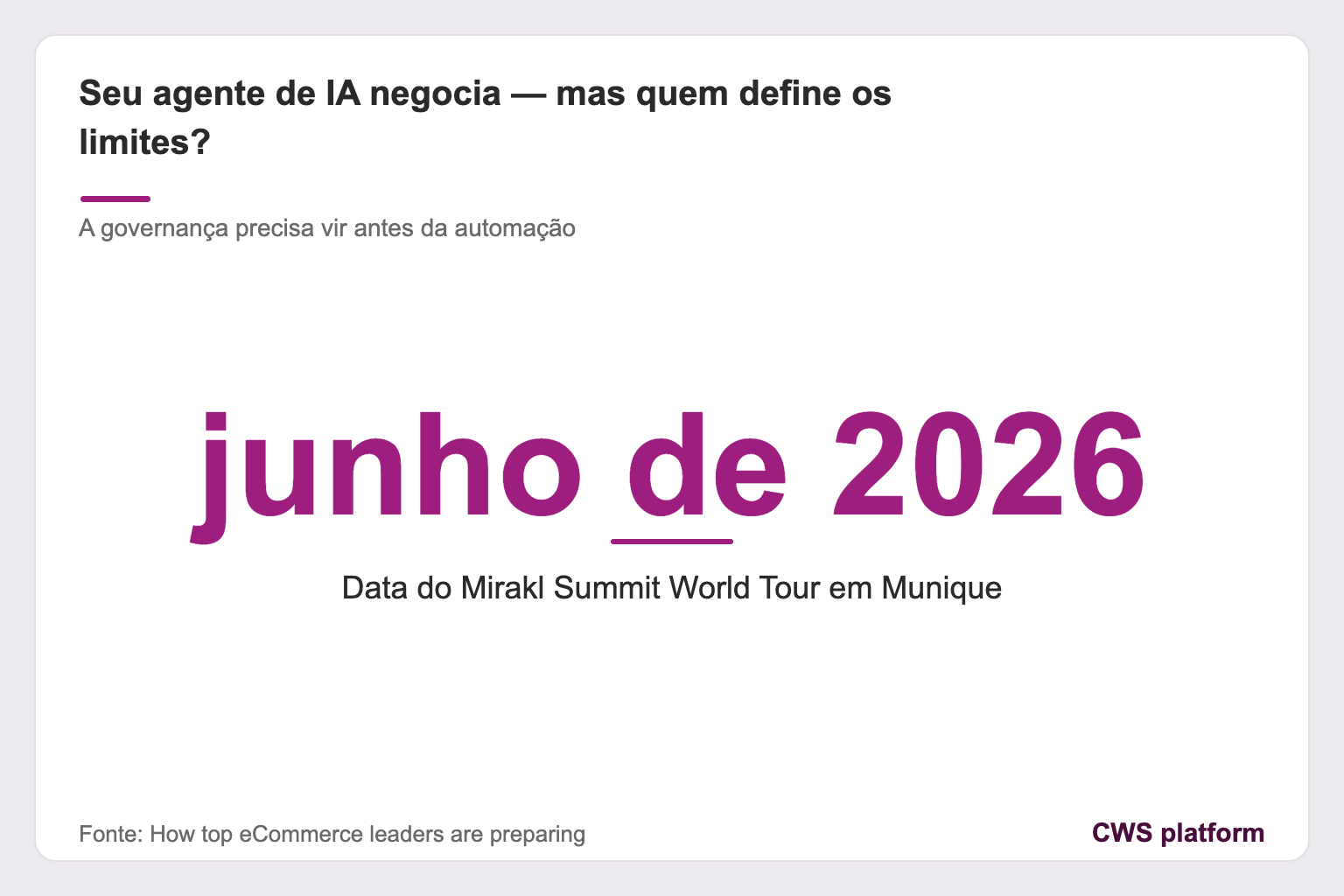
In June 2026, the Mirakl Summit World Tour stopped in Munich with an agenda that brought together leaders from BCG, Coca-Cola Hellenic, Bunzl, Decathlon, Kaufland, Redcare Pharmacy, Douglas, and other organizations. The central theme: how digital commerce companies are preparing for the era of "agentic commerce," the model in which AI agents execute transactions autonomously, without human approval at every step.
The event was not a conference about distant trends. It was a diagnosis of a movement already underway. Companies that have historically led marketplace transformation were in the room discussing not whether to adopt agents, but how to structure that adoption.
For a B2B commercial leader, reading that signal should produce a specific tension: my competitors are accelerating negotiation automation, while my operation still processes manual discount approvals through a spreadsheet.
The pressure is real. So is the trap.
What "Agentic Commerce" Actually Means for a B2B Operation
An AI agent is not a chatbot that answers questions. It is a system that receives an objective ("close the best possible order within certain conditions") and acts: queries the catalog, evaluates price, negotiates terms, confirms inventory, submits the purchase order. No human in the middle of each step.
In B2B, that cycle is dense. A single order can involve customer segmentation, relationship history, margin policy by channel, promotional window, credit limit, and minimum order rules. When an agent runs that cycle, it needs explicit parameters for each variable, or it will make decisions based on heuristics nobody approved.
The Mirakl Summit in Munich brought together leaders from operations as different as Jumia (high-complexity African retail logistics) and Bunzl (global B2B distribution of consumables and supplies at scale). The fact that both were in the same conversation about agents illustrates that the topic is not confined to one sector or model: it is a question of commercial decision architecture.
The Governance That Must Exist Before Automation
The problem that emerges is not technical. It is about sequence.
Many operations arrive at the AI agent conversation carrying the same flaw they brought to digitization ten years ago: they want to automate the process before they have formalized it. The result back then was digitizing chaos. Now, the risk is agentizing improvisation.
In B2B, digital conversion does not depend on creative assets or media spend. It depends on contextual pricing, segmented by channel, region, and time window, combined with prior margin governance. When that structure exists, promotions stop being a risk and become a calculated lever. When it does not exist, the agent operates in a vacuum, and every autonomous transaction is a gamble.
The question that should be at the center of any B2B commercial leader's preparation is not "which agent platform should I buy," but:
- Are my margin policies codified and system-accessible?
- Does my catalog carry contextual pricing by segment, channel, and condition?
- Are there explicit negotiation authority limits the agent is required to respect?
- When the agent encounters a situation outside its parameters, what happens?
If the answer to any of those questions is "it depends on who's available," the operation is not ready for autonomous agents. It is ready for autonomous risk.
The Cost of Inaction
There is a trap that mirrors premature automation: analytical paralysis while the market moves.
Companies like Bunzl, Decathlon, and Coca-Cola Hellenic were not in Munich discussing agents out of hype. They were there because automating buying and selling decisions compresses transaction costs, reduces human error at volume, and frees the commercial team for what machines still do poorly: relationship management, exception handling, and strategic thinking.
The leader who waits for "the right moment" while doing nothing to build governance is not being prudent. They are accumulating two deficits simultaneously: an internal readiness deficit and an external competitive deficit.
Inaction is not neutral. It has a cost.
Principles for Preparing Your Operation
- Formalize before you automate: map and codify negotiation rules, margin limits, and pricing policies by segment before any agent is deployed.
- Separate what the agent can decide from what requires human escalation: explicitly define the boundaries of autonomous authority.
- Treat the catalog as live data: contextual pricing, availability, and conditions must be queryable in real time by the system.
- Monitor the agent the way you monitor a sales rep: decision logs, audit trails, and periodic review of negotiation patterns.
- Start in a controlled scope: deploy within one segment, channel, or product line where parameters are most mature, before scaling.
Frequently Asked Questions
Is my operation too small to be thinking about AI agents? Size is not the criterion. Decision complexity per transaction is. If your B2B operation has multiple customer segments, differentiated pricing policies, and an order volume that consumes significant manual approval time, the conversation is relevant now, even if implementation is still in the future.
Should I wait for technology vendors to mature their tools? The tools already exist and are already being adopted, as the 2026 Mirakl Summit demonstrates. What needs to mature is not the technology: it is internal governance. That work does not depend on any vendor.
Does the agent replace the commercial team? That is not the dynamic the companies at the Munich Summit are describing. The agent absorbs repeatable transactional volume and frees the team for exception negotiations, new account development, and strategic relationship management.
From Someone Already Living This
"We work with B2B solutions on CWS." Leonardo C., verified reviewer, automotive sector, company of 1,001 to 5,000 employees, via Software Advice (https://www.softwareadvice.com/product/546664-CWS-Platform/)
A Case That Illustrates the Point
In B2B operations where contextual pricing and margin governance were structured before automation, promotions stopped being a margin risk and became a calculated lever: segmented by channel, region, and time window, with limits the system respects without manual approval at each instance. That is the model that makes negotiation automation scalable and auditable, not just fast.
About This Publication
The Cost of the Sale is CWS Platform's publication on B2B commercial operations: negotiation governance, transaction cost, and technology-assisted decision-making. Written for CEOs, commercial leaders, and operations owners who need analysis, not a pitch.
Sources
- Mirakl. "How top eCommerce leaders are preparing for the agentic commerce era." Mirakl Blog, June 4, 2026. Account of the Mirakl Summit World Tour in Munich, with participation from BCG, Coca-Cola Hellenic, Bunzl, Decathlon, Kaufland, and other leaders discussing marketplace strategies and AI agent adoption in digital commerce. https://www.mirakl.com/blogs/agentic-commerce/how-top-ecommerce-leaders-are-preparing-for-the-agentic-commerce-era/
- Software Advice. CWS Platform user reviews. Independent software review portal, featuring testimony from Leonardo C., verified reviewer in the automotive sector. https://www.softwareadvice.com/product/546664-CWS-Platform/
"The support model is differentiated — the project team actually understands B2B complexity and stays close throughout implementation."
Want to see this in your operation?
Real B2B operations already run on it.