When the Agent Makes a Mistake, the 10-K Records It: What WESCO Teaches Us About Governance Before Automation
Agentic AI without deterministic rules doesn't cut the cost of sales — it scales the error

When the Agent Makes a Mistake, the 10-K Records It: What WESCO Teaches Us About Governance Before Automation
TL;DR
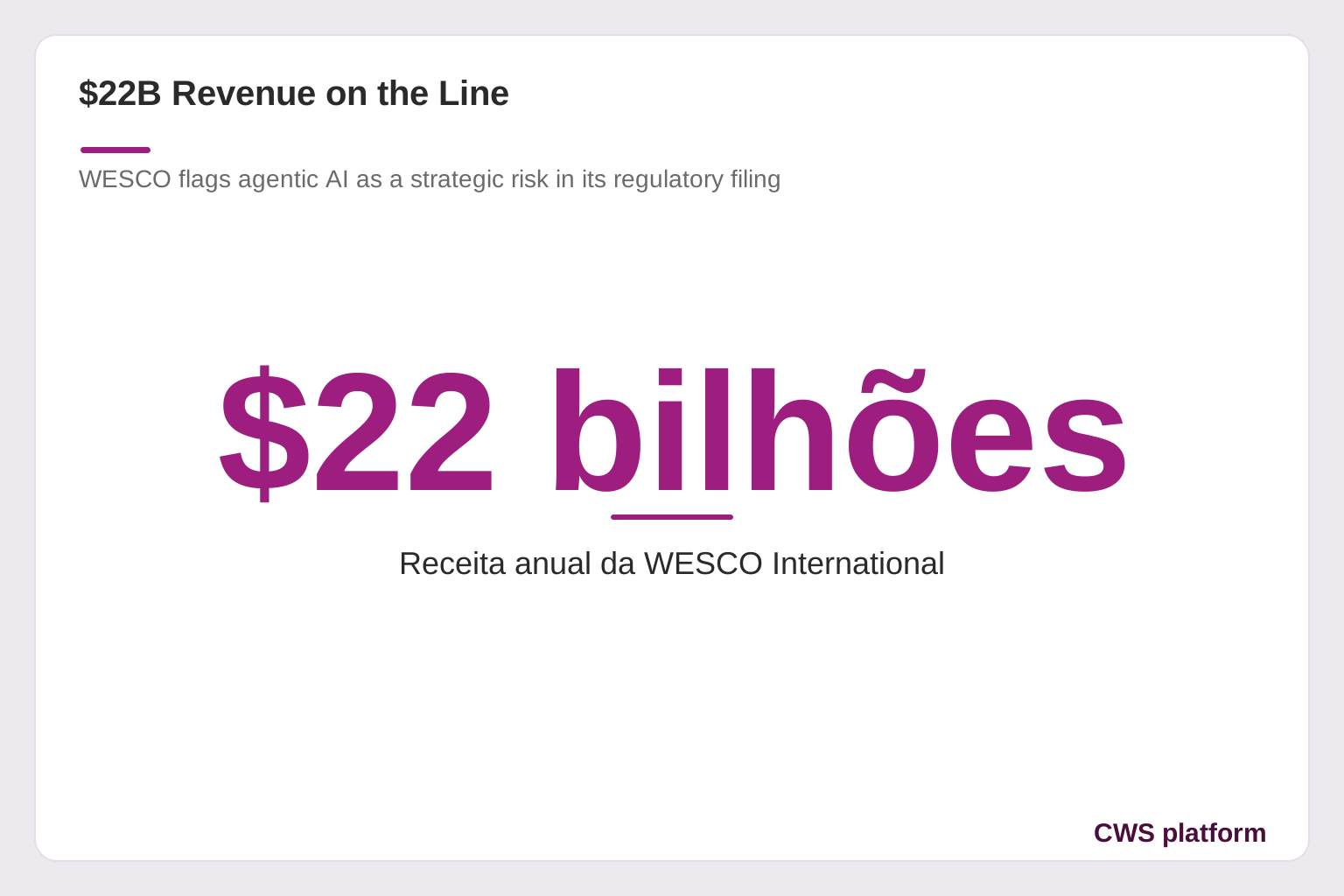
- WESCO International, an industrial distributor with $22 billion in revenue, included agentic AI as a strategic risk in its most recent regulatory filing, signaling that the industry already treats AI agents as a business issue, not an IT one.
- The problem is not the technology: it is the absence of deterministic rules for pricing, credit, and approval authority written down before the agent acts.
- Without that governance layer, automation does not eliminate the cost of selling, it replicates and scales human error at industrial speed.
- The right question for any B2B commercial leader is not "when will I adopt agents?" but "what is my agent authorized to decide, and where is that recorded?"
Is your operation ready to delegate commercial decisions to an agent?
When a $22 billion company places agentic AI in the same risk paragraph as foreign exchange, regulation, and supplier concentration, it is making a precise statement: the agent is not an auxiliary tool. It is an actor with the power to affect margin, credit, and customer relationships, and therefore requires governance equivalent to that of any other human sales agent.
WESCO International, one of the largest industrial distributors in the world, did exactly that in its 10-K. The filing does not describe an abstract concern about "AI risks in general." It names agentic AI as a vector of strategic risk within an operation that processes volumes where any pricing or credit deviation is an event with measurable financial consequences.
What this reveals for anyone operating B2B in distribution, manufacturing, or industrial services is more uncomfortable than it appears at first reading.
The pain the filing makes visible
Most B2B commercial operations arrive at the conversation about AI agents with a prior unsolved problem: the rules that should govern the agent do not exist in a format any system can execute.
Pricing is negotiated outside the ERP. Credit is approved over the phone. Discount authority lives in the regional manager's head. Exceptions become practice. Practice becomes invisible culture.
That is the diagnosis the WESCO case illuminates indirectly: it is not that AI agents are inherently dangerous. It is that they will execute, at scale and speed, exactly what has been defined, and if what has been defined is imprecise, ambiguous, or absent, the agent will not ask for confirmation. It will decide.
And when the agent decides based on incomplete logic, the error does not stay isolated to one negotiation. It replicates across every order that flows through the same process, until someone notices the anomaly in the month-end consolidated margin report.
What "governance before automation" means in practice
The phrase is not a compliance metaphor. It is a technical and business sequence with concrete steps.
First, the rules must exist in deterministic form: if customer X with risk profile Y orders product Z with payment terms W, the permitted price is this, the available credit is this, the approval authority is this. Not a guideline. An executable instruction.
Second, those rules must be recorded in a system the agent consults before acting, not after. The agent is not where commercial policy is created. It is the executor of a policy that has already been deliberated, approved, and recorded by humans.
Third, every decision the agent makes must generate an auditable trail. Not for bureaucratic control, but because without auditability there is no learning, no policy adjustment, and no regulatory defense if the outcome is questioned.
The absence of any one of these three elements transforms the promise of "reducing the cost of selling with AI" into an operational risk that shows up, sooner or later, in the income statement.
Principles for those structuring this layer
- Map what your agent will need to decide before choosing the technology that will execute the decision.
- Separate commercial policy (deliberated by humans, recorded in a system) from operational execution (delegable to the agent).
- Treat pricing authority and credit limits as governance perimeters, not technical configuration parameters.
- Require native auditability: every agent decision must be traceable back to the rule that originated it.
- Do not automate what you cannot describe in deterministic language; human ambiguity becomes machine-scale error.
The cost of inaction
There are two paths to arriving late to this conversation.
The first is adopting agents without prior governance, absorbing margin and credit errors, and spending twice the original cost trying to correct what was automated incorrectly. That is the cost of premature automation.
The second is adopting nothing, keeping the operation entirely dependent on decentralized human decision-making, and watching the cost of selling grow while competitors with structured governance operate with leaner structures. That is the cost of inertia.
What WESCO signals by naming the risk in its 10-K is that the industrial distribution market has already passed the point where the question is "whether" to adopt agentic AI. The operational question that remains is whether the governance that must precede the agent has been built.
For B2B operations where margin, credit, and approval authority are variables negotiated at volume, that question has a direct financial answer.
Frequently asked questions
Is WESCO's risk specific to very large companies? Size amplifies the impact, but it is not the source of the risk. A mid-market operation that automates credit approval without deterministic rules faces the same problem at a proportional scale.
Does prior governance make the agent less useful? The opposite: without clear rules, the agent requires constant human supervision, which eliminates the scale advantage. Well-structured governance is what makes delegation safe and, therefore, the agent genuinely useful.
Where does someone start if they do not yet have this layer in place? With a mapping of the commercial decisions that today depend on individual human judgment, identifying which ones have reproducible logic. Those are the candidates for formalization before any automation begins.
Who is already living this
"We had been trying to implement a B2B solution for almost 2 years. With CWS, we went live in 60 days."
Edivaldo C., verified reviewer, automotive sector, company of 201 to 500 employees, via Software Advice.
The time lost in previous attempts is rarely purely technical. In most cases, what causes the delay is the absence of commercial rules formalized enough for a system to execute them, the same prerequisite that must precede any AI agent.
A case that illustrates the point
In operations that digitized the B2B sales interface without digitalizing the pricing decision, a consistent pattern emerges: negotiations continue happening outside the system, making margin and auditable data inaccessible to the ERP and management. The digital interface becomes a storefront. The actual decision remains informal.
That is the same problem that precedes the agent: if the pricing and credit decision is not in the system before the agent arrives, the agent will either ignore the rule (because it does not exist in executable form) or invent one, which is worse. Digitizing the interface without digitizing the governance creates an automation that operates in a vacuum.
About this publication
The Cost of Selling is CWS Platform's publication on commercial governance in B2B operations. Each edition starts from a market fact, a filing, a public case, a sector data point, to examine what is costing more than it should in the commercial operation and what can be done about it with analytical rigor, not roadshow optimism. CWS Platform is a B2B Commerce Platform for Governed Negotiation: the place where pricing, credit, and approval authority rules are recorded before any automation acts.
Sources
- WESCO International 10-K (regulatory filing): Annual reference document for WESCO International, an industrial distributor with $22 billion in revenue, in which agentic AI is cited as a strategic risk. Central factual basis for this article.
- Software Advice, review by Edivaldo C.: Verified user review from the automotive sector regarding CWS Platform implementation. https://www.softwareadvice.com/product/546664-CWS-Platform/
"The support model is differentiated — the project team actually understands B2B complexity and stays close throughout implementation."
Want to see this in your operation?
Real B2B operations already run on it.