You Digitized the Channel. Why Hasn't Margin Improved?
Replacing email with a portal digitizes the interface, not the decision. And margin lives in the decision.
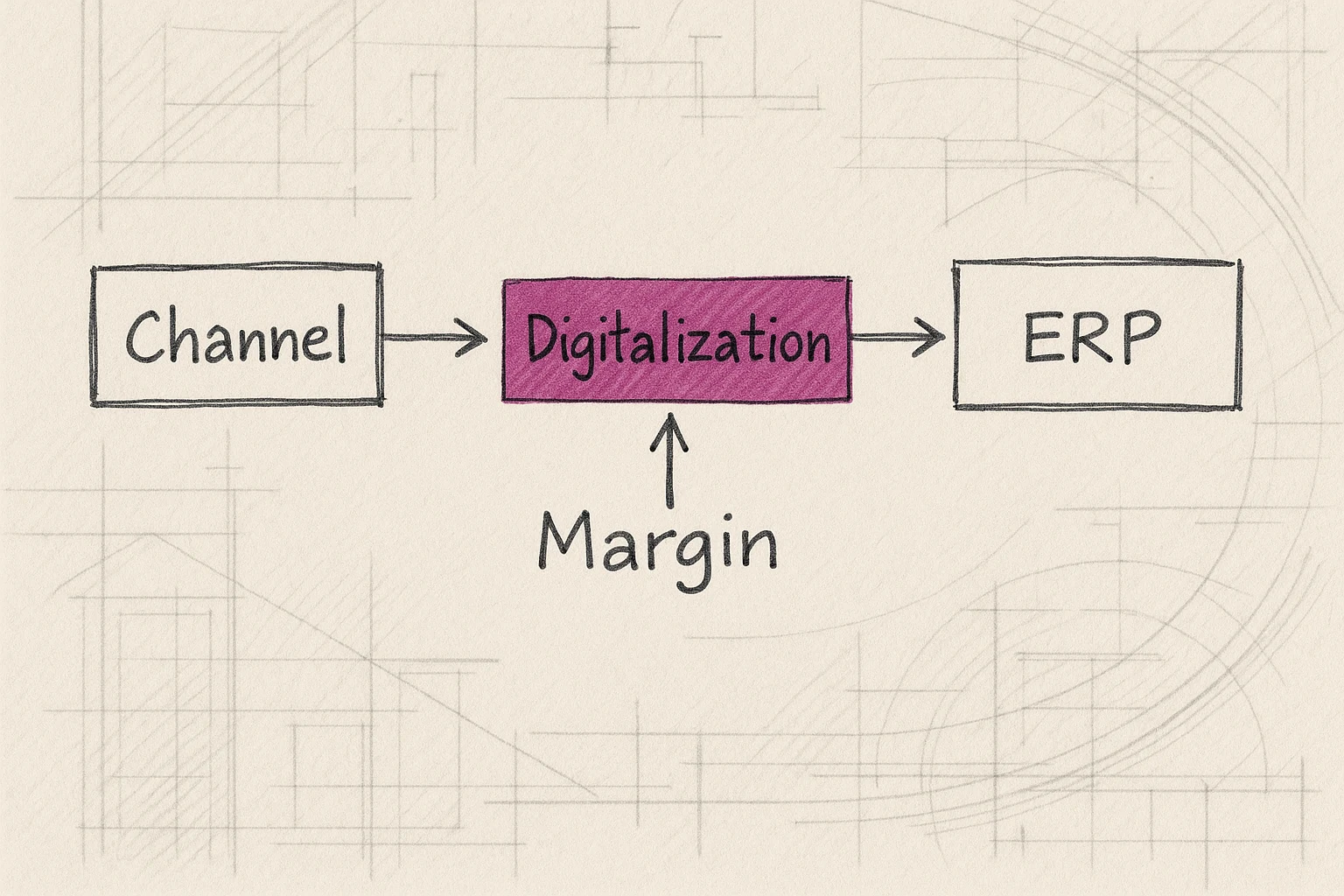
You Digitized the Channel. Why Hasn't the Margin Improved?
TL;DR
- Swapping email for a web form or PDF for a portal is digitizing the channel, not the sales decision.
- Margin grows when the customer sees the full catalog and buys what they didn't know existed, not when they receive a bigger discount.
- Without price, credit, inventory, and product mix integrated into the ERP at the moment of negotiation, commercial governance stays outside the digital environment.
- The hard part isn't the technology: it's changing how you sell and keeping the team on the right side of the change curve.
What, Exactly, Was Digitized in Your Channel?
There's a question few B2B sales leaders ask themselves honestly: when a customer places an order through the new portal, how many message threads, spreadsheets pulled outside the system, or manual approvals does it still take to decide which item to sell, at what price, with what credit terms?
If the answer is "a few," the channel was digitized. The decision was not.
That's the diagnosis fintech executives articulated in a recent discussion on B2B SMB growth, reported by KNN India: "many companies put a form where there used to be an email, swap paper for a PDF, and call it digital transformation." The channel changes. The decision continues to be made with incomplete information, in the wrong context, at the wrong time.
The phenomenon isn't unique to small businesses. It happens at distributors, dealers, and industrial operations of any size that invested in interface digitization without digitizing the commercial logic underneath it.
The Invisible Cost of Deciding Outside the Right Context
When price, credit, and inventory are not integrated at the moment the customer is browsing the catalog, three things happen simultaneously, and each one erodes margin or revenue:
- The customer sees less than they could buy, because the displayed catalog is kept conservative (to avoid surfacing items with no defined pricing rule).
- The sales rep negotiates with stale information, giving away discounts as a substitute for clarity.
- Exception approvals happen outside the workflow, with time costs and the risk of inconsistency.
The result: digitization creates operational efficiency in part of the process, while the real productivity gain, and margin gain, remains locked in the gap between the channel and the decision.
The KNN India report points directly to this gap: "AI only creates real value when it enters at the moment someone is deciding to buy, sell, negotiate, or approve. Not before, not after." Digitizing the decision means structuring data, process, and governance in the same place where the negotiation happens.
What Happens When the Decision Is Integrated: The Tracbel Case
Tracbel, a Volvo Gold dealer, is a verifiable example of what changes when commercial logic moves into the channel together. The company brought the sales decision into a platform integrated with SAP in real time, with price, credit, inventory, and product mix resolved by rule, not by manual negotiation.
The result ran counter to the most common intuition about B2B digital: channel margin went up. Not because discounts were cut by decree, but because customers began seeing far more of the catalog and buying items they didn't even know existed. Customer-driven mix discovery, made possible by structured catalog visibility, did the work that no discount ever could.
One caveat from the case itself is worth noting: "no platform does this on its own." The credit belongs to the Tracbel team that held through the change curve, tuned the catalog, and trusted the process. Technology without an operation committed to change delivers, at best, a new channel running the same old decision-making.
The Cost of Doing Nothing
Keeping the current model, where the channel is digital but the decision is analog, carries costs that accumulate quietly:
- Margin surrendered in discounts as compensation for the lack of visibility into mix alternatives.
- Underutilized product mix: items with lower velocity that the customer would buy if they knew they existed remain invisible.
- Credit and pricing risk managed outside the system, meaning manually approved exceptions generate no structured learning.
- Cycle cost: every approval that happens outside the digital workflow consumes sales rep time, manager time, and customer time, all friction that adds no value.
The scale of these costs varies by operation, but the direction is consistent: the more complex the catalog and the more variable the commercial policy, the greater the cost of keeping the decision outside the digital context.
Principles for Digitizing the Decision, Not Just the Channel
- Map where pricing, credit, and mix decisions actually happen today: if it's outside the system, that's the priority intervention point.
- Integrate commercial rules into the ERP before expanding catalog exposure: visibility without governance creates inconsistency.
- Treat the catalog as a live asset: items invisible to the customer are trapped revenue, not margin protection.
- Understand that the change curve is operational, not technological: the team needs to trust the process for it to work.
- Evaluate AI and automation at the point of decision, not the point of record entry: efficiency in logging is a smaller gain than governance at the moment the negotiation actually occurs.
FAQ
Isn't B2B channel digitization the same as digital transformation? Not necessarily. Digitizing the channel means creating a digital interface for customers to place orders. Digitizing the decision means that pricing, credit, inventory, and mix rules are structured and integrated into the same context where the negotiation happens. The difference in outcomes, in margin and mix, is significant.
Why can margin go up with digital, if the common assumption is that digital pushes prices down? Because price pressure comes largely from a lack of visibility into alternatives. When the customer sees the full catalog under structured rules, they discover mix they didn't know about, and the buying decision is no longer anchored solely on a discount for the item they already had in mind. The Tracbel case illustrates this mechanism concretely.
What's the prerequisite before expanding the digital catalog? Commercial governance integrated into the ERP: price, credit, and inventory with rules structured inside the system. Expanding the catalog without that shifts onto the sales rep or manual approver the decision load the system should be carrying.
Who's Already Living This
Leonardo C., a verified reviewer on Software Advice (Automotive, 1,001–5,000 employees), captures the experience plainly: "We work with B2B solutions on CWS." The mention of B2B context as a working reality, not a side project, says something about where commercial operations actually run. Source: Software Advice.
About This Publication
The Cost of the Sale is the CWS Platform publication for B2B commercial operations leaders. It covers negotiation governance, transaction cost, and the real conditions that determine margin in complex sales channels. CWS Platform is a B2B commerce platform for governed negotiation, integrated with the ERP, that connects commercial rules to the moment the buying and selling decision is made.
Sources
- KNN India, "AI and Digitalisation To Power Next Phase Of MSME Sector Growth" (https://knnindia.co.in/news/newsdetails/msme/ai-and-digitalisation-to-power-next-phase-of-msme-sector-growth-say-top-fintech-executives): reporting featuring fintech executives on B2B SMB digitization in India; the basis for the distinction between channel digitization and decision digitization.
- Tracbel / CWS Platform case (LI-006): public case study of a Volvo Gold dealer that integrated the sales decision into SAP via CWS Platform and recorded margin improvement through mix discovery.
- Software Advice, verified review by Leonardo C. (https://www.softwareadvice.com/product/546664-CWS-Platform/): public user testimonial from a B2B operation in the automotive segment.
"The support model is differentiated — the project team actually understands B2B complexity and stays close throughout implementation."
Want to see this in your operation?
Real B2B operations already run on it.