You Digitized the Payment. The Purchase Decision Is Still a Black Box.
Modernizing your payment channel doesn't fix what happens before it: the chain of decisions on vendor selection, pricing, credit terms, and conditions that most B2B operations still run manually, in silos, with no audit trail.
You Digitized the Payment. The Purchase Decision Is Still a Black Box.
TL;DR
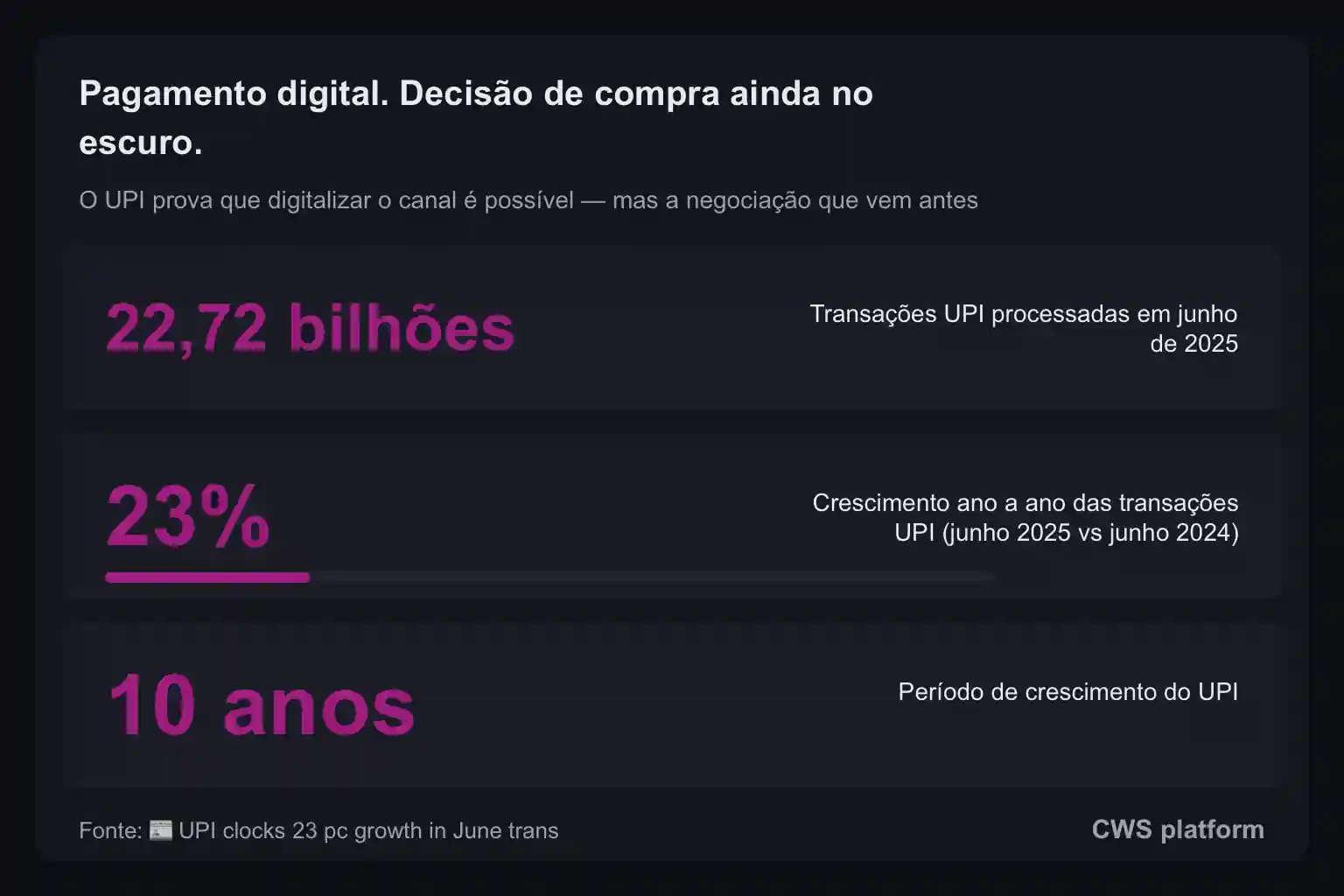
- India's UPI processed 22.72 billion transactions in June, growing 23% year over year: digitizing the payment channel is technically feasible and has already been done at historic scale.
- In B2B, payment is the end of the journey. What precedes it is a chain of decisions about vendor, volume, terms, and conditions that, in most companies, is still manual, fragmented, and unauditable.
- Digitizing only the payment leaves the most expensive part of the process untouched: the negotiation that happens before.
- Structured governance of the purchase decision is not bureaucracy. It is the condition under which scale does not destroy margin.
When the Channel Is Already Digital, Why Is the Purchase Chain Still Opaque?
India's UPI processed 22.72 billion transactions in June 2025, growing 23% compared to the same period the prior year. In ten years, the system went from negligible volume to over 24,000 crore transactions annually, according to data reported by the Indian press. It is a case of infrastructure modernization with few parallels in the world.
The problem is that this number measures the end of the journey.
Payment is the moment when the decision has already been made, the vendor has already been selected, the volume has already been negotiated, the terms have already been accepted, the conditions have already been agreed upon. What UPI digitized with extraordinary efficiency is the final instant of a chain that, in B2B, tends to be long, opaque, and expensive.
For the CEO or sales leader of a B2B operation, this raises a concrete question: does your company have full traceability of everything that happened before the payment? Who approved the discount? Based on which rule? Was the payment term granted within the current credit policy? Was the negotiated condition recorded somewhere auditable, or did it live inside a conversation between your sales rep and the buyer?
If the answer is "depends on who you ask," the problem has been identified.
The Decision Chain Nobody Governs
In B2B, pricing policy rarely lives in one place. It is distributed across a table in the ERP, an exception logged in the CRM, a minimum margin the regional manager knows from memory, and a series of agreements that exist in email threads or spreadsheets. When a sales rep opens a quote, they do not consult a rule. They interpret scattered fragments. And interpretation has variance. Variance has cost.
The cost surfaces in distinct ways. Margin eroded by discounts that should never have been granted. Credit terms approved outside policy because the rep did not know the customer's credit limit. Volume committed without visibility into inventory. Special conditions promised that the ERP cannot actually execute.
Each of these problems shares a common root: the purchase decision has no governance. What was negotiated is not structured, not auditable, and therefore not manageable.
Digitizing the payment channel does not solve any of these problems. ACH, virtual cards, or same-day wire can settle the transaction in seconds. That does not mean the transaction was well-negotiated, or that the company will know tomorrow why that price was offered.
What Purchase Decision Governance Actually Requires
Structuring the B2B decision chain before payment is not a technology problem in isolation. It is a question of where the rules live and how they are enforced.
When the rules for pricing, credit, payment terms, and deal conditions are centralized in deterministic logic, what changes is not just the speed of the quote. What changes is what can be audited, delegated, and automated safely. The quote stops being a sales rep's interpretation and becomes a proposal derived from pre-agreed rules. The buyer and the seller arrive at payment after a process that built trust, not just convenience.
This has direct consequences for margin. When the rep knows exactly what the maximum allowable discount is for that customer, at that volume, under those payment conditions, there is no interpretation required. They apply the rule. And what was applied can be reviewed, benchmarked, and corrected.
Catalog visibility also changes. When the purchase process is structured, the customer discovers product mix they did not know existed, not through a sales push, but because the architecture of the negotiation enables that discovery. Margin grows not from a smaller discount, but from volume negotiated with greater intelligence.
The Cost of Inaction
Keeping the purchase decision chain fragmented carries a cost that rarely appears in a single line item. It is distributed: in the discount that should not have been given, in the credit extended outside policy, in the condition promised that the system could not execute, in the audit that cannot be performed because the record does not exist.
Companies that have already digitized payment tend to underestimate this cost because the final step works well. The money arrives. The transaction settles. But the margin left on the table during the preceding process does not appear in any report in aggregated form. It disappears, distributed across dozens of exceptions that each rep considered reasonable in the moment.
Inaction here is not a lack of technology investment. It is the absence of a governance architecture for the part of the process that precedes payment.
Principles that guide a structured approach to B2B purchase decision governance:
- Pricing, credit, and condition rules must live in a single place, not distributed across the ERP, CRM, and the rep's memory
- Every quote must be traceable: who negotiated it, which rule was applied, what the exception was, and who approved it
- Delegating discount authority without audit trails is not agility; it is untracked margin erosion
- The decision chain must be structured before payment, not documented after the fact
- Scale without price governance does not expand margin; it expands variance
Questions That Surface the Problem
If I asked why a specific price was offered on a deal from last month, could anyone answer with precision? In most B2B operations, the honest answer is: it depends on who you ask, and the answer will come from memory or an email thread, not a structured record.
What is the cost of a mispriced quote that has already cleared payment? The payment settled, but the margin stayed on the table. That cost does not appear on the transaction receipt.
Does my sales team apply the same credit policy to the same customer profile? If the policy lives in fragments, application is interpretation. And interpretation has variance.
Does digitizing the quoting process solve the governance problem? Not automatically. Digitizing a quote without centralizing the rules behind it only accelerates the variance.
Who Already Lives This
The public review from Maite S., a verified reviewer in the automotive sector (company with 5,001 to 10,000 employees), published on Software Advice, describes what she encountered working with complex commercial rules: "The support and project team, responsive, technically engaged, and willing to work through complex commercial rules (negotiated pricing, credit, customer-specific conditions)." (Software Advice: https://www.softwareadvice.com/product/546664-CWS-Platform/)
The detail that matters: negotiated pricing, credit, and customer-specific conditions are exactly the elements that, without centralized governance, remain scattered and unauditable.
A Case That Illustrates
A B2B operation that integrated pricing, credit, and inventory rules into its ERP found that broader catalog visibility drove product mix discovery by the customer. Margin grew not from reducing discounts, but because the buyer began to see items they did not know existed within a structured negotiation. The digital channel delivered convenience. Decision governance delivered margin.
About This Publication
The Cost of the Sale is CWS Platform's publication on governance, efficiency, and transaction cost in B2B operations. Each piece starts from a real fact to address a concrete pain point for those who run, lead, or finance complex commercial chains. CWS Platform is a B2B commerce platform that structures the purchase decision chain, from quote to order, with governance of pricing, credit, and conditions integrated into the ERP.
Sources
- UPI June 2025 transactions, Daily World India (https://dailyworld.in/business/upi-clocks-23-pc-growth-in-june-transactions-hit-2272-billion-689616.html): source of data on volume and growth of the UPI payment system, used as evidence that digitizing the payment channel can be done at historic scale without, by itself, resolving the decision chain that precedes it.
- Software Advice, public review by Maite S. (https://www.softwareadvice.com/product/546664-CWS-Platform/): verified testimonial from a user at a large automotive operation, cited to illustrate the complexity of commercial rules, negotiated pricing, credit, customer-specific conditions, that structured governance must address.
"The support model is differentiated — the project team actually understands B2B complexity and stays close throughout implementation."
Want to see this in your operation?
Real B2B operations already run on it.