Your Operation Scaled. Your Pricing Governance Probably Didn't.
Charging every customer the same price isn't a policy — it's the absence of one. And the cost shows up in your P&L before it shows up in any diagnosis.
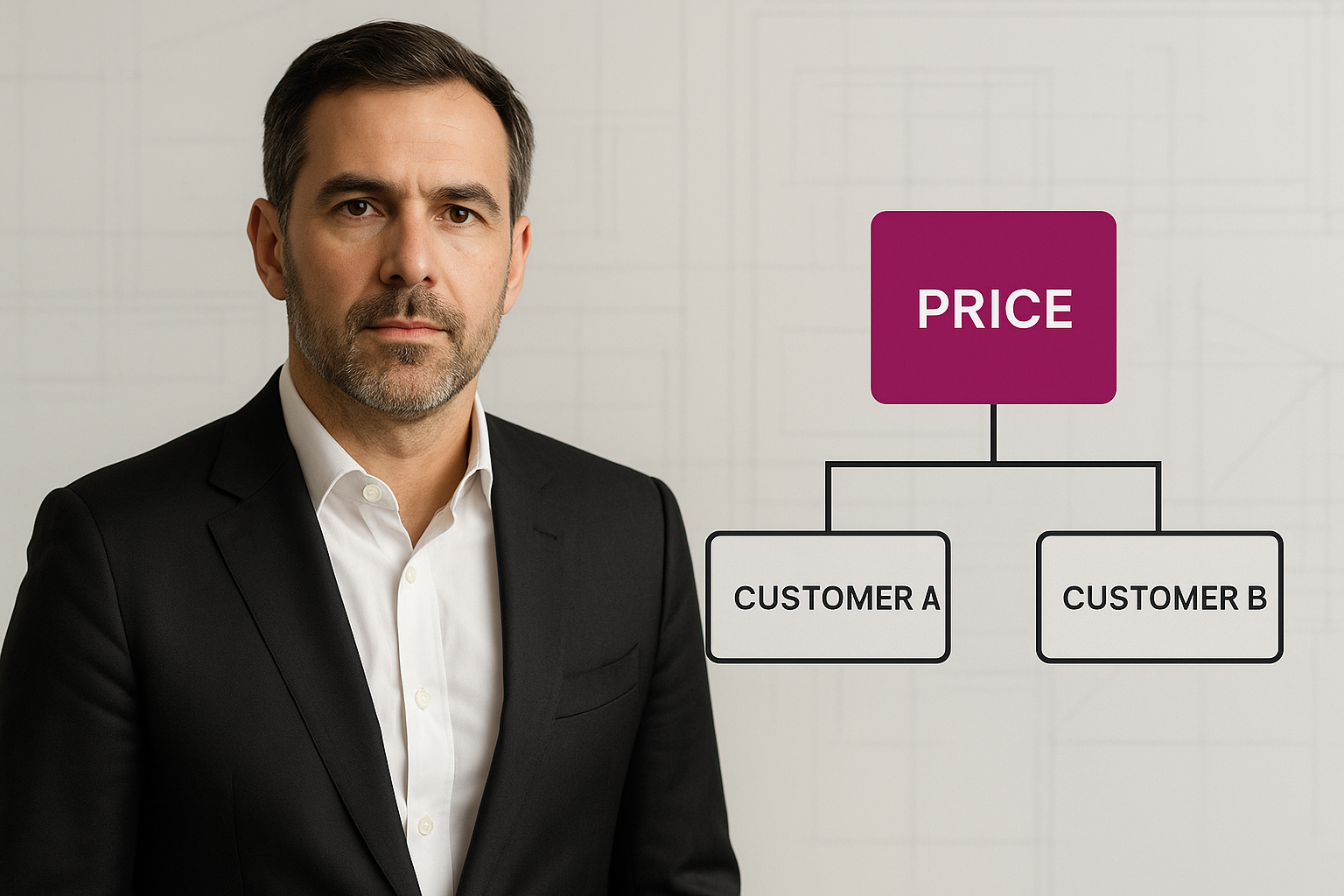
Your Operation Scaled. Your Pricing Governance, Probably Didn't.
TL;DR
- Charging the same price across different customer profiles isn't fairness: it's ignoring context and quietly surrendering margin.
- Informal negotiation carries an invisible cost: decisions made without data, without history, and without auditable criteria turn discounts into habits and margin into an unmanaged variable.
- Publicly traded distribution companies are already showing the symptom in their earnings: digital revenue growth without digital margin growth.
- Pricing governance isn't a more sophisticated spreadsheet; it's differentiated logic by segment, channel, and timing, embedded in the negotiation workflow, with full traceability.
Is uniform pricing a policy, or an absence of governance?
There's a common operational belief in growing B2B businesses: standardizing price simplifies management. In practice, it's the opposite.
A customer who buys every month, with predictable volume and low service cost, doesn't carry the same risk profile as a spot buyer with a long sales cycle and high credit cost. Charging both the same isn't equity: it's ignoring context. The same logic applies to geography, market timing, and inventory availability. The price that protects margin in Chicago may destroy competitiveness in a secondary market. The right price in January may be the wrong price in September.
Most leaders agree with this at the conceptual level. The problem is that execution doesn't follow understanding.
Four signals that the gap has become structural are common in operations that scaled without adjusting their pricing architecture:
- The sales rep requests a discount over Slack or text and the manager approves it without seeing the margin impact.
- Two customers in the same segment receive different terms with no documented rationale.
- Finance discovers the deal terms only when the invoice is generated.
- Revising the pricing policy requires a meeting, a spreadsheet, and an email chain, not a system parameter.
Each signal in isolation looks like operational noise. All four together point to an architecture problem.
The trail that disappears before reaching the ERP
There's an even more silent pattern than the informal discount: the untraceability of the negotiation itself.
The final price on a meaningful B2B order rarely originates in the system. It originates in an email thread, a Slack message, a spreadsheet adjusted on the fly, a phone call no one recorded. By the time the number enters the ERP, the negotiation is over and the path that led there has vanished.
Without a trail, there's no audit. Without an audit, there's no learning about margin. Without learning, every negotiation starts from scratch, dependent on the memory of whoever was in the conversation.
Finance leaders talk extensively about visibility into inventory, cash, and receivables risk. Visibility into the negotiation itself, the process that determines the agreed price and terms, is systematically left off the dashboard. The direct question for CFOs and VP of Sales is this: can your company reconstruct, step by step, how it arrived at the price and terms of its last significant order? Not the final number. The path.
Digitizing the interface doesn't fix the decision
A public example illustrates the problem clearly. A VP of Sales showed, with legitimate pride, the B2B e-commerce portal the company had just launched: clean interface, fast, well-designed. When asked how pricing reached the portal, the answer was that the pricing team updated a spreadsheet and IT imported it once a week. When a customer called on a Thursday asking for a special arrangement, "the rep handles it offline and we true it up later."
The portal was good. The problem was elsewhere: commercial negotiation was still happening outside any structure, over the phone, over text, in the sales rep's memory. The digital layer had arrived before the governance that sustains it.
This isn't rare. It's the norm. Most B2B operations have digitized the interface. Few have digitized the decision. And the decision is where the risk, the margin, and the data that matter actually live.
The same pattern shows up in B2B equipment rental. Companies digitizing the rental commerce channel, integrating catalog, contracts, and asset management, are completing the first step. The second, harder step is digitizing the decision behind the channel. In B2B, every transaction carries negotiated terms: timeline, volume, price, SLA. When that process is manual, those terms live in the sales rep's head or in an email. Whoever structures negotiation governance captures an additional layer of scale that interface digitization alone never delivers.
The signal already appearing in public earnings
Publicly traded distribution companies have revealed this problem objectively in their results: digital revenue growth without digital margin growth. The channel scales; pricing doesn't follow. The difference disappears into the quarterly numbers.
That's the cost of lacking contextual pricing governance. And it shows up in no direct cost line on the P&L. It appears as margin that should be there, and isn't.
The Cost of Inaction
The absence of pricing governance carries three costs that accumulate in silence:
- Untracked margin erosion: the discount the rep "handled offline" doesn't appear as a cost; it appears as lower margin with no identifiable origin.
- Decisions that don't learn: without structured negotiation history, every rep starts from zero. What works for each segment doesn't become a criterion, it becomes individual memory, and therefore doesn't scale.
- Audit and compliance risk: differentiated commercial terms without documented rationale create legal and tax exposure that only becomes visible once it's expensive to resolve.
When pricing logic is structured by segment, channel, and timing, the sales rep negotiates within limits that make sense for the business. The customer receives a proposal that reflects the real value of the relationship. And the CFO can see where margin is being built, or eroded.
Pricing governance isn't operational complexity. It's the recognition that different contexts require different logic, and that logic needs to live in the system, not in someone's head.
Principles for structuring pricing governance in B2B operations
- Differentiating price by segment, channel, and timing isn't an exception to policy: it is the policy.
- Discount criteria must be auditable before approval, not discovered on the invoice.
- Negotiation traceability isn't bureaucracy: it's the asset that enables learning about margin over time.
- Digitizing the sales interface without digitizing the commercial decision creates an illusion of control.
- Contextual governance doesn't remove the sales rep's ability to be flexible: it defines where flexibility fits and where it destroys value.
Frequently Asked Questions
Doesn't pricing governance constrain the sales rep? Not when structured correctly. It defines the boundaries within which the rep has real autonomy. What actually constrains is the absence of criteria: a rep who has to seek informal approval on every deal has less autonomy, not more.
Is this only relevant for large operations? The four signals of structural gaps appear frequently in mid-market companies that scaled quickly. The issue isn't size, it's the speed of growth outpacing architectural adjustment.
Is a more sophisticated pricing spreadsheet enough? No. The problem isn't the spreadsheet. It's that the negotiation happens outside any system and the result enters the ERP without the context that generated it. Governance needs to be embedded in the negotiation workflow, not applied after the fact.
What happens when AI enters this workflow without governance? Anthropic's integration of Claude into Excel and PowerPoint illustrates a relevant dynamic: AI models are becoming general-purpose infrastructure. The durable differentiator isn't the model, it's the foundation on which it operates. If it runs on disorganized data, unstructured workflows, and decisions with no history, it automates noise. If it runs on a governed foundation with structured data and traceability, it amplifies quality decisions. Negotiation governance becomes a competitive asset precisely when AI arrives.
From the Field
"We had been trying to implement a B2B solution for almost 2 years. With CWS, we went live in 60 days."
EDIVALDO C., verified reviewer, automotive sector, company of 201–500 employees. Source: Software Advice
A Case That Illustrates
The B2B portal with weekly spreadsheet price updates and deals handled "offline" by the sales rep isn't an isolated case, it's the pattern found across most operations that digitized the interface before structuring the decision. The digital layer arrived before the governance that sustains it, and margin pays the cost of that inverted sequence. The full case is referenced
"The support model is differentiated — the project team actually understands B2B complexity and stays close throughout implementation."
Want to see this in your operation?
Real B2B operations already run on it.