CWS Platform Perspective

OroCommerce vs Spryker: how does each connect ERP and procurement?
A CTO comparison of OroCommerce and Spryker for B2B: pricing, quotes and PunchOut, ERP integration, billing, and maintenance, with each vendor's public records on an SAP connector and PunchOut outside the license, cXML coverage, and the order invoice.
Read →
Optimizely vs Spryker: who maintains the ERP integration layer?
A comparison for CTOs between Optimizely Configured Commerce and Spryker in B2B: pricing, quoting, ERP integration, billing, and implementation, with each vendor's public records on connectors, LTS branches, Glue, and the Commerce MCP Server.
Read →
OroCommerce vs Optimizely: how does each organize the B2B catalog?
A comparison for COOs between OroCommerce and Optimizely Configured Commerce for the B2B catalog: pricing, quoting, ERP integration, billing, and implementation, with each vendor's public records on categories, multiple sites, customer part numbers, and search.
Read →
VTEX vs Spryker: which fits a B2B marketplace with sellers?
A comparison for commerce leaders between VTEX and Spryker for B2B marketplaces: pricing, quoting, ERP integration, billing, and implementation, with each vendor's public records on what the seller controls, the winning offer, and the merchant relationship.
Read →
VTEX vs Optimizely: what goes on the B2B bill?
A comparison for CFOs between VTEX and Optimizely Configured Commerce in B2B: pricing, quoting, ERP integration, billing, and implementation, with each vendor's public records on transaction-based fees, additional fees, per-domain licensing, and support by version.
Read →
Optimizely vs commercetools: what must the proposal include?
A comparison for CFOs between Optimizely Configured Commerce and commercetools in B2B: pricing, quoting, ERP integration, billing, and implementation, with each vendor's public records on plans, licensing, test environments, and beta features.
Read →
OroCommerce vs SAP Commerce Cloud: is long-term support in the bill?
A CFO comparison of OroCommerce and SAP Commerce Cloud for B2B: pricing, quotes, ERP integration, billing, and maintenance, with each vendor's public records on GMV-based licensing, extended version coverage, an edition sold in blocks of orders, and stack updates.
Read →
VTEX vs OroCommerce: what can change after an order is invoiced?
A comparison for COOs between VTEX and OroCommerce in B2B order operations: pricing, quoting, ERP integration, billing, and implementation, with each vendor's public records on order changes, inventory, external orders, and posted invoices.
Read →
commercetools vs SAP Commerce Cloud: where do orders meet the ERP?
An integration comparison for the CIO between commercetools and SAP Commerce Cloud in B2B: how each moves prices, quotes and orders to the ERP, who writes and who maintains that bridge, and what each vendor's documentation records about it.
Read →
OroCommerce vs Salesforce Commerce Cloud: which price applies in B2B?
A Director of Commerce comparison of OroCommerce and Salesforce Commerce Cloud: OroCommerce combines price lists by website, group, and customer, converts requests for quote into quotes or orders, with only one quote workflow active per application, and assigns payment terms to the customer; Salesforce Commerce Cloud puts B2B and D2C in the same org, with price lists and entitlements loaded by CSV, up to 25 price books evaluated per call, and an always custom B2B checkout.
Read →
Optimizely vs SAP Commerce Cloud: how much of the store depends on the ERP?
A CIO and CTO comparison of Optimizely Configured Commerce and SAP Commerce Cloud: Optimizely talks to the ERP through an agent on the customer's network or through APIs, keeps the customer price matrix, and leaves invoicing in the ERP; SAP documents paths into its own ERP, with managed connectivity in the Cloud ERP edition, price replication with S/4HANA, and an order module that requires the Composable Storefront.
Read →
Spryker vs SAP Commerce Cloud: what does the contract guarantee?
A CFO comparison of Spryker and SAP Commerce Cloud for B2B: pricing, quotes, ERP integration, billing, and maintenance, with each vendor's public records on support SLAs, the update tool, extensions being removed, and unsupported versions.
Read →
commercetools vs Adobe Commerce: what changes in B2B order operations?
An operations comparison for the COO between commercetools and Adobe Commerce in B2B: how each handles approval, quoting, order lookup, cart pricing and fixes, and what each vendor's documentation records about those points.
Read →
Spryker vs Adobe Commerce: which price reaches the B2B order?
A commerce director's comparison of Spryker and Adobe Commerce for B2B: contract pricing, quotes, ERP price integration, billing, and maintenance, with each vendor's public records on which price prevails, decimal places, and payment on account.
Read →
Optimizely vs Adobe Commerce: what changes with each new version?
A CTO comparison of Optimizely Configured Commerce and Adobe Commerce: price calculation, quotes, ERP integration, version costs, front end, and upgrades, based on each vendor's documentation.
Read →
Spryker vs Salesforce Commerce Cloud: who handles the large B2B order?
A VP of Sales comparison of Spryker and Salesforce Commerce Cloud: approvals, quotes, in-store agents, cart size, buyer groups, ERP, and implementation, based on each vendor's documentation.
Read →
VTEX vs commercetools: is B2B assembled or composed?
A comparison for commerce leaders between VTEX and commercetools in B2B: pricing, quoting, ERP integration, billing, and implementation, with each vendor's public records on quoting, permissions, and buyer hierarchy.
Read →
B2B ecommerce platforms: the 9 leading options compared
SAP Commerce Cloud, Salesforce Commerce Cloud, Adobe Commerce, VTEX, commercetools, Spryker, OroCommerce, Optimizely Configured Commerce, and CWS Platform compared through the three platform models, with what to bring to each demo.
Read →
OroCommerce vs Magento B2B: what weighs on order operations?
A COO's comparison of OroCommerce and Adobe Commerce (Magento): customer pricing, invoices and terms, quotes, ERP loads, billing, and what has to be running on the server, based on each vendor's documentation.
Read →
commercetools vs Spryker: what changes in integration and upgrades?
An architecture comparison for the CTO between commercetools and Spryker in B2B: where contract pricing lives, how each delivers messages to the ERP, who applies upgrades, and what each vendor's documentation records about limits and transitions.
Read →
commercetools vs Salesforce Commerce Cloud: who decides the rebuild?
An architecture comparison for the CTO between commercetools and Salesforce Commerce Cloud in B2B: pricing, quoting, ERP integration, billing, and implementation, with each vendor's public records on what changes in the store when the platform changes.
Read →
VTEX vs Salesforce Commerce Cloud: can B2B and retail coexist?
A comparison of VTEX and Salesforce Commerce Cloud for the Director of Commerce: how B2B promotions and price tables coexist with retail ones on the same platform, with two public records on each side.
Read →
VTEX vs SAP Commerce Cloud: what can a CFO predict before signing?
A CFO comparison of VTEX and SAP Commerce Cloud for B2B: pricing, quoting, ERP integration, billing, and deployment, with each vendor's public records on what the proposal asks you to price and what reaches the invoice afterward.
Read →
Optimizely Configured Commerce vs Salesforce B2B Commerce: where do reps sell?
A VP of Sales comparison of Optimizely Configured Commerce and Salesforce B2B Commerce: customer pricing, rep quoting, serving many accounts, ERP, and implementation, based on each vendor's documentation.
Read →
Salesforce Commerce Cloud vs Adobe Commerce: where does the catalog limit live?
A CTO comparison of Salesforce Commerce Cloud and Adobe Commerce: Salesforce documents search of up to 1 million products in a 4-million-product store and at most 70 searchable attributes, filterable attributes, and sort rules per store; Adobe ships quotes and shared catalogs in its B2B extension, three deployment options, and, on record, indexers stuck in an open issue and 20 items per synchronous API request.
Read →
SAP Commerce Cloud vs Adobe Commerce: what drives the three-year cost?
A CFO comparison of SAP Commerce Cloud and Adobe Commerce for B2B: pricing, quoting, ERP integration, billing, and deployment, with each vendor's public records on what counts toward the license and what happens when a version goes out of support.
Read →
SAP Commerce Cloud vs Salesforce Commerce Cloud: who talks to the ERP?
A CIO and CTO comparison of SAP Commerce Cloud and Salesforce Commerce Cloud: SAP queries or replicates pricing, inventory, and orders from its own ERP, with quotes in SAP CPQ and billing in order blocks; Salesforce places the store in the Salesforce org, with no ERP connector described in the sources and an always customized B2B checkout, and recommends extensions over the checkout integrations framework.
Read →
VTEX vs Adobe Commerce: which one handles the typical B2B order?
A comparison of VTEX and Adobe Commerce for the Director of Commerce, through the typical B2B order: several units, high quantities, prices with decimal places, and delivery to multiple addresses, with two public records on each side.
Read →
VTEX vs. CWS Platform: what is the B2B total cost over three years?
A cost comparison for the CFO: in its 20-F annual report, VTEX states that the transaction-based fee, primarily a percentage of the value of orders processed, accounts for most of its subscription revenues, and add-ons are purchased separately. On CWS Platform, pricing is a platform license plus an integration license, with no percentage of sales.
Read →
B2B marketplace: VTEX or CWS Platform?
A B2B marketplace comparison for the CFO: VTEX documents its Marketplace module and Seller Management, but records as open known issues the marketplace price applied to the whole cart when one seller is overridden and trade policy changes that do not reindex the seller's products. On CWS Platform, tables, rules, and contracts are configurable and commercial policy sits in parameters.
Read →
B2B sales reps: VTEX or CWS Platform?
A B2B portal and sales force comparison for the VP of Sales: VTEX records that Sales App does not support the B2B model yet, and an open known issue makes order history follow the rep's permissions during impersonation. On CWS Platform, customer and sales rep use the same interface.
Read →
Multi-store inventory: VTEX or CWS Platform?
A comparison for the COO of a store network: VTEX records as an open known issue that warehouse choice follows the order in which warehouses appear in the system, and marked No Fix a deleted warehouse that remains in the availability base. On CWS Platform, the sales rep builds the cart with the source of each item.
Read →
VTEX vs. CWS Platform: what do VTEX known issues say about maintenance?
A maintenance comparison for the CIO or CTO: on the VTEX known issues page, accessed on November 5, 2026, 1,458 of 2,070 items were open, with a median age of 3.2 years; the Master Data scroll has a timeout recorded as open, and VTEX does not guarantee that the request limit will not trip on the pricing API. On CWS Platform, integration runs through REST APIs and webhooks and commercial policy lives in parameters.
Read →
Fashion wholesale: VTEX or CWS Platform?
A fashion wholesale comparison for the VP of Sales: VTEX records that Quick Order adds items in parallel batches of 10, with concurrency risk, and that exporting orders with more than 200 SKUs can time out (No Fix). On CWS Platform, the cart holds 250 line items by default, with a configurable limit, and the largest matrix order goes into the proof.
Read →
Auto parts catalog: VTEX or CWS Platform?
An auto parts comparison for the CIO: VTEX records that the Catalog Search API returns at most 2,500 results (marked No Fix) and that spreadsheet import fails above roughly 4.5 MB. On CWS Platform, the design starts from integration, API-first, with REST and webhooks.
Read →
VTEX vs. CWS Platform: what comes ready in VTEX B2B commerce?
A comparison for the Director of Commerce: at VTEX, B2B Buyer Portal and the B2B contracts that depend on it are available to selected accounts, and outside it B2B is assembled from VTEX IO apps. On CWS Platform, price tables, rules, and contracts are configurable and all customers run the same version.
Read →
Assisted selling: VTEX or CWS Platform?
An assisted selling comparison for the Director of Commerce: in VTEX, two open known issues mean an impersonated order does not register who finished the purchase and the balance shown in telesales is the agent's. On CWS Platform, the order records who built the cart and who chose the payment.
Read →
Multi-branch B2B portal: VTEX or CWS Platform?
A comparison for the COO of a multi-branch distributor: VTEX records as an open known issue that search does not sort or filter by price tables and, on its official forum, answered that the requested regionalization cannot be done with trade policies alone. On CWS Platform, tables, rules, and contracts live on the platform.
Read →
B2B and B2C in one network: VTEX or CWS Platform?
A complex retail comparison for the CEO: VTEX unifies channels and brings franchise inventory to connected VTEX marketplaces, a feature it discontinued for external marketplaces, but records that payouts are not split across the whole chain in multilevel inventory and that the availability calculation disregards routes above 10,000. On CWS Platform, CDL Workspace is a single system for the entire ecosystem.
Read →
Dealer marketplace: VTEX or CWS Platform?
A dealer marketplace comparison for the Director of Commerce: VTEX gives dealers a standardized Seller Portal and an external seller protocol, but records that sellers cannot modify the marketplace catalog and that the marketplace waits 2.5 seconds at most for the fulfillment response. On CWS Platform, CDL Workspace is a single system for the entire ecosystem, with API integration.
Read →
B2B procurement: VTEX or CWS Platform?
A B2B procurement comparison for the CFO: VTEX organizes buyers into organizations and cost centers, but records that buying policies only work with Buyer Portal, available to selected accounts, and marked No Fix the purchase button that stays active with insufficient credit. On CWS Platform, the credit limit is maintained on the platform.
Read →
Agribusiness B2B: VTEX or CWS Platform?
A comparison for the CFO of an agricultural input distributor: VTEX records as known issues, open since 2021, that a notes payable transaction is not cancelled after the due date and that integrations relying on payment terms or credit conditions may fail. On CWS Platform, the customer's credit limit is maintained on the platform.
Read →
VTEX vs. CWS Platform: do B2B quotes close the way the rep negotiated them?
A B2B quotes comparison for the VP of Sales: VTEX has a formal quoting cycle, but an open known issue ignores the unit multiplier and the quote checkout is locked with B2B Checkout Settings. On CWS Platform, the rep builds the cart and sends the link for the customer to complete.
Read →
VTEX vs. CWS Platform: how do order changes work?
An order changes comparison for the COO: VTEX records that increasing an order's value only applies to credit card purchases, and an open known issue keeps a removed item in the invoice-referencing-items step. On CWS Platform, the order accepts more than one payment method and talks to ERP and tax through APIs.
Read →
Building materials: VTEX or CWS Platform?
A building materials comparison for the Director of Commerce: VTEX records a Logistics error when simulating thousands of units of the same SKU (marked No Fix) and per-item discount rounding with non-integer multipliers. On CWS Platform, net terms support split, scheduled shipments.
Read →
B2B marketplace: Spryker or CWS Platform?
A B2B marketplace comparison for the VP of Sales: how Spryker creates the merchant relation between merchant and buyer, what the documentation says about buy-box and the Merchant Portal, next to CWS Platform rules in parameters and split model.
Read →
B2B portal for sales operations: commercetools or CWS Platform?
A B2B sales portal comparison for the CIO/CTO: commercetools Connect delivers events at least once with no ordering guarantees and requires code in a GitHub repository with a release tag. CWS Platform is API-first, with REST, webhooks, and commercial policy in parameters.
Read →
B2B self-service portal for multiple branches: Optimizely or CWS Platform?
The multi-branch customer is the hardest test of self-service. We compare Optimizely Configured Commerce and CWS Platform on where the financial information a branch sees lives and how operations pulls volume from the portal.
Read →
Assisted selling and agent assist: Spryker or CWS Platform?
An assisted selling comparison for the Director of Commerce: how Spryker Agent Assist acts in the customer's account, which cart the agent can reach, and the PHP 8.3 calendar, next to the shared customer and sales rep order on CWS Platform.
Read →
Assisted selling: commercetools or CWS Platform?
An assisted selling comparison for the Director of Commerce: commercetools lets the rep take over the customer's session, but its limits guide recommends flattening hierarchies and import endpoints remain in beta. On CWS Platform, customer and rep use the same interface.
Read →
B2B marketplace: OroCommerce or CWS Platform on the CFO's spreadsheet?
Architecture comparison for a B2B marketplace through the CFO's math: in OroCommerce, the marketplace and multi-website call for the Enterprise edition and OroPay requires provisioning and an approved merchant account; on CWS Platform, the split percentage is the marketplace owner's commission.
Read →
Building materials distribution: OroCommerce or CWS Platform?
Architecture comparison for building materials distribution: in OroCommerce, a product lives in a single master catalog category and the LTS version is supported for 48 months; on CWS Platform, contracts and price tables are parameters and all customers run the same version.
Read →
Auto parts distribution: Optimizely Configured Commerce or CWS Platform?
In auto parts, a replenishment order starts with the number the customer uses and usually has many lines. We compare Optimizely Configured Commerce and CWS Platform on search, search migration, and the replenishment cart.
Read →
Spryker vs. CWS Platform: how do order approval operations hold up?
A comparison for the COO: how Spryker's Approval Process confines approval to the business unit, what happens to an order above every limit, and where the Back Office lives, next to CWS Platform approvals and single system.
Read →
commercetools vs. CWS Platform: how do B2B order approvals work for sales?
A comparison for the VP of Sales: in commercetools, the documented approval is the buyer's, with up to five levels per rule and at most five stages per order, and Intake depends on a support request. On CWS Platform, the sales rep's discount goes through multi-level approvals.
Read →
Optimizely Configured Commerce vs. CWS Platform: who maintains the ERP integration?
For a CIO, the cost of ERP integration lies in who keeps the connector alive as the framework, the ERP, and the platform change. We compare Optimizely Configured Commerce and CWS Platform from that angle.
Read →
Optimizely Configured Commerce vs. CWS Platform: what is the total cost over three years?
For a CFO, the three-year cost of a B2B platform depends on how the plan is put together and what it costs to keep pace with versions. We compare Optimizely Configured Commerce and CWS Platform on those two lines.
Read →
commercetools vs. CWS Platform: what goes into the three-year total cost of ownership?
A comparison for the CFO: commercetools licenses by order volume, but add-ons carry additional terms and pricing and public beta features sit outside the SLA. CWS Platform bills a platform license plus an integration license, with no percentage of sales.
Read →
OroCommerce vs. CWS Platform: how does sales rep quoting work?
Architecture comparison for the VP of Sales: in OroCommerce, quoting is a single workflow per application and kits sit outside the quick order form; on CWS Platform, negotiation starts from the cart the sales rep builds and sends as a link.
Read →
Spryker vs. CWS Platform: what goes into total cost of ownership after you sign?
A comparison for the CFO: how Spryker versions move forward through the Code Upgrader, what depends on PaaS+, and what the documentation says about support resolution times, next to CWS Platform licensing and single version.
Read →
OroCommerce vs. CWS Platform: what happens to order operations after checkout?
Architecture comparison for the COO: in OroCommerce, the full OroCloud backup does not cover Elasticsearch and RabbitMQ and external order import does not export legacy history; on CWS Platform, the order talks through APIs and accepts split shipments from multiple origins.
Read →
Spryker or CWS Platform: Where Does Customer Pricing Travel in the ERP Integration?
For technology leaders at distributors: what the Spryker documentation records about the Data Exchange API and Glue, and where CWS Platform keeps commercial rules.
Read →
The Three B2B Commerce Platform Models: Assemble, Buy Ready-Made, or Move Commercial Rules Into the Platform
A category guide for anyone evaluating B2B commerce platforms: three models, where each keeps commercial rules, and who pays to maintain them.
Read →
Optimizely Configured Commerce or CWS Platform: Can You Change Commercial Rules Without a Ticket?
For revenue leaders: what the Optimizely Configured Commerce documentation records about price breaks and quotes, and where CWS Platform keeps commercial rules.
Read →
commercetools or CWS Platform: What Does It Cost to Keep Commercial Rules Integrated?
For technology leaders at distributors: what the commercetools documentation records about API limits, and where CWS Platform keeps commercial rules.
Read →
OroCommerce or CWS Platform: What Goes Into the Math When the Digital Channel Grows?
For finance leaders: what the OroCommerce documentation records about GMV-band licensing and ERP integration, and how CWS Platform is billed.
Read →
Mandatory Updates: Who Pays for Customization at Each Version in SAP, Salesforce, and Adobe
Who carries the customization to the new version? What the public documentation of SAP, Salesforce, and Adobe records about updates and migration.
Read →
ICMS, ST, and NF-e: Where Brazilian Tax Lives in B2B E-commerce
Where will ICMS, tax substitution, and NF-e live in your B2B e-commerce? What the public documentation of SAP, Salesforce, and Adobe records about tax.
Read →
One System for the Whole Ecosystem: How Many Tools Does Your Team Need to Learn?
How many tools do your team and your sellers need to learn to operate the channel? What the public documentation of SAP, Salesforce, and Adobe records by role.
Read →
Adobe Commerce vs CWS Platform: Who Upgrades When Versions Hit EOL?
What happens to the operation when the version in production reaches the end of support? A comparison between Adobe Commerce and CWS Platform for the CTO.
Read →
SAP Commerce Cloud vs. CWS Platform: Does Your License Scale with Sales Volume?
Should the B2B commerce license grow along with the volume sold? See the comparison between SAP Commerce Cloud and CWS Platform from the CFO point of view.
Read →
What It Costs to Grow: The License Tied to Volume Sold in SAP, Salesforce, and Adobe
When the channel grows, does the license grow with it? What the public documentation of SAP, Salesforce, and Adobe records about license measurement.
Read →
Salesforce vs. CWS Platform: Who Rebuilds the Storefront When Frameworks Change?
When the technical base of the store changes, who redoes the work? A maintenance comparison between Salesforce and CWS Platform for the CTO.
Read →
Adobe Commerce vs CWS Platform: Do Returned Orders Count Toward Licensing?
Does a returned order leave the license count? A comparison between Adobe Commerce and CWS Platform on the measurement rule, for the CFO.
Read →
Assisted Sales and Digital Counter: SAP Commerce Cloud or CWS Platform?
Examine how SAP Commerce Cloud and CWS Platform tackle real-time negotiation, discount tiers, and customer context in corporate sales desks.
Read →
Integration Maintenance Costs: SAP Commerce Cloud vs CWS Platform in API Architecture
Analyze the real technical maintenance costs between SAP Commerce Cloud and CWS Platform through decoupling, pipelines, and data governance.
Read →
B2B Ecommerce with Sales Reps: SAP Commerce Cloud vs CWS Platform
Integrating digital portals with existing sales teams requires solid architecture across pricing, credit limits, and assisted sales. Here is how both platforms compare.
Read →
B2B Marketplace with Sellers: SAP Commerce Cloud vs. CWS Platform
Evaluating whether an integrated Mirakl-plus-SAP architecture or a native unified core best resolves B2B multi-seller operational frictions.
Read →
Cost Per Order in Three Years: Salesforce vs. CWS Platform
Selecting an enterprise B2B platform requires looking past initial licensing to how architectural decoupling scales order processing margins over time.
Read →
Salesforce or CWS Platform: Who Governs Commercial Execution Without Vendor Lock-In?
Choosing between Salesforce and CWS Platform comes down to governance: where transactional truth lives and how to protect enterprise margins without service lock-in.
Read →
Assisted Sales and Digital Counter: Salesforce or CWS Platform?
Compare Salesforce with CWS Platform for assisted sales and order desk operations, focusing on margin control, branch inventory, and live order building.
Read →
Salesforce vs. CWS Platform: Which Architecture Supports Branch-Level B2B Self-Service?
This comparison examines how Salesforce and CWS Platform assign responsibilities in a B2B self-service portal for a multi-location distributor. The choice depends on whether complexity is concentrated in the storefront or in commercial execution by fulfillment location, customer, and order.
Read →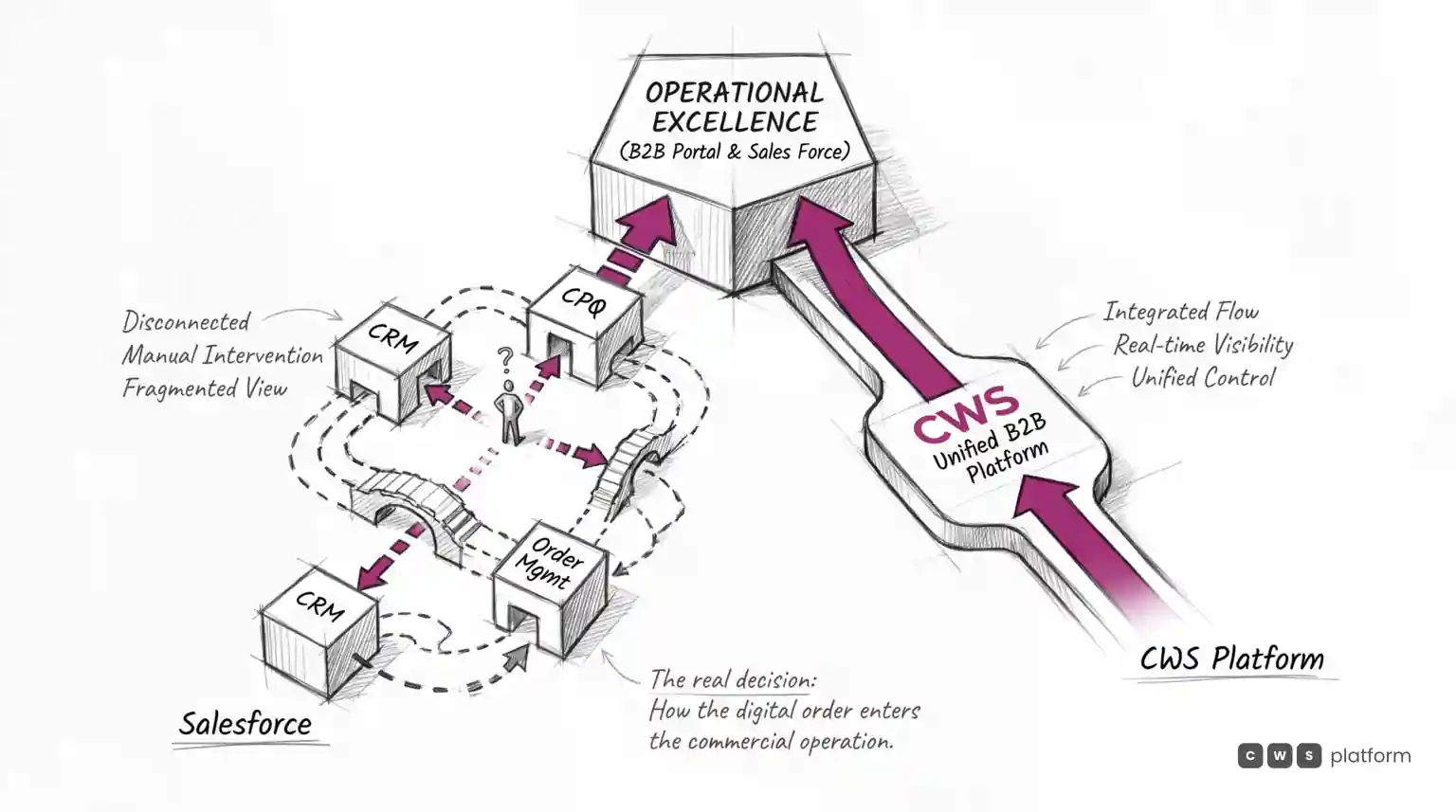
Salesforce vs. CWS Platform: Which Architecture Helps a B2B Portal Sell With Your Sales Team?
This comparison examines how Salesforce and CWS Platform connect a B2B portal to sales operations. The key question is where account context, pricing, approvals, credit, and order governance live.
Read →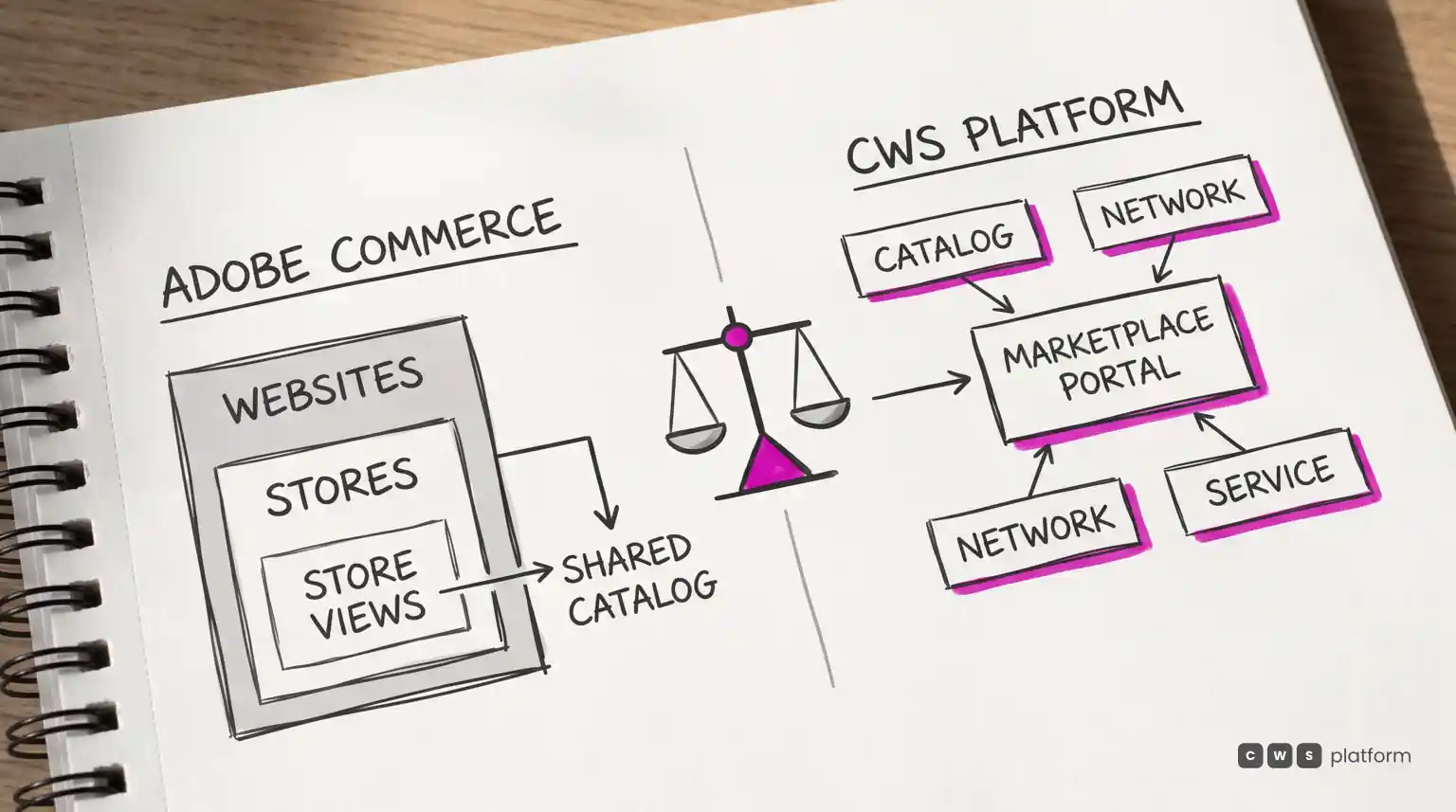
Dealer Marketplace: Adobe Commerce or CWS Platform for Catalog, Network, and Service Operations?
This comparison examines how Adobe Commerce and CWS Platform structure fitment data, regional dealer preference, assisted selling, and multi-source orders.
Read →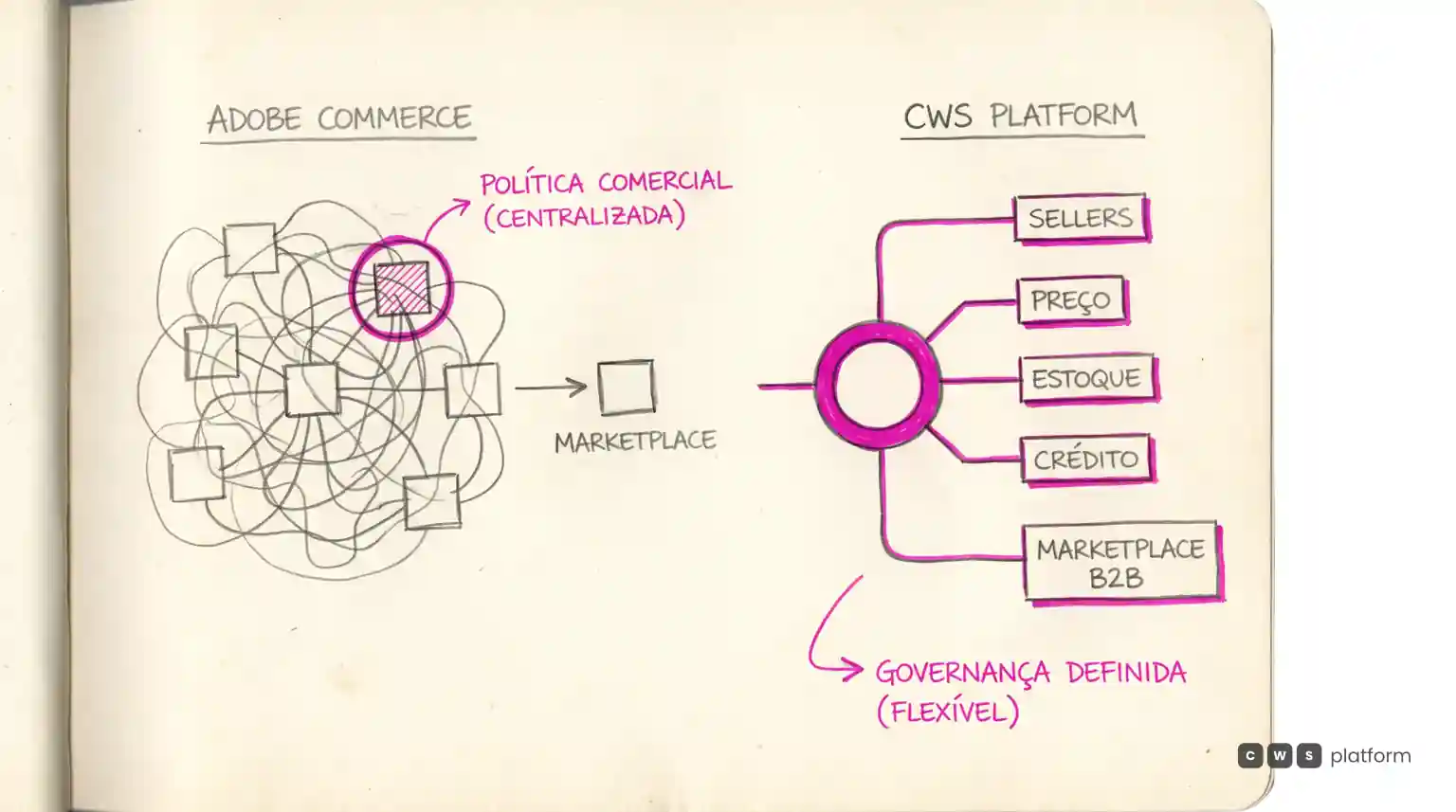
Adobe Commerce vs. CWS Platform: What Architecture Does a B2B Marketplace With Sellers Require?
This comparison examines how Adobe Commerce and CWS Platform structure commercial policy for a B2B marketplace with independent sellers.
Read →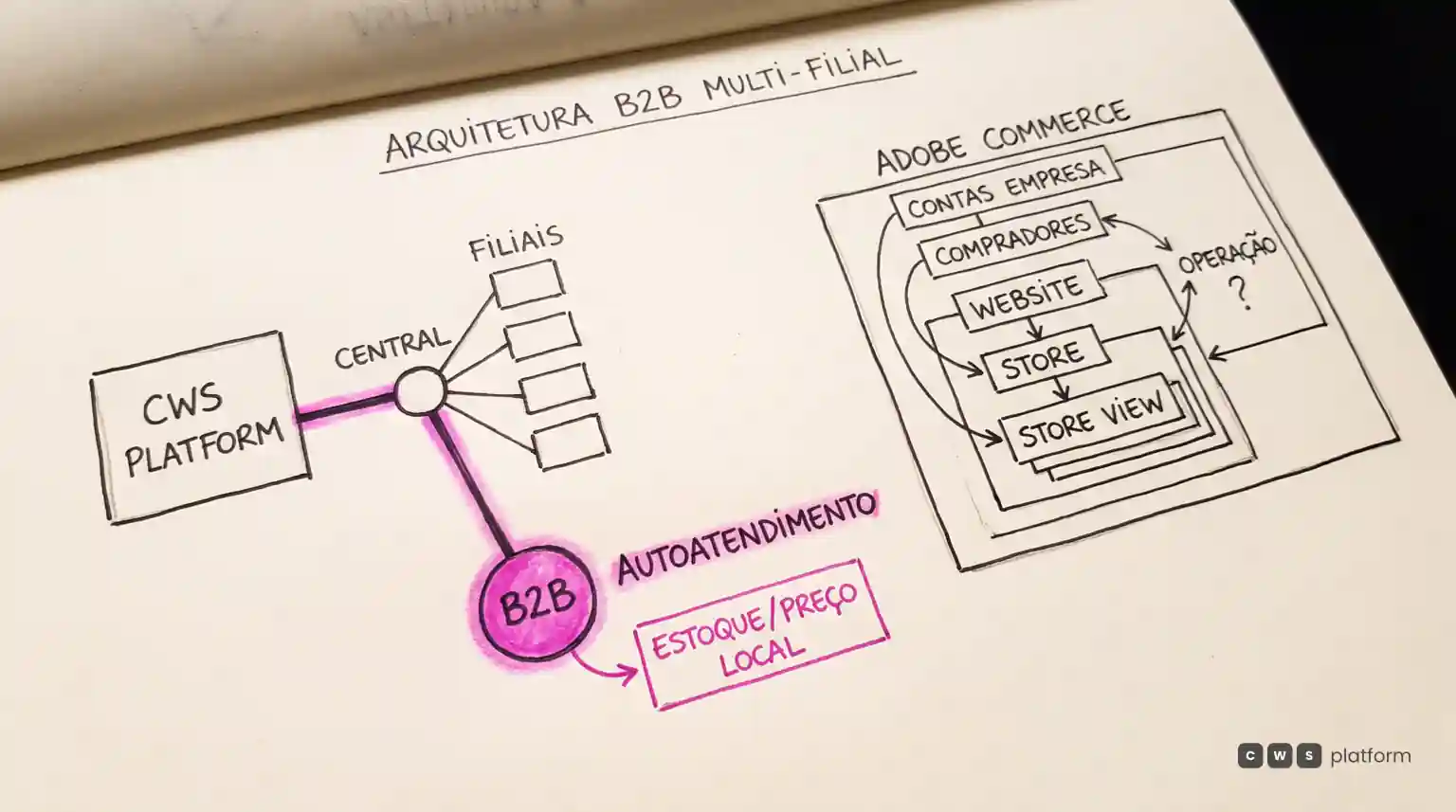
Which Architecture Keeps Location-Level Inventory and Pricing Accurate in B2B Self-Service?
This comparison examines how CWS Platform and Adobe Commerce handle locations, inventory, pricing, identity, checkout, and reordering in a B2B portal.
Read →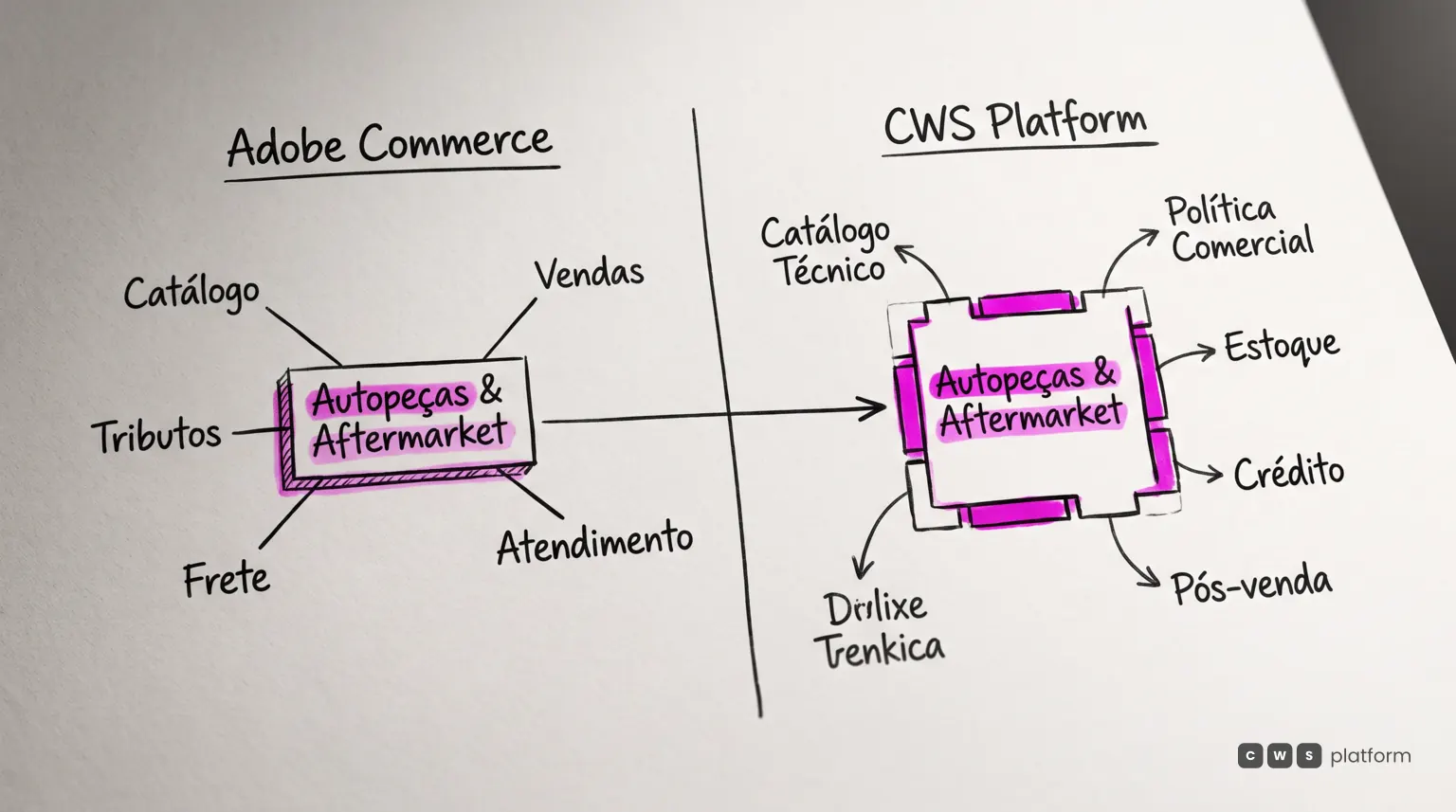
Adobe Commerce vs. CWS Platform: Which Architecture Does Auto Parts Distribution Require?
Adobe Commerce and CWS Platform organize B2B complexity around different architectural units. This comparison examines the impact on part discovery, negotiated pricing, order execution, and margin.
Read →
Adobe Commerce vs. CWS Platform: Who Does the CEO Depend On?
Adobe Commerce and CWS Platform create different forms of dependency. The comparison shows whether change sits with engineering, the ecosystem, the vendor, or business operations.
Read →
Adobe Commerce vs. CWS Platform: Where Should Replenishment Policies Run in a B2B Procurement Marketplace?
For recurring contract purchases, the storefront is not the core decision. The key question is where commercial policies run and how each order reaches fulfillment in a consistent state.
Read →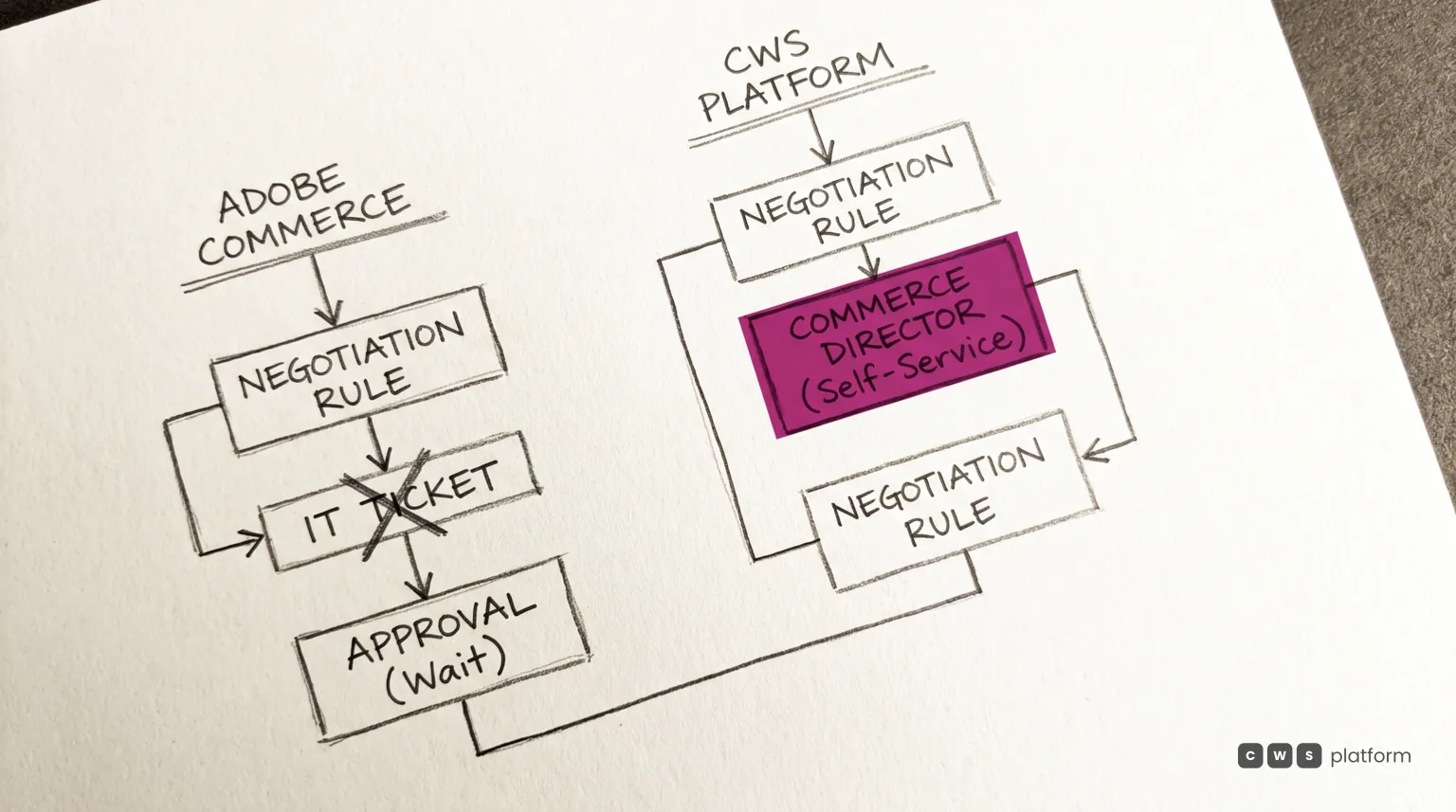
Adobe Commerce vs. CWS Platform: Can You Change a Negotiation Rule Without Opening a Ticket?
A head-to-head architecture comparison between Adobe Commerce and CWS Platform through the lens of a Director of Commerce: who turns a negotiated term into an executable rule, who can change it, and how that change reaches the order.
Read →
How to Cut the Cost of Every Recurring Contract Order Without Losing Procurement Control
A B2B supplies marketplace doesn't start with the storefront — it starts with the procurement policy that already exists. We compare how Adobe Commerce and CWS Platform execute contracted pricing, approvals, credit, and inventory on every repeat order.
Read →
B2B Portal Meets Counter and Field Sales: Adobe Commerce vs. CWS Platform, Side by Side
A head-to-head architecture comparison for distribution leaders who own marketing and channel revenue: Adobe Commerce's assigned pricing via shared catalogs versus CWS Platform's pricing calculated at the moment of sale. Including the four scenarios where Adobe Commerce is the right call.
Read →
Seven Questions That Separate B2B Commerce Architectures
Your RFP scorecard doesn't separate vendors because every platform answers 'yes' to the same questions. These seven questions surface the difference that would otherwise show up eighteen months in: whether commercial logic lives inside the platform or outside it.
Read →