The Cost of Selling
215 posts
-

OroCommerce vs Spryker: how does each connect ERP and procurement?
Oro records that its SAP integration and its Greenwing PunchOut are custom extensions outside the license agreement. Spryker records that its default PunchOut flow does not parse cXML elements outside the coverage list and that the order invoice email is not a structured e-invoice. The integration decision depends on who maintains each bridge, not only on the APIs. -

Optimizely vs Spryker: who maintains the ERP integration layer?
Optimizely records that it offers its ERP connectors in their current state, without .NET 8 support, and that LTS branches get hotfixes for four months. Spryker records that Glue gets fixes but no new endpoints, and that the Commerce MCP Server is for demonstration and prototyping, with production through professional services. The CTO's question is what each vendor maintains in the layer that talks to the ERP. -

OroCommerce vs Optimizely: how does each organize the B2B catalog?
OroCommerce builds web catalogs by site and customer group on top of a master catalog, and records that each product sits in only one category of that catalog and that multiple websites require the Enterprise edition. Optimizely Configured Commerce calculates pricing per customer and takes orders by item number, and records that Search v3 does not search customer-specific part numbers and that provisioning it takes more than a day. The COO's question is where the catalog is maintained and how buyers reach the product. -

VTEX vs Spryker: which fits a B2B marketplace with sellers?
VTEX opens the B2B marketplace on its retail platform, with Seller Portal and seller management, and records that a Seller Portal seller cannot modify the marketplace catalog. Spryker organizes the marketplace around merchant relationships, with merchant pricing per buyer business unit, and records that there is no built-in buy-box ranking. The commerce leader's question is who controls catalog, price, relationship, and offer. -

VTEX vs Optimizely: what goes on the B2B bill?
VTEX states in its 20-F that its transaction-based fee is primarily structured as a percentage of order value, and records that VTEX Shield may carry additional fees. Optimizely records that Configured Commerce licenses are associated per domain and that support only escalates to engineering on the current LTS version or newer. The CFO's question is what each line of the bill is tied to. -

Optimizely vs commercetools: what must the proposal include?
Optimizely records that every plan is individually packaged and that the partner or implementation team hosts the development and test environments. commercetools records an order-based license, not a GMV-based one, and that public beta features are not covered by SLAs. The CFO's question is what each proposal needs to put in writing to close the three-year math. -

OroCommerce vs SAP Commerce Cloud: is long-term support in the bill?
Oro records a license tied to GMV bands, 48 months of support for LTS versions of the Enterprise Edition, and extended coverage that may be purchased case by case. SAP records a cloud ERP edition sold in blocks of 10,000 orders per year, with SAP Finance licenses as a prerequisite, and manual code review in the move to JDK 21. The long-term bill depends on version coverage and update work, not only on the license. -

VTEX vs OroCommerce: what can change after an order is invoiced?
VTEX brings orders from several channels under one orchestration and records that an order invoiced in full can no longer be modified and that the platform does not subtract items from inventory automatically. OroCommerce keeps quoting, terms, and invoices in the product and records that a posted invoice can no longer be modified and that external order import does not export legacy orders. The COO's question is which system decrements inventory and which flow a change follows after invoicing. -

commercetools vs SAP Commerce Cloud: where do orders meet the ERP?
On commercetools, your team writes integration applications on Connect, whose code must sit in GitHub with a release tag, and resource-specific import endpoints remain in public beta. On SAP Commerce Cloud, the bridge comes from SAP, but the Calculation SPI needs custom work for the B2B flow and synchronous S/4HANA orders do not support multiple cost centers. The choice is who writes and who maintains the bridge. -

OroCommerce vs Salesforce Commerce Cloud: which price applies in B2B?
OroCommerce resolves price through chains of lists or a single list in Flat mode, where a missing price stays missing in the store, and only one quote workflow can be active per application. Salesforce Commerce Cloud evaluates at most 25 price books per call and uses a custom B2B checkout, where calculating shipping requires extending an Apex class. The Director of Commerce's question is which list each buyer's price comes from and how a quote becomes an order. -

Optimizely vs SAP Commerce Cloud: how much of the store depends on the ERP?
Optimizely queries price and inventory from the ERP or uses the Price Matrix kept in the platform, sends orders to the ERP through Windows Integration Service jobs, and only displays the invoices the ERP provides. SAP queries SAP Cloud ERP in the Cloud ERP edition or replicates prices from S/4HANA, and records that the S/4HANA order module is supported only on the Composable Storefront. The CIO's question is how much of the store stops when the ERP does not respond. -

Spryker vs SAP Commerce Cloud: what does the contract guarantee?
Spryker records that its support SLA does not guarantee resolution times, and that the Code Upgrader is shipped with PaaS+ in the EU and US regions. SAP records that running an unsupported version can mean breach of contract, and that AddOn-based OCC v2 extensions stop receiving updates once removed. The cost after signing depends on support and maintenance, not only on the license. -

commercetools vs Adobe Commerce: what changes in B2B order operations?
On commercetools, approval runs up to five sequential stages per rule and Order Search indexes only orders from the last 3 months. On Adobe Commerce, the cart caching issue remains open and Adobe published a fix for a vulnerability already being exploited. The COO's choice is who builds, looks up and fixes the order after the click. -

Spryker vs Adobe Commerce: which price reaches the B2B order?
Spryker records that the storefront shows the default price when it is lower than the merchant relation price, and that the Data Exchange API does not support customer-specific pricing. Adobe records that Commerce rounds all prices to two digits, and that Payment on Account is not supported for orders with multiple shipping addresses. In both, the deciding test is a real order at the negotiated price. -

Optimizely vs Adobe Commerce: what changes with each new version?
Optimizely calculates customer pricing in its own matrix, quotes with the rep, and integrates the ERP through an agent on the customer's network; Adobe Commerce lets you choose between SaaS and dedicated PaaS, with a headless storefront and B2B as an extension of the store. The documentation records version work on both sides: a mandatory Search v1 replacement and a front end rewrite from Classic to Spire at Optimizely, the end of PHP 8.2 and 8.3 support in 2.4.9 and an upgrade that involves fixing code conflicts at Adobe. The choice depends on which work your team is willing to take on. -

Spryker vs Salesforce Commerce Cloud: who handles the large B2B order?
Spryker organizes the large order around the buying company, with business units, role purchase limits, approvals, quotes with the rep, and an agent in the store; Salesforce puts the B2B store in your Salesforce org, with accounts and buyer groups, and documents sales management in Sales Cloud. The documentation records limits on both sides: approval confined to the approver's own unit and agents limited to carts saved in the database in Spryker, a 500 line cart in most stores and an index of 2,000 buyer groups per product in Salesforce. The choice depends on where the large orders in your book get stuck. -

VTEX vs commercetools: is B2B assembled or composed?
VTEX delivers B2B through B2B Suite apps, with organizations, cost centers, and predefined roles, and records that its Order Quote app is on the list of deprecated apps. commercetools delivers B2B as API resources, with Business Units and seller-defined roles, and its limits guidance recommends flattening Business Unit hierarchies. The commerce leader's question is who builds and maintains quoting, permissions, and hierarchy. -

B2B ecommerce platforms: the 9 leading options compared
There is no single best B2B ecommerce platform: commercetools and Spryker serve companies that build, OroCommerce and Optimizely those that want out-of-the-box B2B, SAP, Salesforce, Adobe, and VTEX those already in the vendor's ecosystem or starting from retail, and CWS Platform those that bring the commercial policy into the platform. For the CEO, the decision is what work the company takes on after signing. One cut question per model narrows the list before the demo. -

OroCommerce vs Magento B2B: what weighs on order operations?
In OroCommerce, B2B capabilities are described in the product; in Adobe Commerce, B2B is an extension that sits alongside B2C. The documentation records limits on both sides: posted invoices that cannot change and a 100-entity synchronous batch in OroCommerce, queue consumers and RabbitMQ in Adobe Commerce. The choice depends on who will run those queues and how the company wants to bill and invoice. -

commercetools vs Spryker: what changes in integration and upgrades?
On commercetools, the project consumes APIs and writes integrations on Connect, whose event delivery is at least once, with no ordering guarantee. On Spryker, the commerce code lives in the project, Glue gets no new endpoints, and the Code Upgrader supports only cloud projects. The CTO's choice is where the hardest code to maintain will live. -

commercetools vs Salesforce Commerce Cloud: who decides the rebuild?
commercetools delivers B2B as APIs plus a storefront template the team maintains, and records that projects created after August 31, 2026 can no longer activate Product Projection Search. Salesforce Commerce Cloud delivers the store from a template, and Salesforce records that migrating an Aura store to LWR means replacing all Aura components. The CTO's question is who sets the rebuild date. -

VTEX vs Salesforce Commerce Cloud: can B2B and retail coexist?
VTEX adds B2B to a unified retail operation, with native promotions and price tables per organization. Salesforce Commerce Cloud runs B2B and D2C in the same org, with shared data and processes. With both, measure how B2B promotions and price tables coexist with B2C ones. -

VTEX vs SAP Commerce Cloud: what can a CFO predict before signing?
Before signing, VTEX asks for the annual GMV range in US dollars, and SAP sells the cloud ERP edition in blocks of 10,000 orders per year, with SAP Finance licenses as a prerequisite. Afterward, App Store app costs go straight to the VTEX invoice, and at SAP running a version without maintenance can breach the contract. The CFO can predict the variable, not the amount. -

Optimizely Configured Commerce vs Salesforce B2B Commerce: where do reps sell?
Optimizely puts the rep inside the portal, quoting within discount and margin limits; Salesforce puts the B2B store in your Salesforce org, with accounts and buyer groups, and documents territories, forecasts, and Spiff for commissions in Sales Cloud. The documentation records limits on both sides: five price breaks per quote and promotions turned off by a quoted price in Optimizely, the account switcher and the buyer group index in Salesforce. The choice depends on where your reps work. -

Salesforce Commerce Cloud vs Adobe Commerce: where does the catalog limit live?
Salesforce publishes its catalog limits: a store accepts 4 million products, search covers up to 1 million, and search, filter, and sort attributes add up to at most 70 per store. On Adobe, quotes and shared catalogs ship in the B2B extension, and the records sit in operations: on-schedule indexers stuck in an open issue and 20 items per synchronous API request with input limiting enabled. The CTO's question is where the limit lives and who answers for it. -

SAP Commerce Cloud vs Adobe Commerce: what drives the three-year cost?
SAP records that returns, refunds, and cancellations do not reduce the GMV counted toward the license, and Adobe records that every accepted order counts as a transaction, even if returned. In both, standing still has a deadline: SAP's Cloud Portal will not build an unlisted release, and Adobe's security-only period for versions 2.4.4 to 2.4.6 will not be extended. The three-year cost depends on measured volume and upgrade cost. -

SAP Commerce Cloud vs Salesforce Commerce Cloud: who talks to the ERP?
SAP documents connectivity to its own ERP: in the Cloud ERP edition, pricing, inventory, and orders are queried from SAP Cloud ERP, and quotes run through SAP CPQ. Salesforce places the B2B store in the Salesforce org, with an always customized checkout, and recommends extensions over the checkout integrations framework. Both record changes of path, and the CIO's question is who maintains the conversation with the ERP when that happens. -

VTEX vs Adobe Commerce: which one handles the typical B2B order?
VTEX assembles B2B from B2B Suite apps, with organizations, cost centers, and their own price tables. Adobe Commerce brings B2B as an extension of the store, on SaaS, dedicated cloud, or open source. On both, the typical account order has points to test in the demo. -

VTEX vs. CWS Platform: what is the B2B total cost over three years?
VTEX states in its 20-F annual report that most of its subscription revenue comes from a fee primarily structured as a percentage of the value of orders processed, and its documentation says add-ons are purchased separately through a subscription agreement. On CWS Platform, pricing is a platform license plus an integration license, with no percentage of sales or GMV. The CFO's question is which variable drives the bill in year three. -

B2B marketplace: VTEX or CWS Platform?
In a B2B marketplace, each line's price is one seller's revenue and the base for the operator's commission. VTEX records as known issues, still open as of November 5, 2026, a price override that applies to the whole cart and seller trade policy changes that do not reindex on their own. Where each line's price comes from in a mixed cart is a question for any vendor's demo; on CWS Platform, commercial policy sits in parameters of the Commerce Rules Engine. -

B2B sales reps: VTEX or CWS Platform?
A B2B portal only wins the book of business when reps work in it. In VTEX, Sales App does not support B2B yet, the rep enters the storefront by impersonation, and an open known issue makes order history follow the rep's permissions. On CWS Platform, customer and sales rep use the same interface, on the same order, and one sales rep serves thousands of customers. -

Multi-store inventory: VTEX or CWS Platform?
In a store network, the delivery promise depends on which warehouse fulfills each item. VTEX records as an open known issue that this choice follows the order in which warehouses appear in the system, and marked No Fix a deleted warehouse that can remain in the availability base. On CWS Platform, the sales rep builds the cart with the source of each item, and net terms support split shipments from multiple ship-from locations. -

VTEX vs. CWS Platform: what do VTEX known issues say about maintenance?
According to the VTEX known issues page, accessed on November 5, 2026, 1,458 of the 2,070 published items were open and 244 marked No Fix, with a median age of 3.2 years for open items. The Master Data scroll timeout is recorded as an open known issue, and VTEX replied on its official forum that it cannot guarantee the pricing API request limit will not trip. On CWS Platform, integration is API-first, commercial policy lives in parameters, and all customers run the same version. -

Fashion wholesale: VTEX or CWS Platform?
In fashion wholesale, the size and color order runs to hundreds of SKUs. VTEX records as a known issue that Quick Order adds items in batches of 10 with parallel checkout calls and that exporting orders with more than 200 SKUs can time out, an item it marked No Fix. On CWS Platform, the cart holds 250 line items by default, with a configurable limit the largest matrix order tests in the proof, and the order records who built the cart and who chose the payment. -

Auto parts catalog: VTEX or CWS Platform?
In auto parts, the catalog has to go in whole through loads and come out whole through reads. VTEX records as a known issue that the Catalog Search API returns at most 2,500 results, an item it marked No Fix, and that product and SKU spreadsheet import fails above approximately 4.5 MB. On CWS Platform, integration is API-first, with REST APIs and webhooks, and tables, rules, and contracts can come from the ERP through an API. -

VTEX vs. CWS Platform: what comes ready in VTEX B2B commerce?
VTEX has a broad foundation, with more than 750 endpoints, more than 900 integrations, and the B2B Organizations app, but B2B Buyer Portal and B2B contracts are available to selected accounts, according to its documentation. For other accounts, B2B is assembled from VTEX IO apps and theme changes. On CWS Platform, price tables, rules, and contracts are configurable or come from the ERP and CRM through APIs, with all customers on the same version. -

Assisted selling: VTEX or CWS Platform?
Assisted selling only helps the channel when the order keeps who built the cart and who chose the payment, and the screen shows the right credit. In VTEX, two open known issues mean an impersonated order does not register who finished the purchase and the telesales balance is the agent's. On CWS Platform, the order records who built the cart and who chose the payment, and the customer's credit limit is maintained on the platform. -

Multi-branch B2B portal: VTEX or CWS Platform?
A multi-branch B2B portal only takes routine orders off the phone when the buyer searches and sees their own price. VTEX records as an open known issue that search does not sort or filter by price tables, and answered on its official forum, in January 2024, that the requested regionalization cannot be done with trade policies alone. On CWS Platform, tables, rules, and contracts are configured on the platform or come from the ERP through an API, and commercial policy sits in parameters. -

B2B and B2C in one network: VTEX or CWS Platform?
A network that sells to businesses and consumers grows by combination: every new store adds inventory, routes, and one more party to pay. VTEX records that in multilevel inventory payouts are not split across the whole chain, and keeps open, as of November 5, 2026, a known issue that disregards routes above 10,000 in the availability calculation. On CWS Platform, CDL Workspace is a single system for the network, and net terms ship from multiple locations. -

Dealer marketplace: VTEX or CWS Platform?
A dealer network's official portal wins on fitment knowledge and dealer inventory, and both need to reach the portal. VTEX records that sellers cannot modify the marketplace catalog and that the marketplace waits 2.5 seconds at most for the external seller's fulfillment endpoint. On CWS Platform, CDL Workspace is a single system for the ecosystem, and integration with each dealer's ERP is through an API. -

B2B procurement: VTEX or CWS Platform?
In a procurement channel, two controls matter to the CFO: the buyer's purchasing rule and credit. VTEX records that buying policies depend on Buyer Portal, available to selected accounts, and marked No Fix a purchase button that stays active without enough credit. Where each control will live is a question for any vendor's demo; on CWS Platform, the credit limit is maintained on the platform. -

Agribusiness B2B: VTEX or CWS Platform?
In agribusiness, input sales are usually on terms, and the CFO needs terms and receivables to reach the ERP and collections intact. VTEX records as known issues, still open as of November 5, 2026, that an unpaid notes payable transaction is not cancelled by the gateway after the due date and that integrations relying on payment terms or credit conditions may fail. On CWS Platform, the customer's credit limit is maintained on the platform, and net terms support split, scheduled shipments. -

VTEX vs. CWS Platform: do B2B quotes close the way the rep negotiated them?
A quote only converts well when it carries the pack rule and survives the last adjustment. In VTEX, an open known issue makes quotes ignore the unit multiplier, and with B2B Checkout Settings the quote checkout is locked. On CWS Platform, the rep builds the cart and sends the link, and the discount goes through multi-level approvals. -

VTEX vs. CWS Platform: how do order changes work?
In B2B, orders change after they are placed, and every change has to reach payment, picking, and the invoice. In VTEX, increasing an order's value only applies to credit card purchases, and a known issue open since 2023 keeps a removed item in the invoicing step. On CWS Platform, the credit limit is maintained on the platform and the order talks to ERP and tax through APIs. -

Building materials: VTEX or CWS Platform?
A job site order arrives in large quantities and fractional units. VTEX records as a known issue that simulating thousands of units of the same SKU produces a Logistics error, an item it marked No Fix, and that discounts with non-integer multipliers are rounded per item, which can lose cents. On CWS Platform, net terms work with split, scheduled shipments to multiple addresses, and the job's real quantity and apportionment go into the proof. -

B2B marketplace: Spryker or CWS Platform?
In a B2B marketplace, who decides the winning offer and who opens the contract shape the sale. Spryker's documentation records no built-in buy-box ranking, the first offer published as the default winner, and that merchants cannot create a merchant relation in the Merchant Portal. On CWS Platform, contracts and prices sit in parameters, and the split is the marketplace owner's commission. -

B2B portal for sales operations: commercetools or CWS Platform?
When reps place orders in the portal, the path to the ERP becomes part of sales operations. In commercetools, Connect events are at-least-once with no ordering guarantees, and the code lives in a GitHub repository with a release tag. On CWS Platform, integration runs through REST APIs and webhooks, and commercial policy sits in parameters. -

B2B self-service portal for multiple branches: Optimizely or CWS Platform?
Multi-branch self-service only lowers cost to serve when orders, financials, and data volume move together. In Optimizely Configured Commerce, the platform does not manage invoicing and displays what the ERP writes, and the Admin API returns at most 100 results per request. On CWS Platform, the account's credit limit is maintained on the platform and net terms support split shipments to multiple addresses. -

Assisted selling and agent assist: Spryker or CWS Platform?
Assisted selling works when the sales rep sees the cart in progress and works on the same order as the customer. Spryker's documentation records that the agent cannot manage a cart stored only in the session and that PHP 8.3 support ends in July 2027. On CWS Platform, the rep builds the cart and sends the link, and the order records who built it and who chose the payment. -

Assisted selling: commercetools or CWS Platform?
Assisted selling depends on how the book of business is designed and loaded, not only on cart access. In commercetools, the rep takes over the session, the guide recommends flattening Business Unit hierarchies, and import endpoints remain in beta. On CWS Platform, customer and rep work on the same order, and one rep serves thousands of customers. -

B2B marketplace: OroCommerce or CWS Platform on the CFO's spreadsheet?
OroCommerce has a documented marketplace, with sellers as organizations and a single cart split by seller, but multi-website management is Enterprise-only and OroPay depends on provisioning and an approved merchant account. On CWS Platform, billing is a platform plus integration license, and the split percentage is the marketplace owner's commission. The math separates software, underwriting, and commission. -

Building materials distribution: OroCommerce or CWS Platform?
OroCommerce offers a web catalog with collections and group visibility, search with synonyms, and customer price lists, but a product can sit in only one master catalog category and the Enterprise LTS version is supported for 48 months. On CWS Platform, tables, rules, and contracts are configurable or come from the ERP through an API, job sites take split, scheduled deliveries, and all customers run the same version. -

Auto parts distribution: Optimizely Configured Commerce or CWS Platform?
In auto parts replenishment, the customer searches by their own number and buys in large orders. In Optimizely Configured Commerce, Vertex AI search does not recognize numbers assigned at the customer level, which Quick Order still accepts, and Search v1 had a mandatory replacement by June 30, 2026. On CWS Platform, the cart holds 250 line items by default, configurable, and the sales rep builds the order and sends the link for the customer to complete. -

Spryker vs. CWS Platform: how do order approval operations hold up?
Order approval is a workflow that needs an owner, a fallback path, and access for the people who run it. Spryker's documentation records that approvers only approve orders from their own business unit, that a quote above every limit has to be edited, and that the Back Office is secured in an intranet. On CWS Platform, the sales rep's discount goes through multi-level approvals and customers, reps, and operations use one system. -

commercetools vs. CWS Platform: how do B2B order approvals work for sales?
The approval that holds up an order can be the buyer's or your margin's. commercetools documents buyer approval in up to five sequential stages and enables Intake through a support request. On CWS Platform, the sales rep's discount goes through multi-level approvals and the rep sends a ready cart for the customer to close. -

Optimizely Configured Commerce vs. CWS Platform: who maintains the ERP integration?
ERP integration weighs over time, not in the first release. In Optimizely Configured Commerce, ERP connectors do not support .NET 8 and are offered in their current state, and the partner hosts development and test environments. On CWS Platform, integration runs through REST APIs and webhooks, and commercial rules sit in parameters. -

Optimizely Configured Commerce vs. CWS Platform: what is the total cost over three years?
The cost of a B2B platform shows up in year three, in license, version moves, and maintenance. In Optimizely Configured Commerce, every plan is individually packaged and each LTS branch receives hotfixes for four months. On CWS Platform, billing is a platform license plus an integration license, with no percentage of sales, and every customer runs the same version. -

commercetools vs. CWS Platform: what goes into the three-year total cost of ownership?
Three-year total cost has more lines than the license. In commercetools, add-ons carry additional terms and pricing, and public beta features have no SLA coverage. On CWS Platform, billing is a platform license plus an integration license, and all customers run the same version. -

OroCommerce vs. CWS Platform: how does sales rep quoting work?
OroCommerce offers quoting with several entry points and routed approvals, but only one quote workflow can be active per application and product kits stay out of the quick order form. On CWS Platform, the sales rep builds the cart with items and ship-from locations and sends the link, and the order records who built it and who chose the payment. The choice is where each team's negotiation lives. -

Spryker vs. CWS Platform: what goes into total cost of ownership after you sign?
The total cost of a B2B platform shows up after the license: version maintenance, subscription model, and support. Spryker's documentation records that the Code Upgrader ships with PaaS+ in the EU and US and that support resolution time is not guaranteed. On CWS Platform, all customers run the same version and licensing takes no percentage of sales. -

OroCommerce vs. CWS Platform: what happens to order operations after checkout?
OroCommerce offers four deployment models, upgrade modes, and recurring orders, but the full OroCloud backup does not cover Elasticsearch and RabbitMQ and external order import does not export legacy history. On CWS Platform, the order talks to ERP, CRM, tax, and payments through APIs and accepts split, scheduled shipments from multiple origins. The COO's question is where the order comes in, where it goes out, and what comes back first. -

Spryker or CWS Platform: Where Does Customer Pricing Travel in the ERP Integration?
The Spryker documentation records that the Data Exchange API supports neither customer-specific pricing nor Order Management System operations, and that Glue gets no new endpoints. In CWS Platform, tables, rules, and contracts sit in configurable parameters and can come from the ERP through an API. -

The Three B2B Commerce Platform Models: Assemble, Buy Ready-Made, or Move Commercial Rules Into the Platform
commercetools and Spryker are composable platforms the customer's team assembles; Optimizely Configured Commerce and OroCommerce are ready-made B2B platforms connected to the ERP through an implementation project; CWS Platform keeps commercial rules in parameters. The choice starts with how often your commercial policy changes. -

Optimizely Configured Commerce or CWS Platform: Can You Change Commercial Rules Without a Ticket?
The Optimizely Configured Commerce documentation records a maximum of 10 price breaks in the price matrix and that a sales rep's quote disallows available promotions on that product. In CWS Platform, tables, rules, and contracts sit in configurable parameters, and thousands of promotions can run at the same time. -

commercetools or CWS Platform: What Does It Cost to Keep Commercial Rules Integrated?
In commercetools, commercial rules become API objects and project code, and the documentation records limits that enter the integration math. In CWS Platform, tables, rules, and contracts sit in configurable parameters, and the integration moves data without carrying pricing policy. -

OroCommerce or CWS Platform: What Goes Into the Math When the Digital Channel Grows?
The OroCommerce pricing page records licenses aligned to GMV bands and integrations handled by the customer's team or partner. CWS Platform bills a platform license plus an integration license, with no percentage of sales or GMV. -

Mandatory Updates: Who Pays for Customization at Each Version in SAP, Salesforce, and Adobe
What SAP, Salesforce, and Adobe publish about version cycles, end of support, and migration, and how CWS Platform treats the same point: one version for all customers, with no framework change on the customer side. -

ICMS, ST, and NF-e: Where Brazilian Tax Lives in B2B E-commerce
The tax pages of the public documentation of SAP, Salesforce, and Adobe do not describe Brazilian tax localization. On CWS Platform, tax per item comes from the ERP tax API, and the price rule uses the customer's tax profile. -

One System for the Whole Ecosystem: How Many Tools Does Your Team Need to Learn?
What the public documentation of SAP, Salesforce, and Adobe records about the tools for each role in a B2B channel, and how CWS Platform treats the same point: all users of the ecosystem in the same CDL Workspace. -

Adobe Commerce vs CWS Platform: Who Upgrades When Versions Hit EOL?
A comparison of Adobe Commerce and CWS Platform through the CTO lens: on one side, a published lifecycle, with versions and dependencies that go out of support; on the other, a single version for all customers, with no upgrade project on the customer side. -

SAP Commerce Cloud vs. CWS Platform: Does Your License Scale with Sales Volume?
A comparison of SAP Commerce Cloud and CWS Platform through the CFO lens: on one side, a subscription measured by GMV or by orders; on the other, a platform and integration license with no percentage on sales. -

What It Costs to Grow: The License Tied to Volume Sold in SAP, Salesforce, and Adobe
What SAP, Salesforce, and Adobe publish about B2B commerce license measurement, by value sold or by orders, and how CWS Platform charges: a platform and integration license with no percentage on sales. -

Salesforce vs. CWS Platform: Who Rebuilds the Storefront When Frameworks Change?
A comparison of Salesforce and CWS Platform through the CTO lens: on one side, the migration of Aura stores to LWR, with components replaced; on the other, a single version for all customers, with no framework change on the customer side. -

Adobe Commerce vs CWS Platform: Do Returned Orders Count Toward Licensing?
A comparison of Adobe Commerce and CWS Platform through the CFO lens: on one side, every accepted order counts as a transaction, even if it is later refunded or returned; on the other, a platform and integration license with no percentage on sales. -

B2B Systems Integration: What to Connect First and How
Effective B2B integration requires establishing strict systems of record for pricing, inventory, and accounts before touching code. Prioritize clean order injection into the ERP with idempotency and retry queues to eliminate manual entry without replacing core back-office systems. -

B2B Pricing Strategies: Moving from Base Cost to Customer-Specific Rates
Effective B2B pricing goes beyond basic cost-plus markup to incorporate client contracts, regional freight, and approval hierarchies. Unifying calculation engines with direct sales channels prevents margin leakage on every order. -

What Is a B2B Sales Order and What Must It Include?
A sales order is the binding authorization for fulfillment and invoicing. When captured manually without real-time validation, bad data stalls processing and erodes gross margins. -

Volume Pricing in B2B: How to Build Tiered Pricing Without Sacrificing Margins
Volume pricing should pass on real operational savings from scale, such as fulfillment and freight efficiencies. Without automated system tiers, volume discounts degrade into discretionary margin leaks. -

Assisted Sales and Digital Counter: SAP Commerce Cloud or CWS Platform?
Assisted selling requires tight alignment between buyer and sales rep without margin leakage. While SAP Commerce Cloud coordinates specialized modules (ASM, SAP CPQ, and ERP), CWS Platform natively handles shared carts, credit limits, and approval tiers in a single transactional layer. -

Integration Maintenance Costs: SAP Commerce Cloud vs CWS Platform in API Architecture
The core engineering tradeoff between SAP Commerce Cloud and CWS Platform is code extensibility via build pipelines versus deterministic API-driven rules. This guide evaluates integration latency, inventory sync, pricing engines, and ERP decoupling. -

B2B Ecommerce with Sales Reps: SAP Commerce Cloud vs CWS Platform
Architectural breakdown between SAP Commerce Cloud and CWS Platform for sales-assisted B2B ecommerce. Discover how shared carts, contextual pricing, and credit checks avoid sales rep friction. -

B2B Marketplace with Sellers: SAP Commerce Cloud vs. CWS Platform
Enterprise B2B marketplaces must balance vendor autonomy with centralized terms, trade credit, and multi-location fulfillment. SAP relies on third-party SaaS extensions like Mirakl on top of Commerce Cloud, whereas CWS Platform resolves pricing, terms, split orders, and buybox rules natively. -

B2B Sales Process: Key Stages and the Role of Commercial Policy
A sales process outlines the operational journey from lead qualification to repeat orders, while commercial policy enforces pricing tiers, terms, and discount guardrails. Scaling without system-level policy governance leads to margin leakage and costly approval bottlenecks. -

What Is a Deal Desk and When Does a B2B Business Need One?
A deal desk reviews and approves non-standard sales agreements to protect margin and enforce policy. Without calibrated approval thresholds and full cart context, it quickly becomes an operational bottleneck. -

B2B Discount Management: How to Protect Margins on Every Deal
Unstructured price concessions directly erode net margins across enterprise sales cycles. Implementing margin-based guardrails, customer-specific price books, and formal approval hierarchies ensures volume growth without margin leakage. -

What Is an Approval Matrix and How to Structure Discount Tiers
A discount approval matrix defines sales team autonomy across pricing, payment terms, and credit limits. Success requires grounding tiers in product gross margins and automating enforcement within the sales system. -

B2B Order Entry Automation: Eliminating Manual Re-Keying in Distribution
Re-keying orders from emails, spreadsheets, and phone calls drives up fulfillment costs and error rates. B2B order entry automation enables self-service ordering, bulk list uploads, and sales-assisted carts that validate pricing and inventory upfront, pushing clean orders straight to the ERP. -

What B2B Customer Service Is and What It Costs per Account
B2B customer service scales expensively when reps field routine inventory and invoice questions. Automating standard inquiries through self-service lowers cost-to-serve while freeing reps to close high-value deals. -

Operating Costs in Distribution: Hidden Leaks and How to Cut Them
Wholesale operating costs scale aggressively when order checks depend on manual review instead of software rules. Establishing self-service reorders, real-time credit checks, and automated validation protects margins as revenue grows. -

What Is Cost to Serve in B2B and How to Calculate It per Account
Cost to serve captures all post-production expenses required to fulfill orders for individual accounts. High-touch manual handling on frequent small reorders erodes operating margins. Shifting repeat transactions to self-service digital commerce optimizes sales team efficiency and profitability. -

What Is a B2B Quote and How to Run Profitable Quote Management
Wholesale quotes are where enterprise margins are won or lost. Relying on disconnected spreadsheets and ad-hoc rep discounting leads to margin dilution, while systematic CPQ and pricing workflows ensure fast, profitable order execution. -

What an ERP Is, What It Does, and What It Doesn't Solve in B2B Sales
ERPs serve as the ultimate system of record for finance, compliance, and fulfillment, not as an agile commerce interface. Forcing an ERP into front-line negotiations leads to rigid workflows, slow order turnaround, and expensive technical debt. Decoupling a dedicated commercial layer from your core ERP preserves data integrity while empowering buyers. -

What B2B Sales Is and How It Actually Works
B2B sales relies on account-specific pricing, payment terms, and repeat orders. Handling routine reorders manually drives up cost to serve and erodes margins; top distributors offload standard replenishments to digital channels to focus sales reps on high-value negotiation. -

What Is B2B: How Selling Changes When the Buyer Is a Business
B2B transactions involve professional buyers, contractual pricing, and net payment terms. Modern distributors and manufacturers must support self-service reorders while retaining strict pricing governance for negotiated deals. -

B2B vs B2C: Structural Differences That Reshape Selling
Corporate procurement relies on negotiated price tiers, net terms, and bulk reorders, contrasting sharply with standard retail transactions. Forcing B2B buyers into B2C workflows creates margin leakage and operational drag. Modern hybrid merchants solve this by using unified digital portals that dynamically enforce account-level rules upon login. -

Essential B2B E-Commerce Integrations: ERP, Tax, Payments, Shipping, and CRM
B2B vendors routinely claim to integrate with anything, yet hidden transactional complexity appears after signing. Scalable architectures need focused, robust integrations across ERP, automated tax, net terms payments, multi-warehouse shipping, and CRM. Validating live data flows prevents costly replatforming. -

ERP Sales Module vs. Dedicated B2B Commerce Platform
ERPs are built as systems of record for accounting and inventory, not as dynamic commercial engines for external buyers and reps. Hardcoding complex pricing rules directly into core systems causes massive backlogs. A dedicated headless commerce layer unblocks field sales while keeping the ERP intact. -

What Needs to Flow Between ERP and B2B Commerce, and at What Cadence
Ghost inventory and failed orders stem from batch sync architectures. B2B buyers need real-time inventory and credit checks at checkout, while the ERP must only receive pre-validated, idempotent orders. -

How to Modernize B2B Sales Without Migrating Your ERP
ERP replacement is an expensive barrier to digital commerce. By introducing an API-driven commercial layer, distributors can enable self-service, rep ordering, and pricing logic without ripping out their core system of record. -

Real-Time B2B Inventory: Webhooks, APIs, or Batch
Batch-only inventory sync creates ghost stock on high-velocity items. Modern B2B commerce architectures leverage event-driven webhooks with idempotent safeguards and off-peak reconciliation to protect ERP performance and eliminate order cancellations. -

Real-Time Pricing in B2B Negotiation: What Changes When Reps See Margin
When sales reps negotiate using static price sheets, discounts become their only lever. Real-time pricing brings landed costs, freight, and payment terms into the deal context, halting margin degradation before orders are booked. -

How to Turn Commercial Policy into Automated Business Rules
Static guidelines in PDFs rely on sales rep memory and inevitably lead to margin leakage. Converting commercial policies into automated rules with approval workflows guarantees margin governance across all direct and digital channels. -

Tiers, Price Books, and Resellers: Managing Complex B2B Pricing Without Spreadsheet Sprawl
Treating B2B pricing as rigid spreadsheets rather than dynamic rules leads to margin leakage and discounting chaos. By implementing clear waterfall logic on top of a single base price, wholesale distributors protect profitability without manual overhead. -

B2B Contract Pricing: Why Negotiated Rates Fail at Invoicing
B2B margins bleed when contract pricing is handled as static paperwork rather than automated pricing logic. Without explicit prevalence rules, platforms stack sales rep discounts on top of contracted rates. Enforcing contracts as real-time pricing rules protects revenue across every channel. -
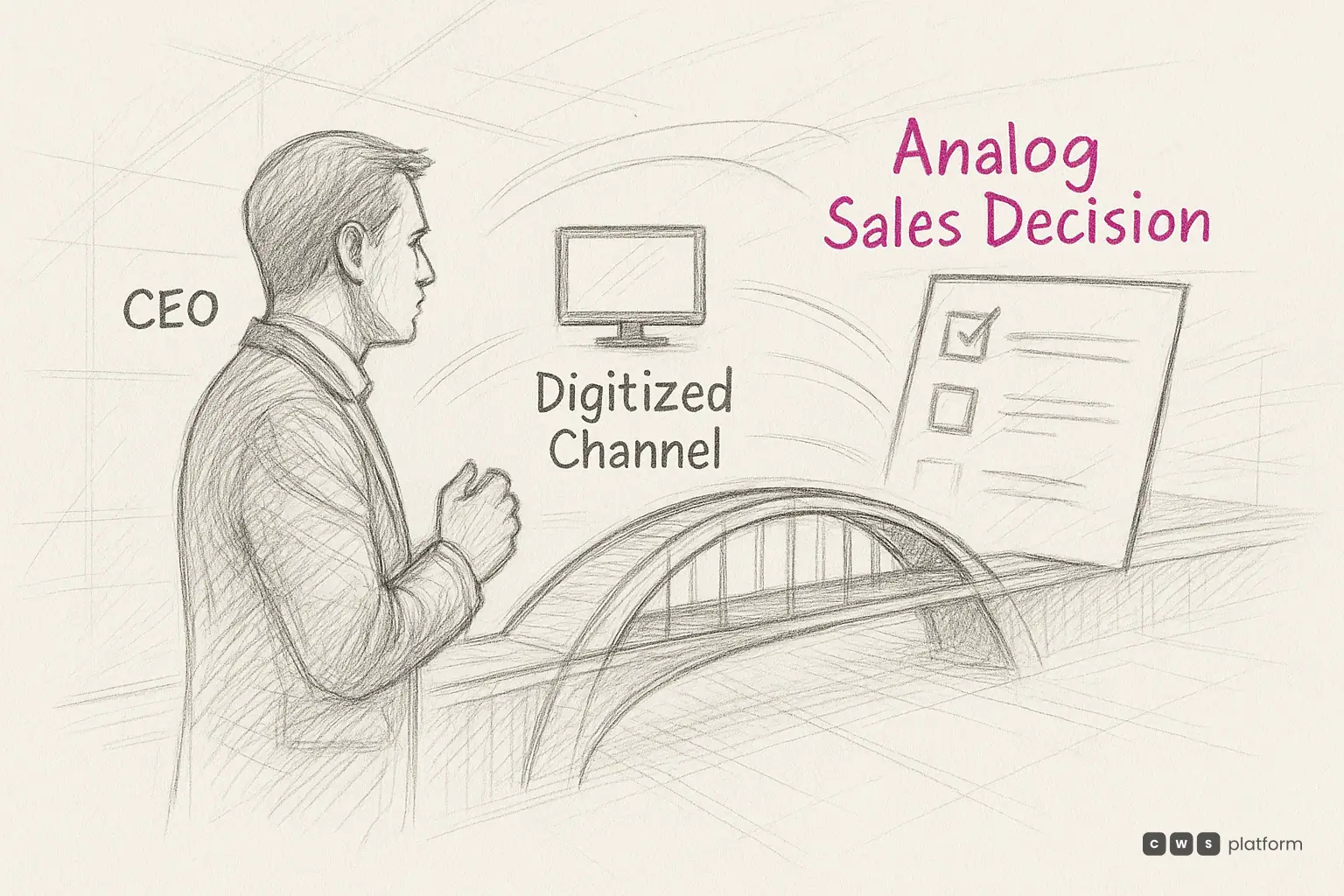
You Digitized the Channel. Your Sales Decision Is Still Analog.
Modernizing front-end portals without automating deal logic keeps transaction decisions analog and slow. Real margin expansion happens when live ERP data, pricing rules, and credit terms govern the exact moment of sale. -

Customer-Specific B2B Pricing: Enforcing Contract Rates Without Spreadsheets
Managing negotiated accounts through spreadsheets introduces severe margin leakage and channel conflict. Effective B2B operations calculate contract pricing dynamically as a rule-based engine across both self-service portals and sales reps. -

What B2B Self-Service Ordering Truly Costs (and the Cost of Inaction)
Evaluating wholesale commerce solely by setup fees masks ongoing manual order entry overhead and rule governance costs. Real ROI is driven by buyer adoption replacing phone and email orders. -

Why Manufacturers Can No Longer Afford Legacy B2B Platforms
Legacy B2B platforms fail because they treat industrial commerce as direct-to-consumer storefronts without configurable commercial policies. Incorporating dealers, distributors, and sales reps into a unified transactional engine eliminates shadow IT and restores sell-out visibility. -

Cost Per Order in Three Years: Salesforce vs. CWS Platform
An architectural comparison between Salesforce and CWS Platform focused on 3-year cost-per-order dynamics. Examines commercial rule execution, complex terms, and operational leverage without revenue-share penalties. -

B2B Customer Portal Best Practices: Built for the Real Buyer
B2B self-service fails when designed like generic retail. Driving high portal adoption requires presenting contract pricing upfront, enabling quick SKU reorders, and unifying rep assistance on the exact same cart. -

Beyond the Shopping Cart: How a B2B Ordering System Handles Complex Orders
Consumer-grade B2B carts fail because they lack bulk import, multi-warehouse split logic, dynamic credit checks, and sales rep collaboration. Enabling buyers to self-serve high-value orders requires calculating pricing, taxes, and freight across hundreds of SKUs simultaneously. -

B2B Customer Portals: Why Buyers Still Call and How to Fix It
Online portals fail B2B buyers whenever they present generic retail storefronts without dynamic pricing or net-terms verification. To eliminate manual phone calls, platforms must validate trade credit, tax, regional stock, and matrix pricing directly on screen. -

B2B Wholesale Online: Why Sales Tax, Credit Terms, and Warehouses Break Retail Platforms
Retail-derived digital commerce fails wholesale distributors by pushing tax computation, trade credit checks, and inventory allocation into manual post-order processing. Sustainable B2B operations require real-time pricing and allocation engines before committing to the ERP. -

Wholesale Distributor Marketplace: Moving Beyond Third-Party Platforms
Third-party marketplaces turn wholesale distributors into low-margin order fulfillment nodes. By building a proprietary wholesale distributor marketplace, distributors curate non-stock inventory, protect commercial terms, and provide unified checkout across vendors and multi-location accounts. -

How to Choose Software for Wholesale Distribution: Five Tests With a Real Order
Standard B2B demos only show single-item orders with list pricing. Distributors must stress-test platforms with 100+ line items, custom tier pricing, net terms validation, and automated multi-warehouse fulfillment. -

Manufacturer Marketplace: How to Launch Without Channel Conflict
A manufacturer marketplace rarely fails on software; it fails when competing with its own dealer network. The sustainable path lets the OEM operate the digital storefront while authorized dealers fulfill orders under clear territory governance. -

How to Automate Wholesale Orders with Real-Time Credit and Inventory Rules
Wholesale orders stall when credit limits and inventory availability are checked after the sale. Inverting this workflow validates pricing, taxes, terms, and warehouse stock simultaneously before order commitment, routing only true exceptions to human approval. -

How to Roll Out a B2B Ordering Portal for Distributors Without Creating Channel Conflict
B2B ordering portals often fail because they launch as standard storefronts lacking negotiated pricing, terms, and credit governance. Successful distributor digital initiatives start with bidirectional ERP integration, consistent rules across assisted and self-serve sales, and reps driving buyer adoption. -

B2B Marketplace Payments: The Multi-Vendor Cart Settlement Trap
Enterprise multi-vendor settlement goes beyond basic payment splits. It demands dynamic shipping tables, net terms allocation, and commission routing per inventory origin to eliminate manual reconciliation overhead. -

B2B Account Activation in Wholesale: Why Reorders Stall When Reps Control the Order
Active account rates stall when sales reps spend most of their day manually entering routine replenishment orders. Exposing negotiated pricing, trade credit, and real-time inventory through self-service commerce lets B2B buyers repurchase on demand without scaling headcount. -

B2B Marketplace Buy Box: Why Lowest Price Shouldn't Decide Alone
A B2B buy box cannot default to the lowest price without creating systemic fulfillment failures and channel conflict. Effective multi-seller architecture prioritizes inventory location, distributor territories, and negotiated buyer terms over nominal unit cost. Platform operators need native policy controls rather than rigid consumer retail algorithms. -

Where ERP Marketplace Integration Breaks Down
Direct ERP marketplace integration collapses under high-frequency buyer queries, distributed inventory, and contract pricing logic. Modern enterprises decouple core ERP systems from the edge using an API-first orchestration layer. -

The Pitfalls of Choosing Retail Software for a B2B Marketplace
Retail marketplace tech fails in wholesale operations by assuming centralized inventory and simple price-first ranking. B2B operators must govern multi-vendor catalogs at the warehouse level, control buy box rules, and automate payment splits. -

How to start a B2B marketplace that scales: 4 operational rules
Launching a portal does not guarantee marketplace viability if pricing, credit lines, and terms still require back-office intervention. True scale demands transforming complex sales policies into governed, executable digital workflows. Commercial governance must always precede workflows automated by AI agents. -

Salesforce or CWS Platform: Who Governs Commercial Execution Without Vendor Lock-In?
Salesforce excels at global CRM pipelines and corporate record aggregation. CWS Platform provides a deterministic engine for contextual pricing, warehouse-level autonomy, and rep-assisted ordering without recurring proprietary re-platforming costs. -

Assisted Sales and Digital Counter: Salesforce or CWS Platform?
Deciding between Salesforce and CWS for assisted sales depends on your main operational bottleneck: relationship pipeline management or transaction-level order execution. Salesforce organizes global territories and enterprise pipelines, while CWS enforces deterministic margin guardrails, shared carts, and multi-branch stock during checkout. -

Off-Policy Discounting: How to Know If Your Sales Reps Are Giving It Away Behind Your Back
Catching off-policy discounts by reviewing margin at month-end is an autopsy, not a control. The problem is rarely rep integrity — it's process design: without measurable discount authority, pricing becomes personal judgment. The fix is moving policy into the transaction itself: a self-serve price band, a tracked negotiation range for reps, and a formal approval trail for every exception. -

Agricultural Input Storefront Capabilities: What Sets the Platform Apart
In agricultural input sales, an order can move forward only when crop season, crop context, credit, prescription requirements, and volume are part of the decision. When those capabilities sit outside the platform, manual reviews and sales-team dependency remain; governance must come before automation and AI. -

Salesforce vs. CWS Platform: Which Architecture Supports Branch-Level B2B Self-Service?
Salesforce centers the architecture on a configurable storefront, accounts, permissions, managed data, and a customized checkout. CWS Platform makes the serving warehouse part of the transaction context, validating inventory, pricing, credit, and tax before creating a governed order. -
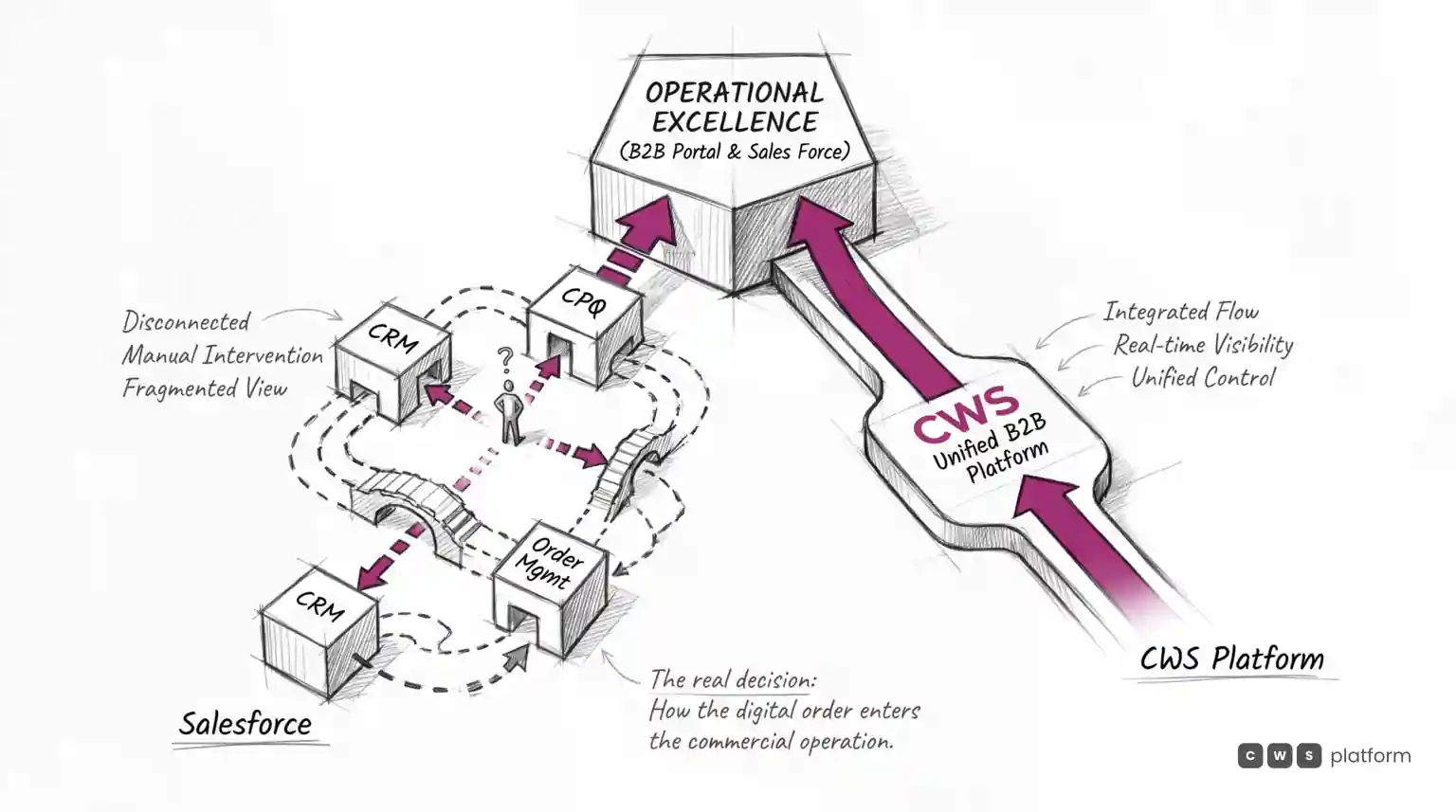
Salesforce vs. CWS Platform: Which Architecture Helps a B2B Portal Sell With Your Sales Team?
Salesforce combines a B2B storefront, buyer access controls, and enterprise sales records. CWS Platform centers the architecture on a shared cart, contextual pricing, and commercial validations before order creation. The right choice depends on which operational complexity the portal must absorb. -
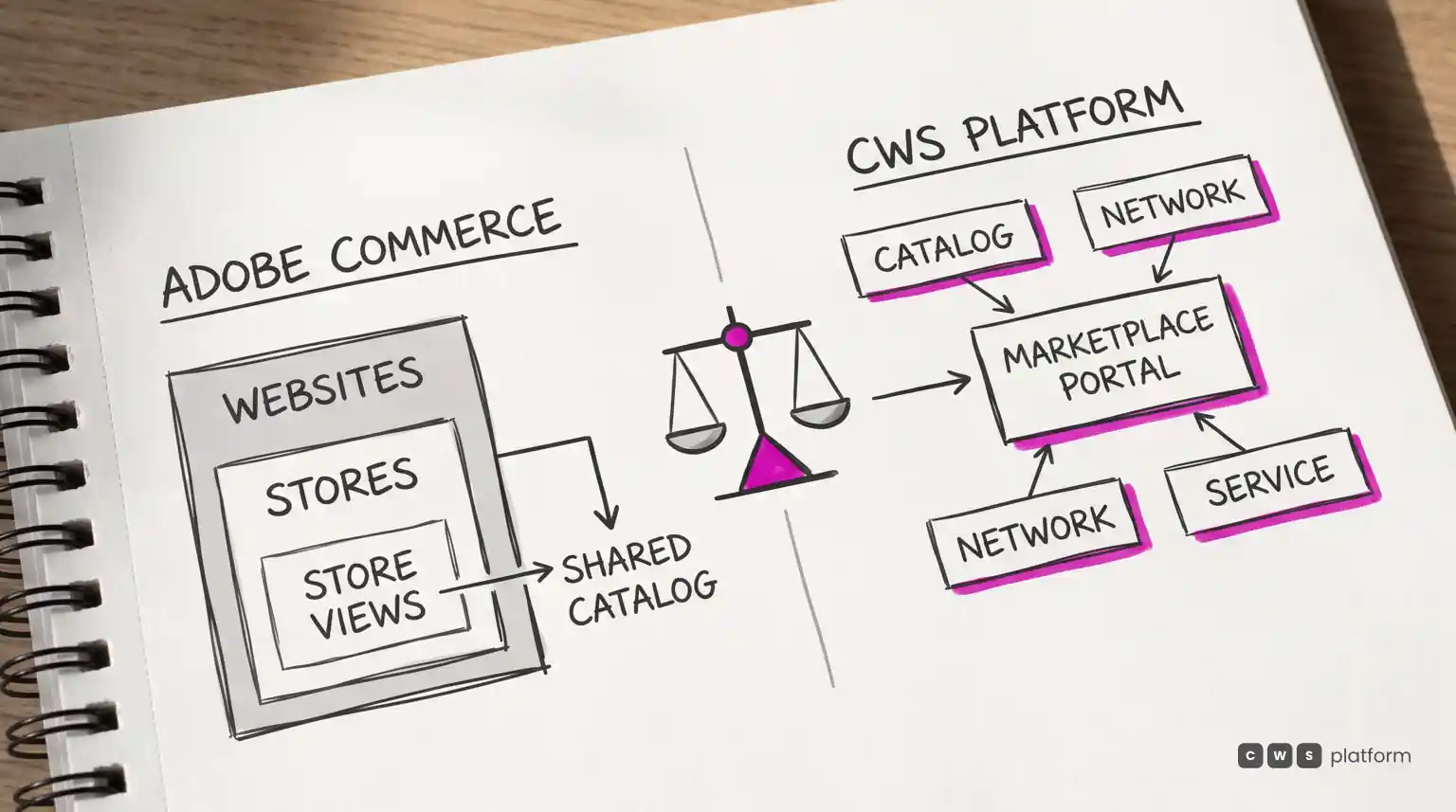
Dealer Marketplace: Adobe Commerce or CWS Platform for Catalog, Network, and Service Operations?
Adobe Commerce structures commerce through websites, stores, store views, and B2B capabilities. CWS Platform keeps fitment catalog data, regional rules, distributed inventory, assisted selling, and source-level fulfillment within the same transaction flow. -
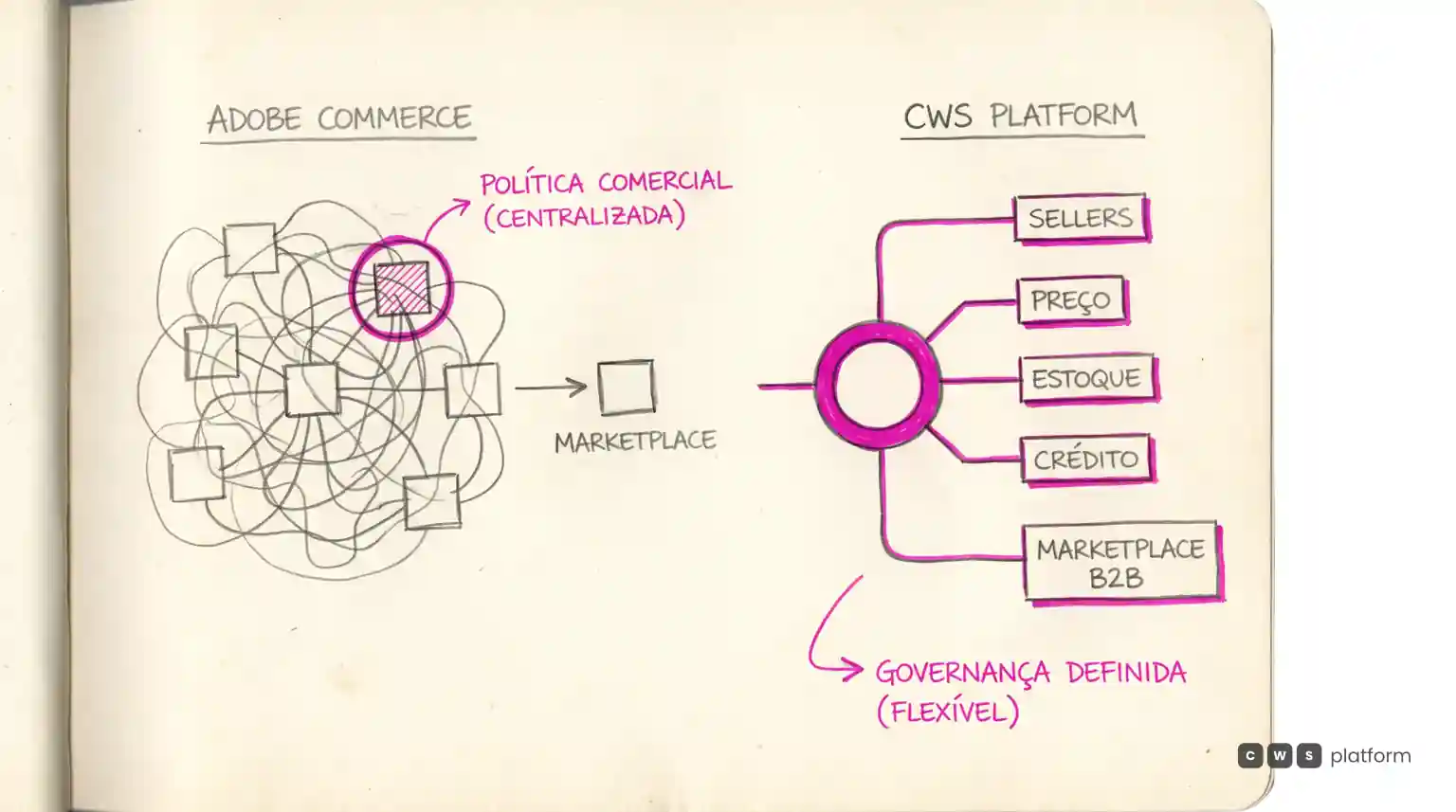
Adobe Commerce vs. CWS Platform: What Architecture Does a B2B Marketplace With Sellers Require?
Adobe Commerce centers B2B governance on company accounts, shared catalogs, permissions, quotes, and purchase orders. CWS Platform centers the operating model on sellers, offers, credit, fulfillment sources, and linked seller orders within the same transaction. -
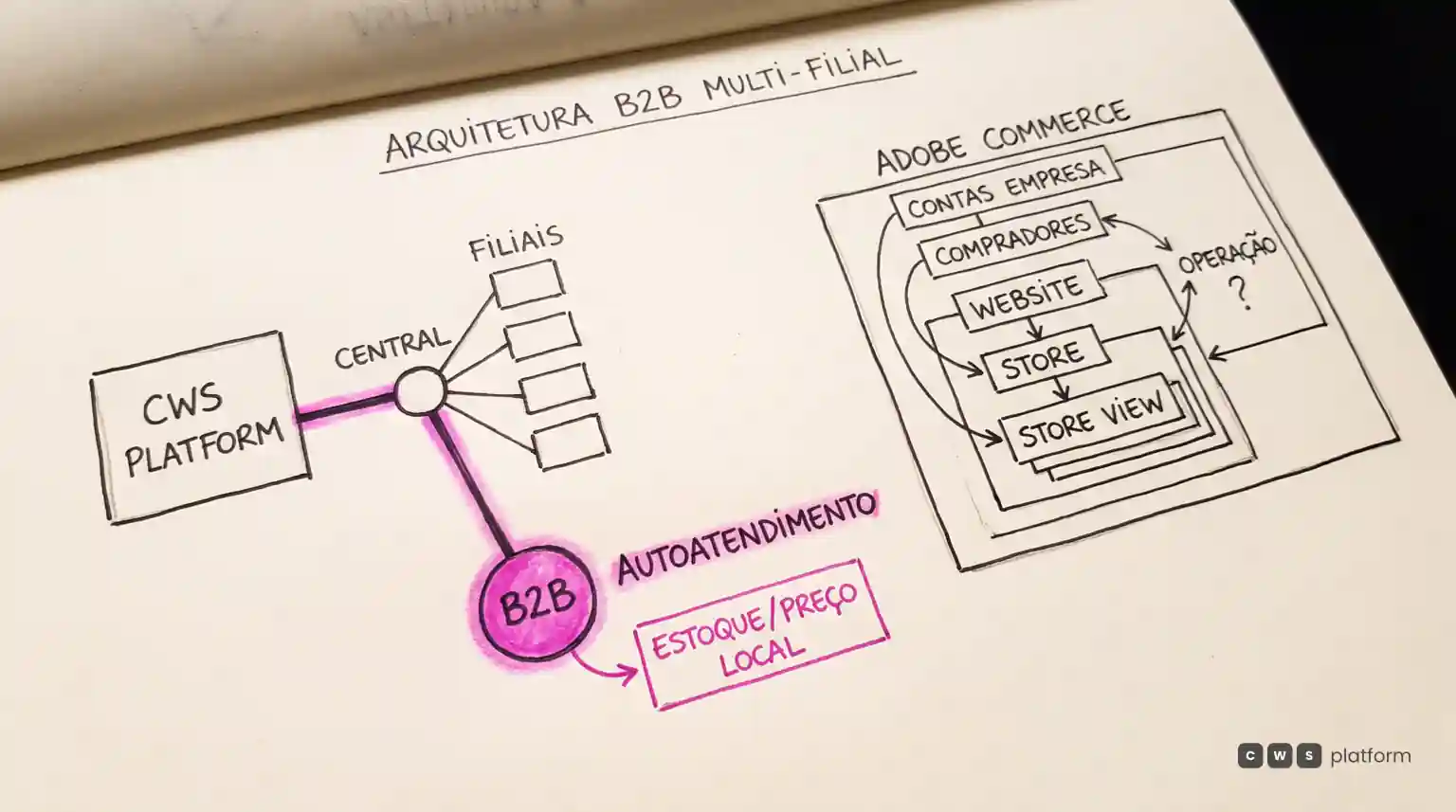
Which Architecture Keeps Location-Level Inventory and Pricing Accurate in B2B Self-Service?
Adobe Commerce structures B2B around company accounts and website and store scopes. CWS starts with the fulfilling warehouse as the executable context for inventory, pricing, credit, tax, and orders; the right choice depends on which complexity drives the business. -
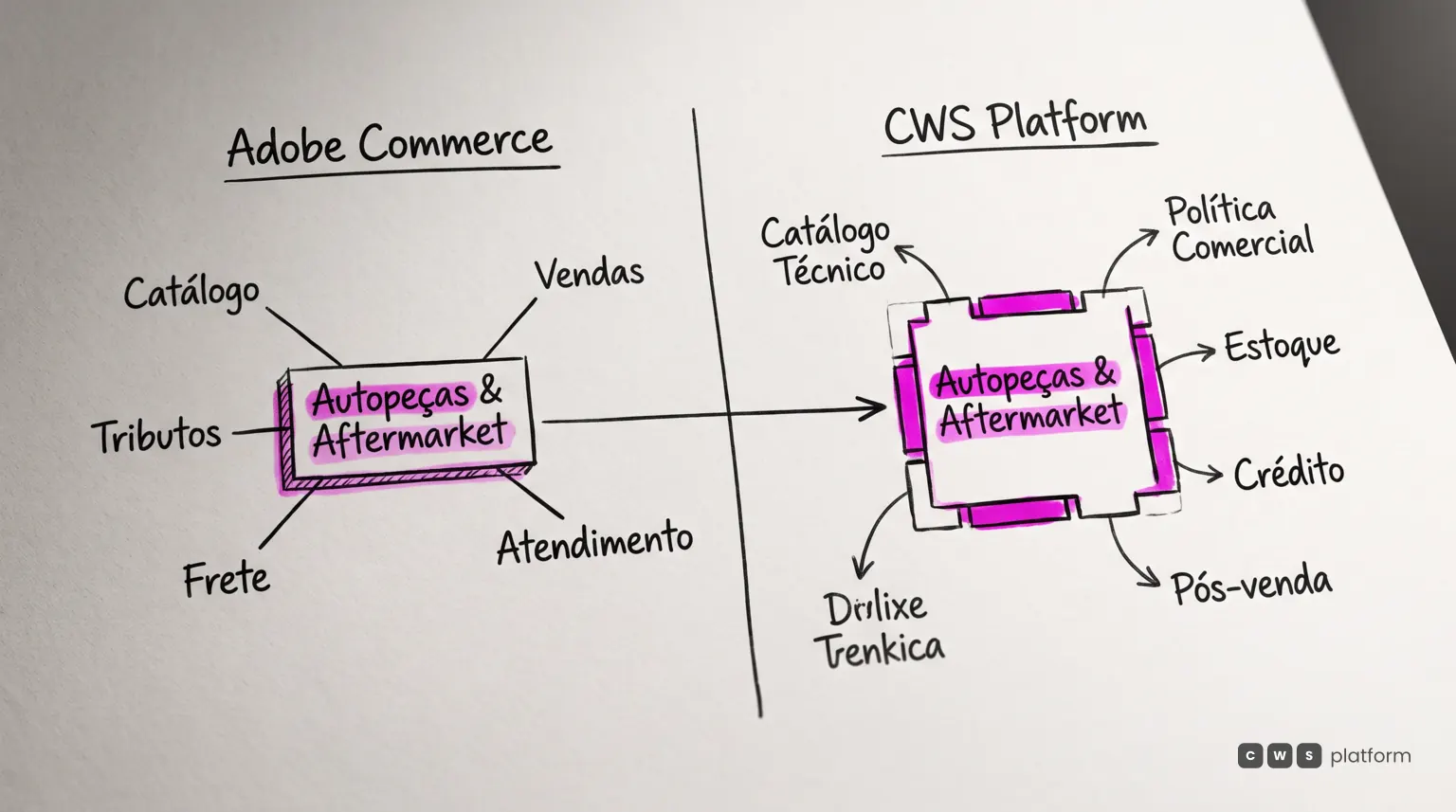
Adobe Commerce vs. CWS Platform: Which Architecture Does Auto Parts Distribution Require?
Adobe Commerce centers governance on company accounts, roles, shared catalogs, quotes, purchase orders, and multi-site structures. CWS Platform centers the contextual transaction, connecting vehicle fitment, customer pricing, warehouse inventory, credit, tax, shipping, returns, and warranties. -

Adobe Commerce vs. CWS Platform: Who Does the CEO Depend On?
Adobe Commerce emphasizes storefronts, a technical ecosystem, and code-based extensibility. CWS centers pricing, credit, inventory, approvals, and assisted selling on configurable operating rules. For a CEO, the choice depends on who should control day-to-day business changes. -

Adobe Commerce vs. CWS Platform: Where Should Replenishment Policies Run in a B2B Procurement Marketplace?
Adobe Commerce organizes company accounts, shared catalogs, negotiated quotes, and purchase orders within the commerce environment. CWS Platform connects pricing, rules, credit, warehouse inventory, and order management to validate policy within the same transaction. -
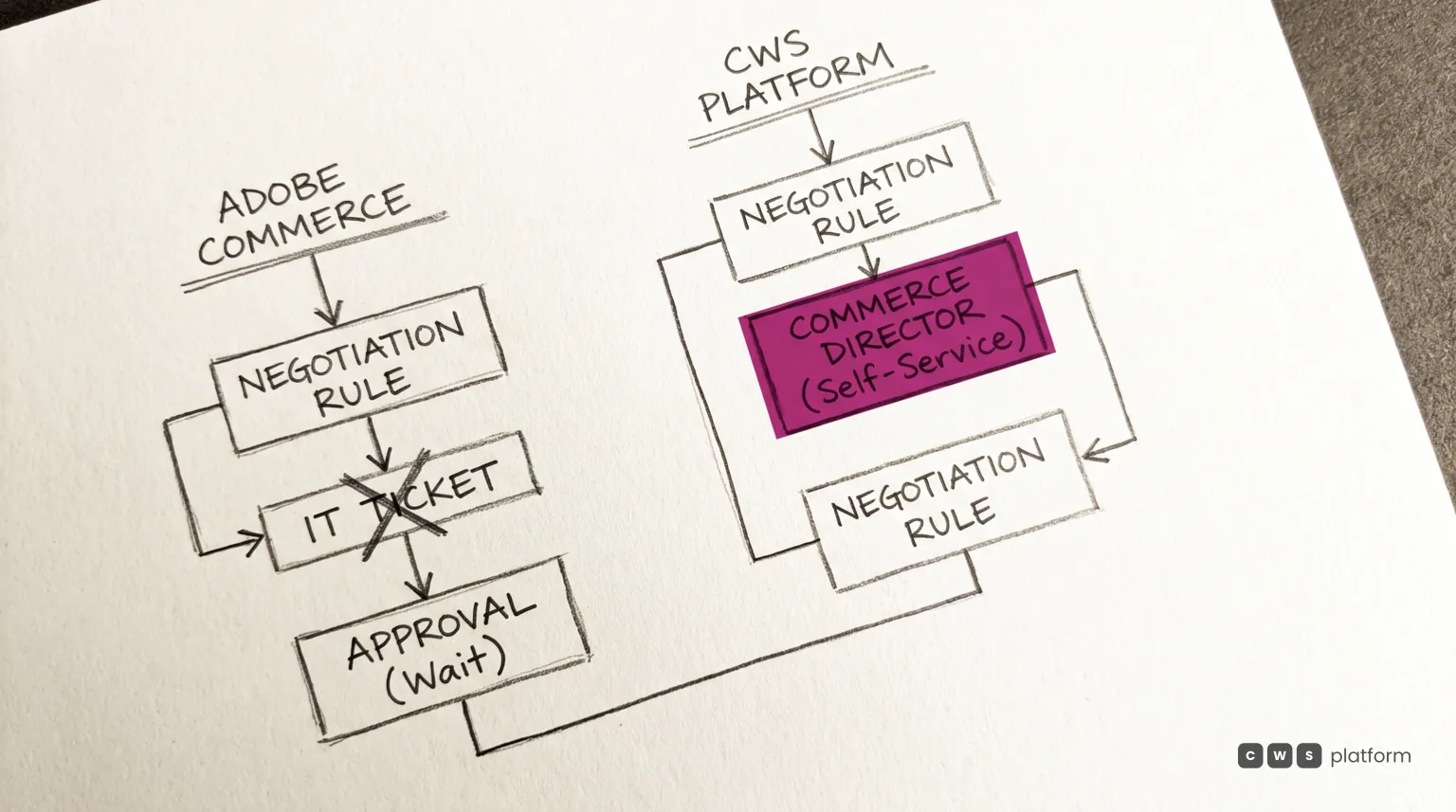
Adobe Commerce vs. CWS Platform: Can You Change a Negotiation Rule Without Opening a Ticket?
Adobe Commerce organizes B2B self-service around company accounts, shared catalogs, and bilateral quotes, per its public documentation. CWS Platform concentrates commercial policies in a deterministic rules engine with mandatory reason codes, contextual pricing, assisted selling, and a credit-first checkout. For a Director of Commerce, the practical question is where the exception is born, who can change it, and which controls follow it through order execution. -
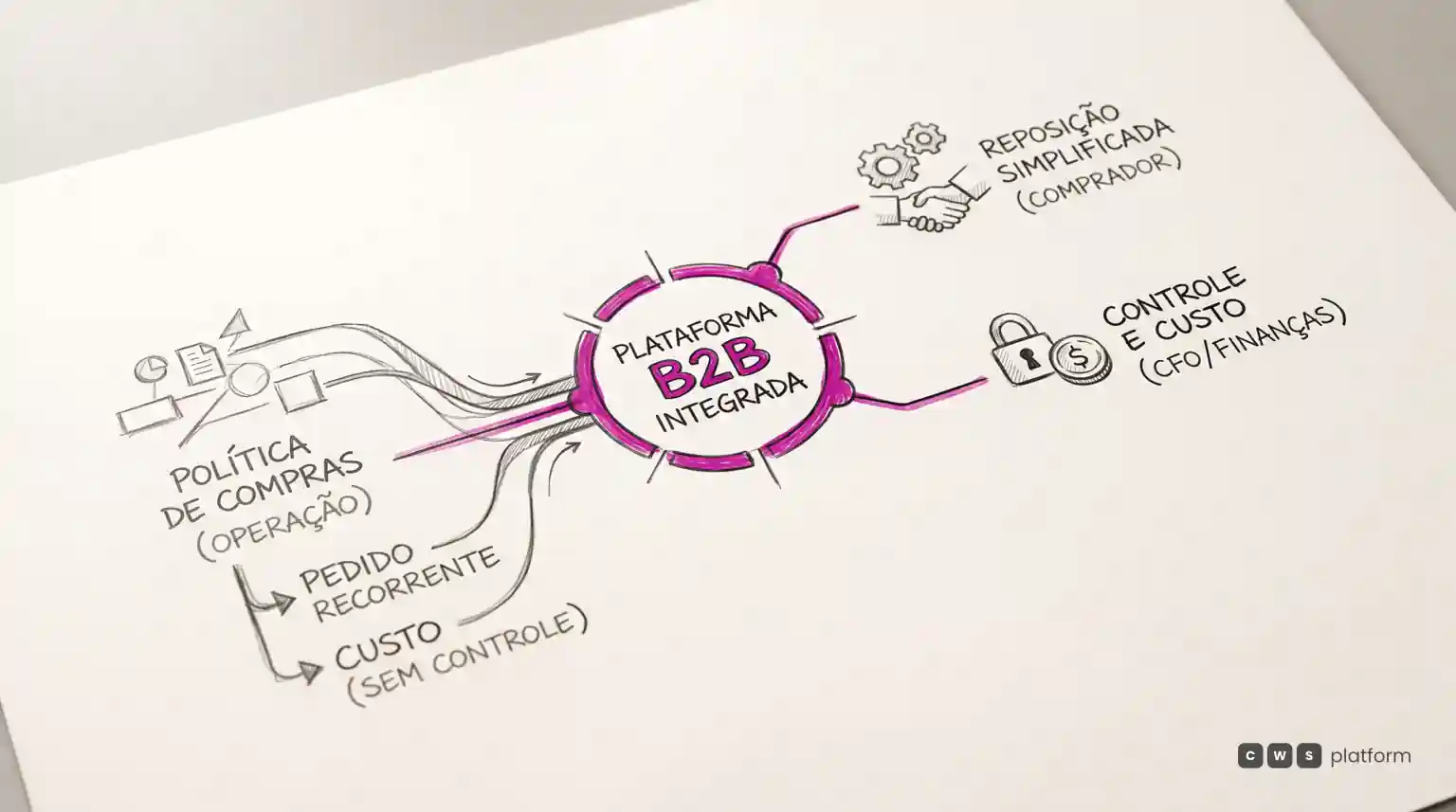
How to Cut the Cost of Every Recurring Contract Order Without Losing Procurement Control
The right benchmark for a B2B supplies marketplace is the cost of completing a contracted reorder with pricing, approval, credit, and warehouse-level availability resolved in the same transaction. Adobe Commerce documents corporate accounts, shared catalogs, and quote flows; CWS concentrates execution of the commercial policy inside the transaction itself. -

B2B Portal Meets Counter and Field Sales: Adobe Commerce vs. CWS Platform, Side by Side
In distribution, CAC often climbs because of measurement error, not weaker campaigns: when the portal, the branch counter, and field reps don't share one transaction, the sale loses its digital origin and the campaign that actually converted gets no credit. The core divergence between Adobe Commerce and CWS Platform is who computes the commercial terms at the moment of sale — assigned pricing from a shared catalog versus a pricing function with contract > rule > price list precedence. The post also names four scenarios where Adobe Commerce is the right choice. -

Seven Questions That Separate B2B Commerce Architectures
Five entirely different architectures fit inside the same 'yes' on an RFP scorecard. What separates them is where commercial logic lives: editable and executed in real time, or locked in a system of record that demands syncs and IT tickets. Seven questions — from price-as-a-function to cost per AI decision — expose that difference before the contract, with examples of strong answers and red flags. -
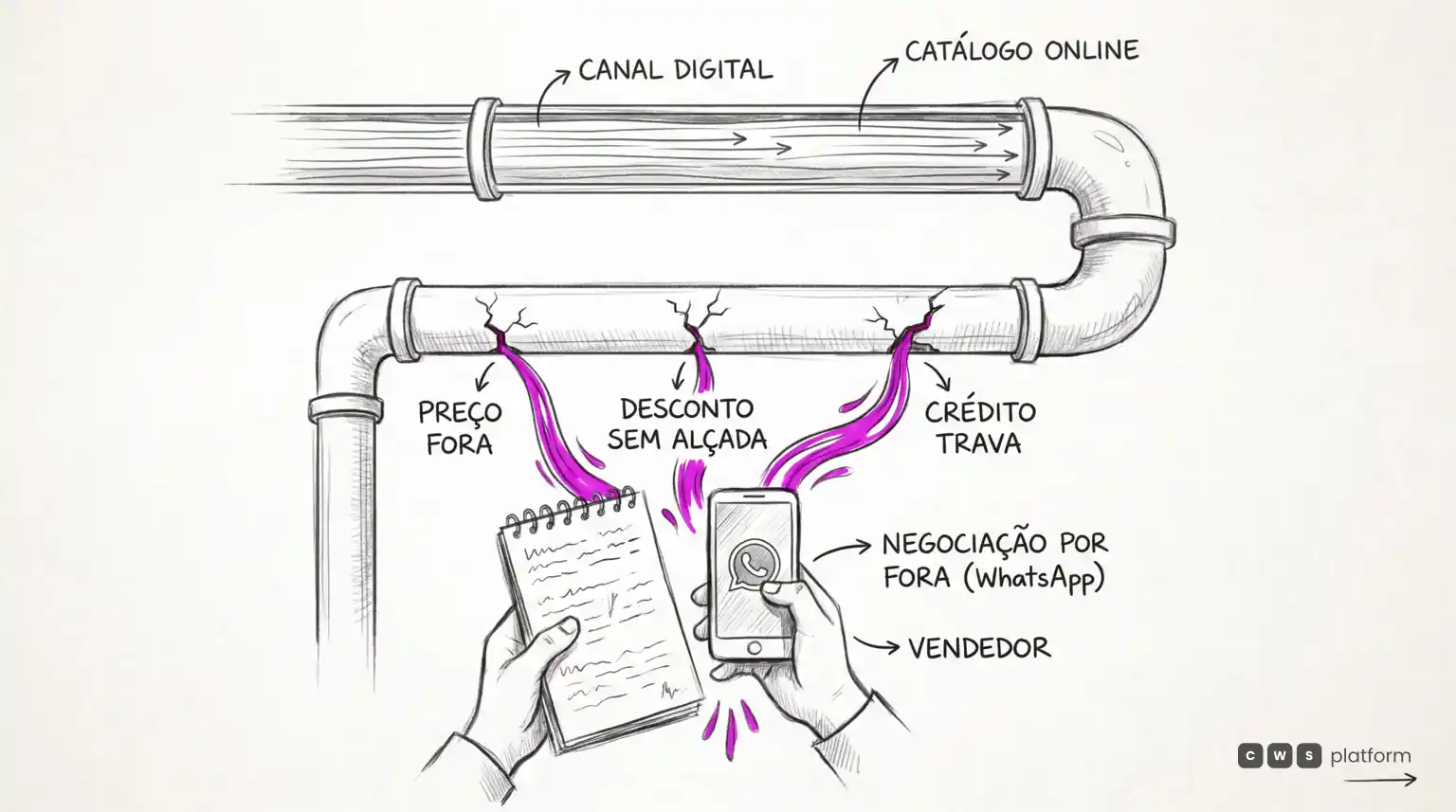
Your digital channel is live, but the deal keeps slipping through the cracks
Once a distributor goes digital, the bottleneck shifts from missing channel to missing deal governance. The signals are concrete: off-contract pricing, discounts without approval authority, credit blocking checkout, and reps operating outside the portal. The answer isn't another channel, it's architecting pricing, approval, and credit inside the flow. -

The 5 value layers of a digital platform
B2B platform value builds in layers: digital presence, governed commercial decisions, systems orchestration, secure AI, and services on top. Storefront-first projects stall at residual volume because the decision layer underneath is missing. Without governed pricing, terms, credit, and inventory, neither campaigns nor AI convert consistently. -
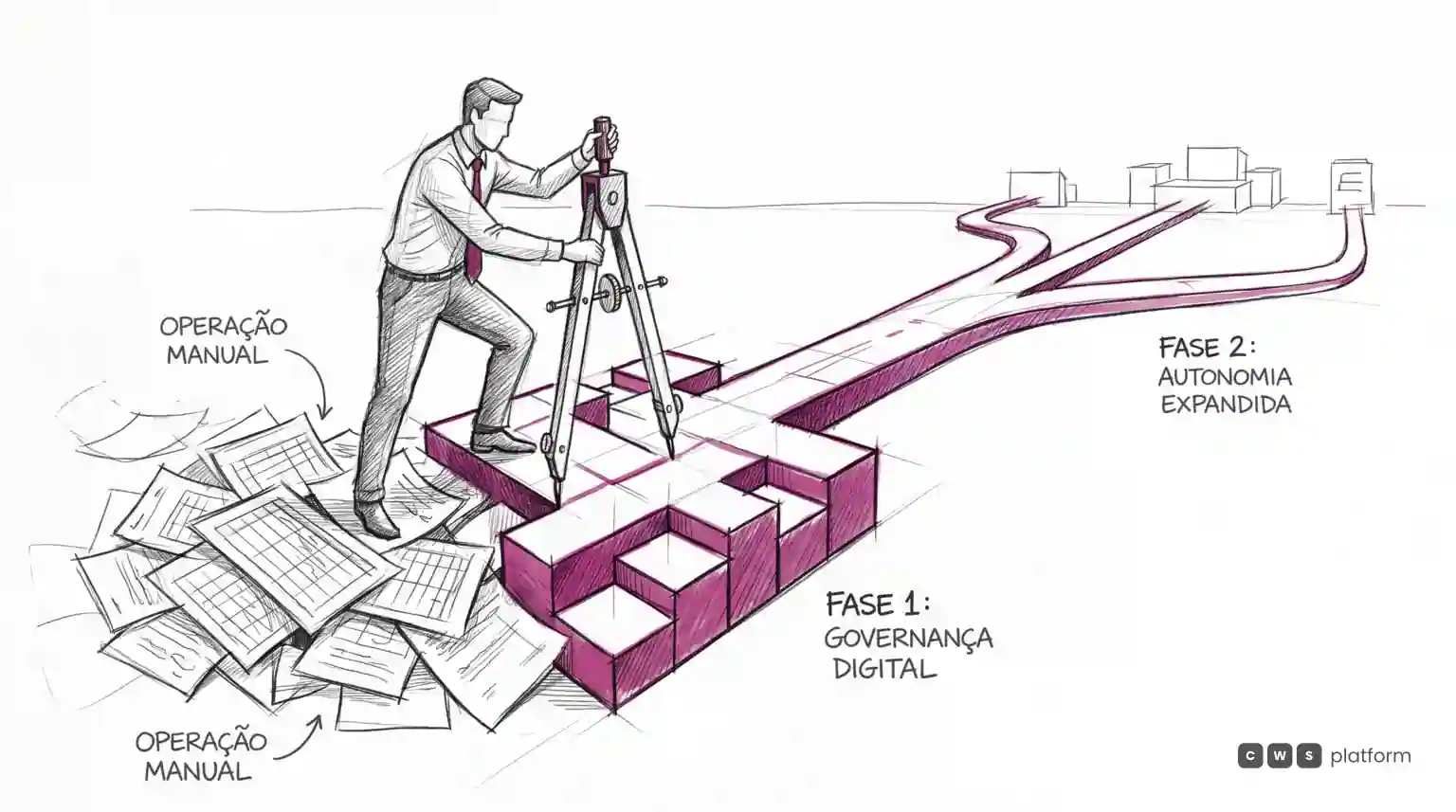
Two-Phase Digital Transformation: Sales as the Adoption Engine
Phase one structures the sales process already generating revenue and gives qualified selling time back to reps. Phase two lets buyers and AI agents execute within deterministic, traceable, and auditable guardrails. -

Digital Sales Platform vs. E-commerce: When the Storefront Can’t Close the Deal
Publishing a catalog and cart does not digitize B2B sales. The platform creates value when it recognizes the account and applies pricing, payment terms, discount, credit, and inventory rules. Governance must come before automation and AI. -

See-Try-Buy-Fly: How Customer Value Grows With Every Cycle
Customer lifetime value grows when each new buying cycle reuses the context and decisions from prior transactions. Before adding automation or channels, companies must turn their negotiation DNA into governed, auditable, and executable rules. -
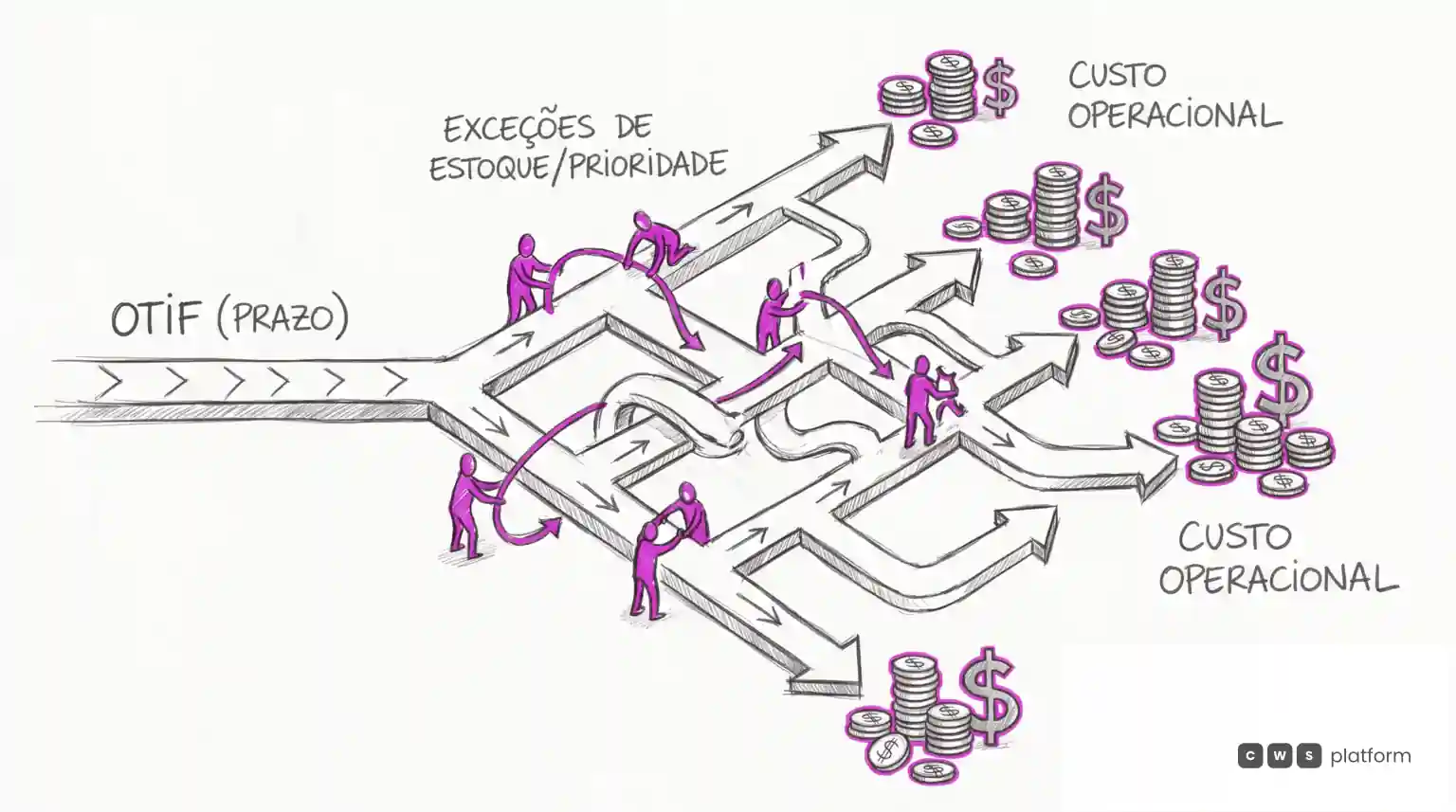
When Every New Order Ships on Time but Raises Operating Costs
Maintaining OTIF does not prove operational scalability when every order requires new scheduling, inventory, or priority decisions. AI agents create scale when they follow clear rules, decision boundaries, and escalation criteria that separate profitable flexibility from operational exceptions. -

The AI Agent Is in the ERP, but the Implementation Never Ends
Without explicit criteria, every business exception can reopen testing, integrations, and approvals. Before expanding automation, the CTO must separate inference, fixed rules, approval authority, evidence, and accountability. -

Is Your Partner Integration Moving Fast Before It’s Ready to Scale?
Partner integrations gain sustainable speed when technical support and governance are involved from the start. Before rolling the process out to the next partner, teams should incorporate lessons and corrections from the initial launch. -

Trading Desk: Incremental Revenue from Inactive Customers
Reactivating inactive customers takes more than generic campaigns or contact lists. A Trading Desk prepares offers using governed commercial rules and routes each opportunity to the branch responsible for execution, preserving local ownership while enabling incremental revenue measurement. -
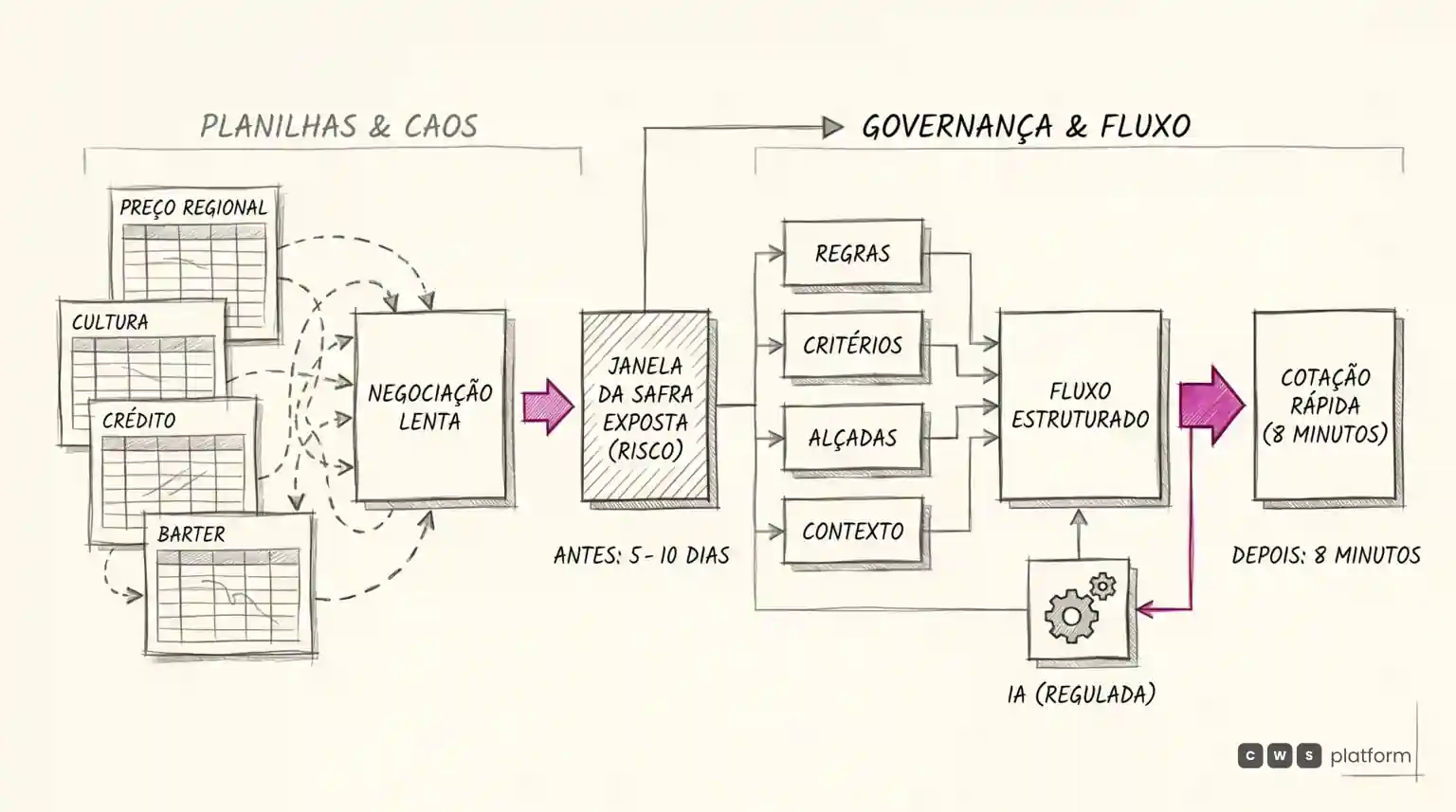
When Negotiations Live in Spreadsheets, the Crop-Season Window Is at Risk
In the public LI-966729 case, a large quote could take 5 to 10 days, while one quote that previously took five days was completed in eight minutes after the workflow was structured. AI can make field sales reps more productive when it operates within governed, auditable company limits. -
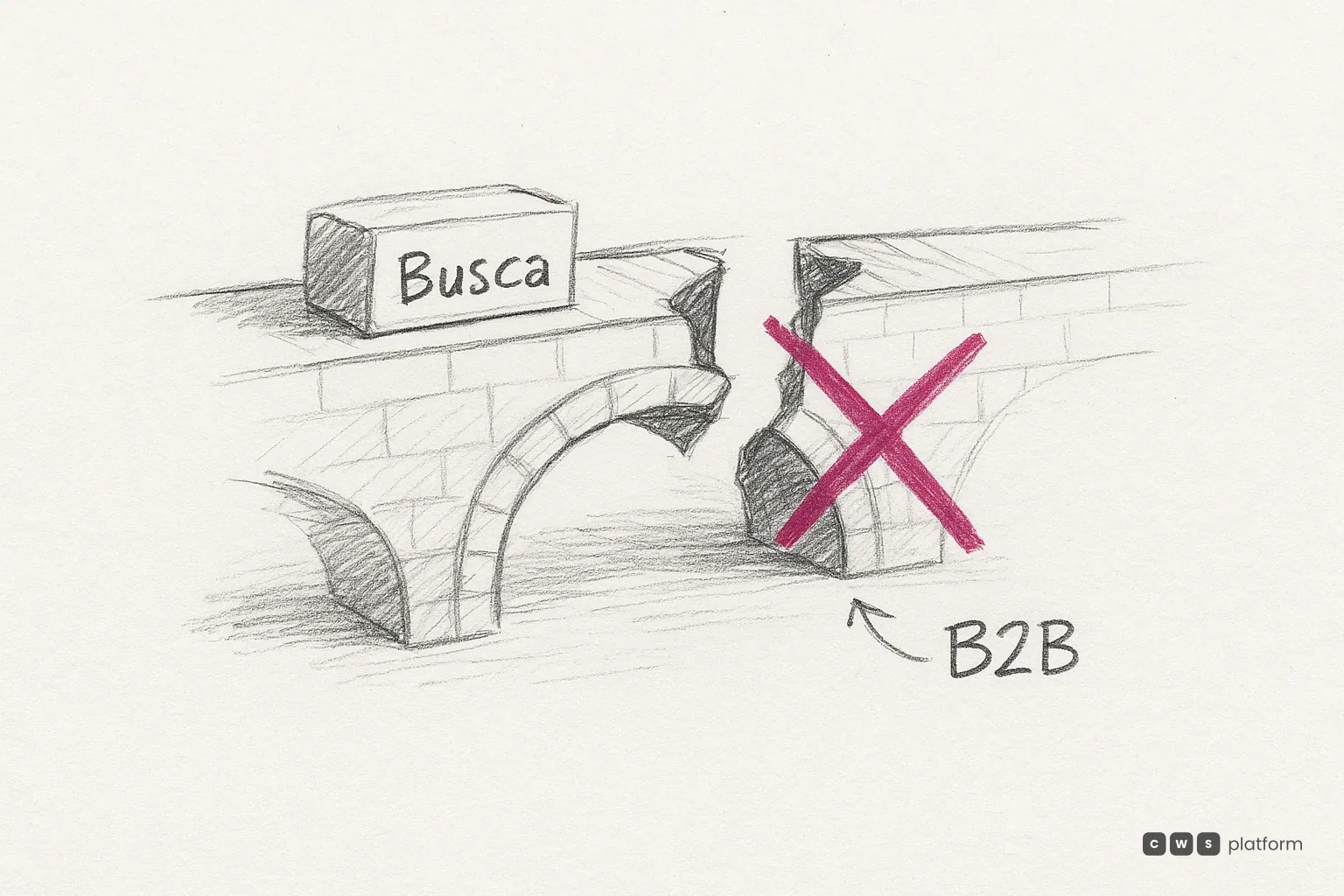
When B2B Search Works Technically but Fails the Business Case
Technical feasibility and economic viability are different assessments. Before automating B2B search, companies must define the rules behind each query, system ownership, and the recurring cost of governance and reconciliation. -

Your Manufacturing Revenue Is Growing, but Margins Aren’t
ERP and CRM systems do not prevent manual back-office work from eroding margins as revenue grows. AI agents can reduce that burden only when pricing, terms, approvals, exceptions, and human escalation criteria are explicitly governed. -
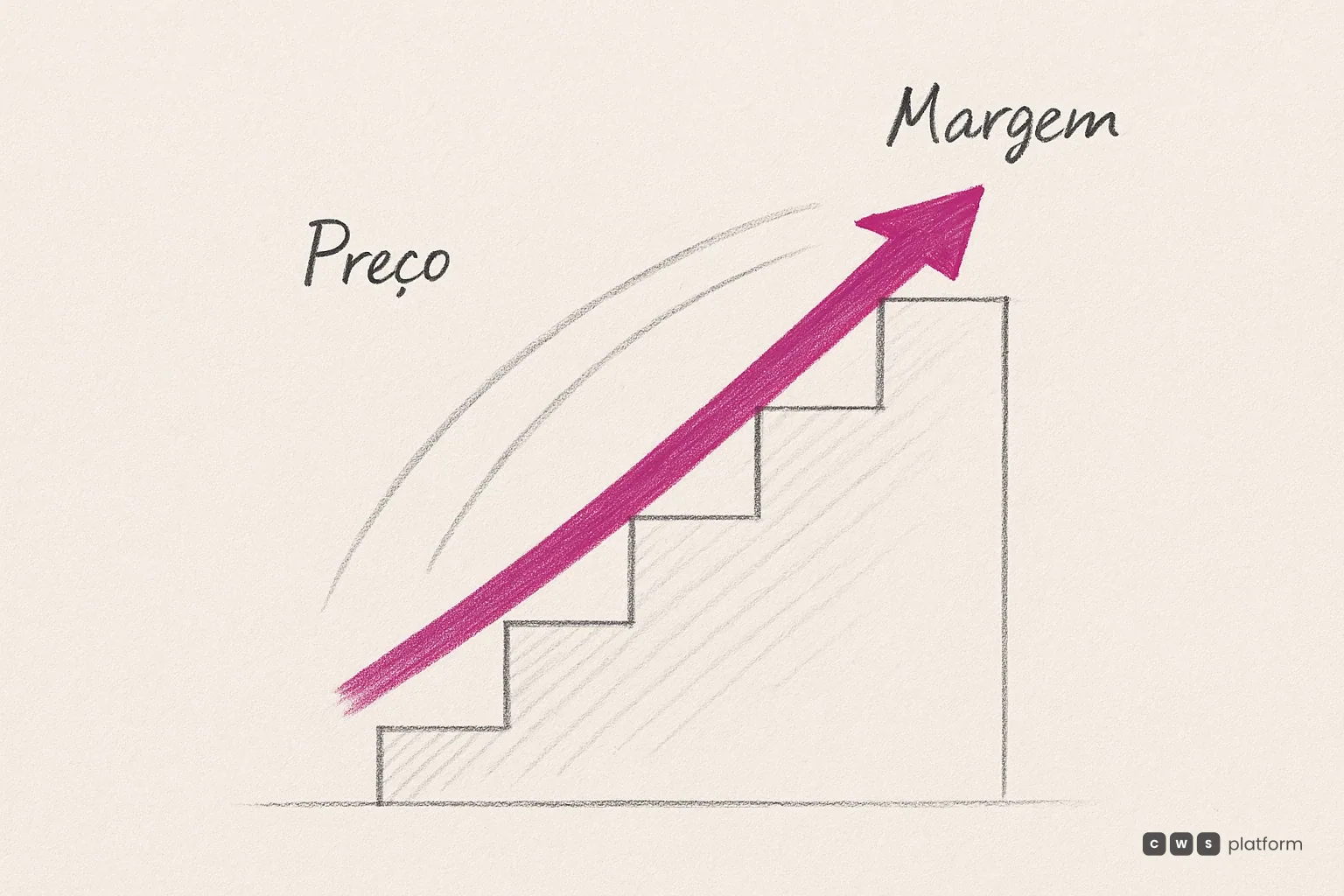
Growing Digital Conversion Without Sacrificing Margin Is Still a B2B Distribution Challenge
Blanket promotions can increase volume while concealing margin erosion. Setting terms in advance by customer segment, channel, region, and time window helps distributors show the right price and monitor economic impact during execution. -
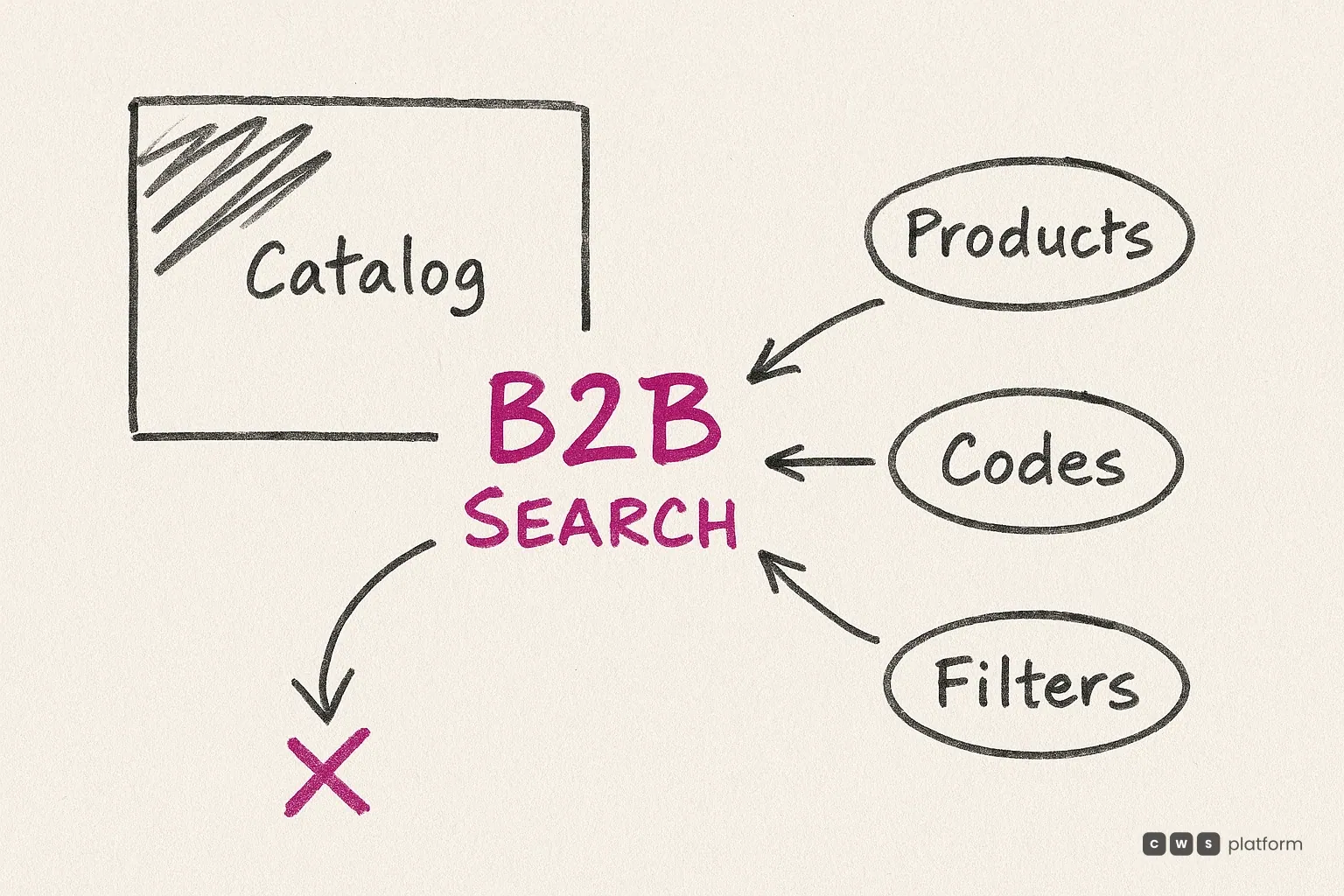
When the Catalog Breaks, B2B Search Stops Supporting Sales
Finding and negotiating the right items requires reliable product data, governed business rules, and results tailored to each authorized buying context. Progress should combine catalog quality, improvements to existing search, and assisted or conversational interfaces. -

When Every Business Unit Decides Differently, ERP Becomes a System of Record, Not Control
Replacing every ERP does not, by itself, fix inconsistent pricing, credit, and catalog decisions across business units. An orchestration layer can preserve local systems and operating autonomy while enforcing centralized, contextual, and auditable rules. -

When the Catalog Turns Chaotic, AI Starts Deciding on a Truth That Doesn’t Exist
Data access does not prove that an agent used the valid source for a specific decision. Agentic AI creates value when it operates on authorized data, explicit commercial rules, and traceable actions. -

Your Distribution Business Gains Marketplace Volume but Loses Margin Along the Way
A marketplace can serve as a demand source, while the direct channel builds relationships, repeat business, and margin. Distributors need channel-specific terms, margin floors, and approval rules before automating offers and orders. -
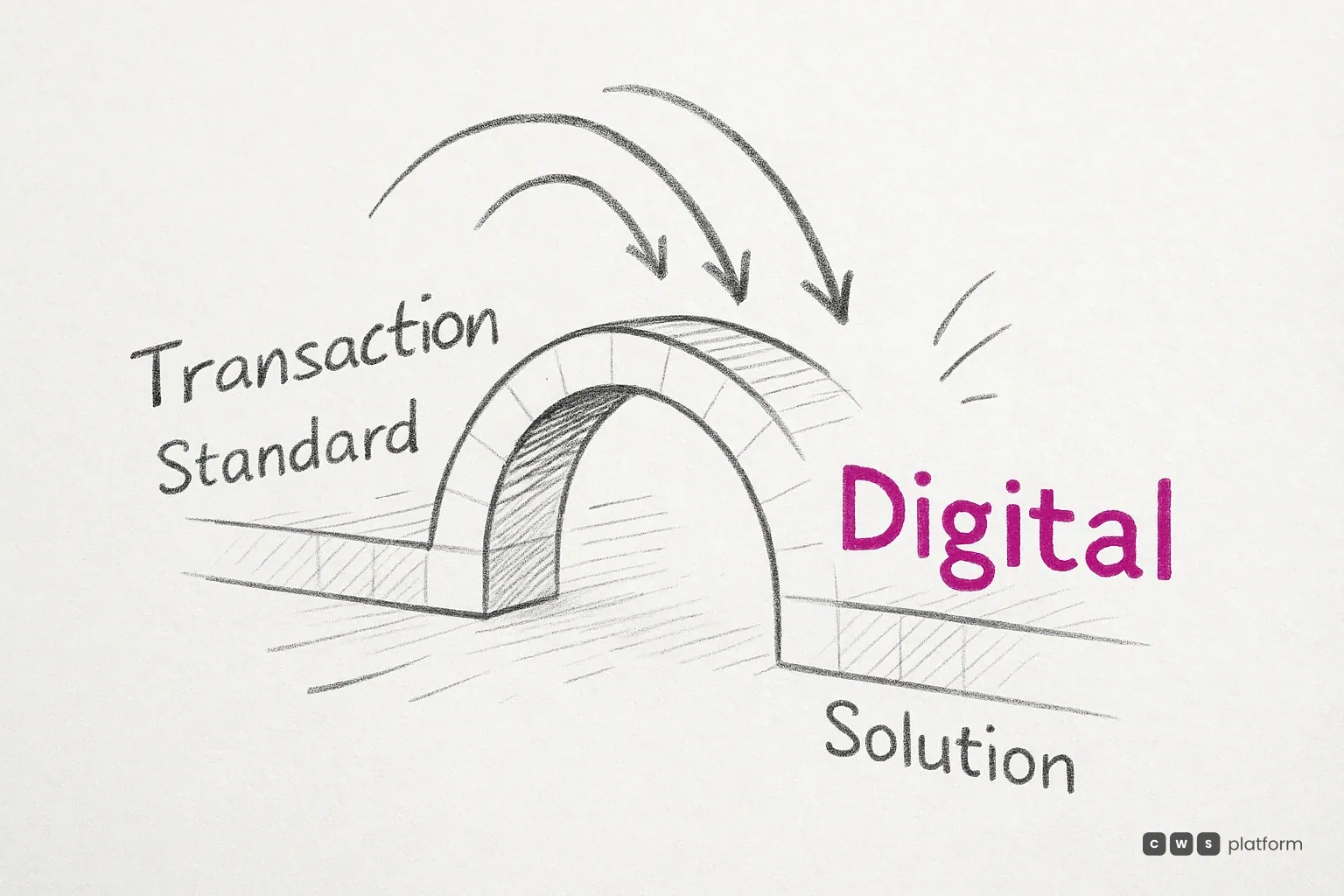
The Transaction × Product Matrix: Where Digital Actually Pays Off
B2B digital initiatives fail when they start in the wrong place. A simple transaction × product matrix shows immediate value lives in repeat/standard orders. Digitize that quadrant first; consultative and first-time complex deals come later. -
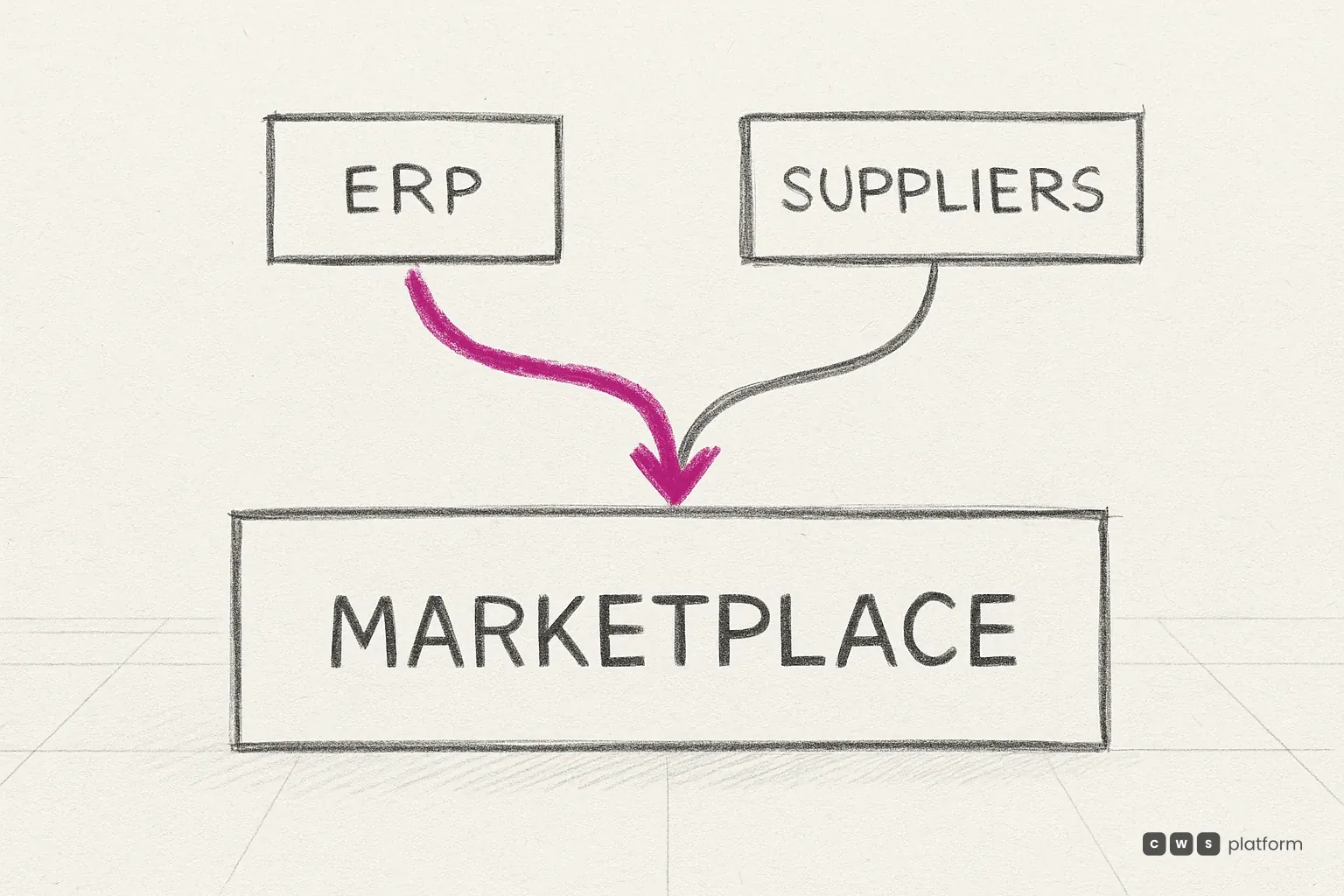
Marketplace Is an Outcome, Not a Goal
Companies that treat “launching a marketplace” as the destination often stall after go-live: thin GMV, reps still on text and email, and leadership questioning the spend. The real asset is the existing network of buyers, sellers, and suppliers; the marketplace only scales when that network is digitized end to end. Frame marketplace as the state of a digitized operation—not a storefront project—and sequence, cost, and adoption change. -
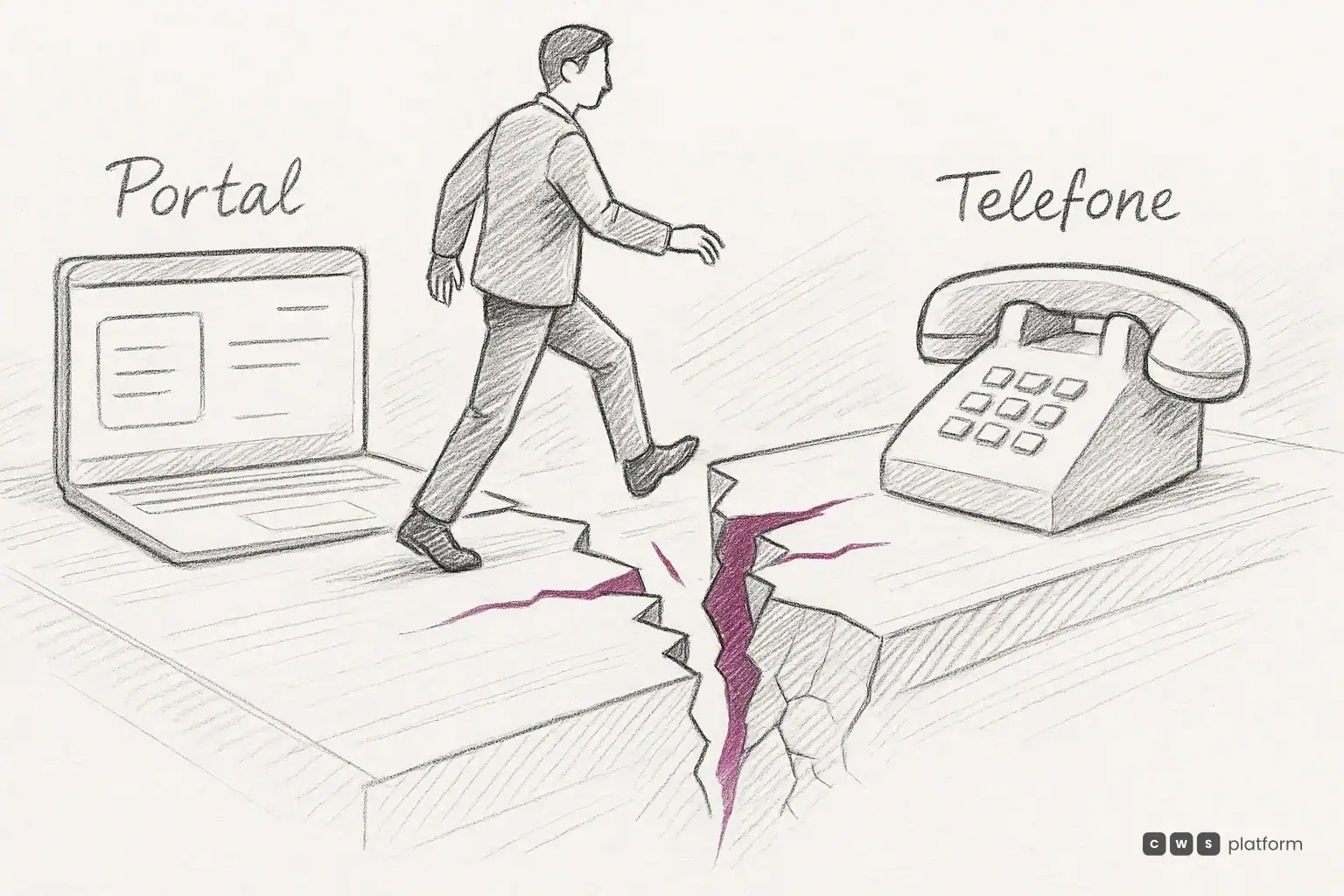
The portal says it’s in stock. The phone confirms it isn’t.
If the B2B portal and operations don’t share catalog, price, and availability, buyers and sellers end up on the phone. Every manual confirmation turns a digital order into rework and raises cost-to-serve. Governing commercial rules before automating the storefront keeps the catalog from becoming operational chaos. -

When an AI Agent Fails, the Error Doesn't Stay Isolated: It Replicates Across Every Order
AI agent autonomy without deterministic commercial governance turns isolated mistakes into systemic errors that compound silently. The cost accumulates through unauthorized discounts, unhomologated suppliers, and policy exceptions treated as rules. The solution: establish commercial policy (pricing, credit, catalog) before the agent executes. -
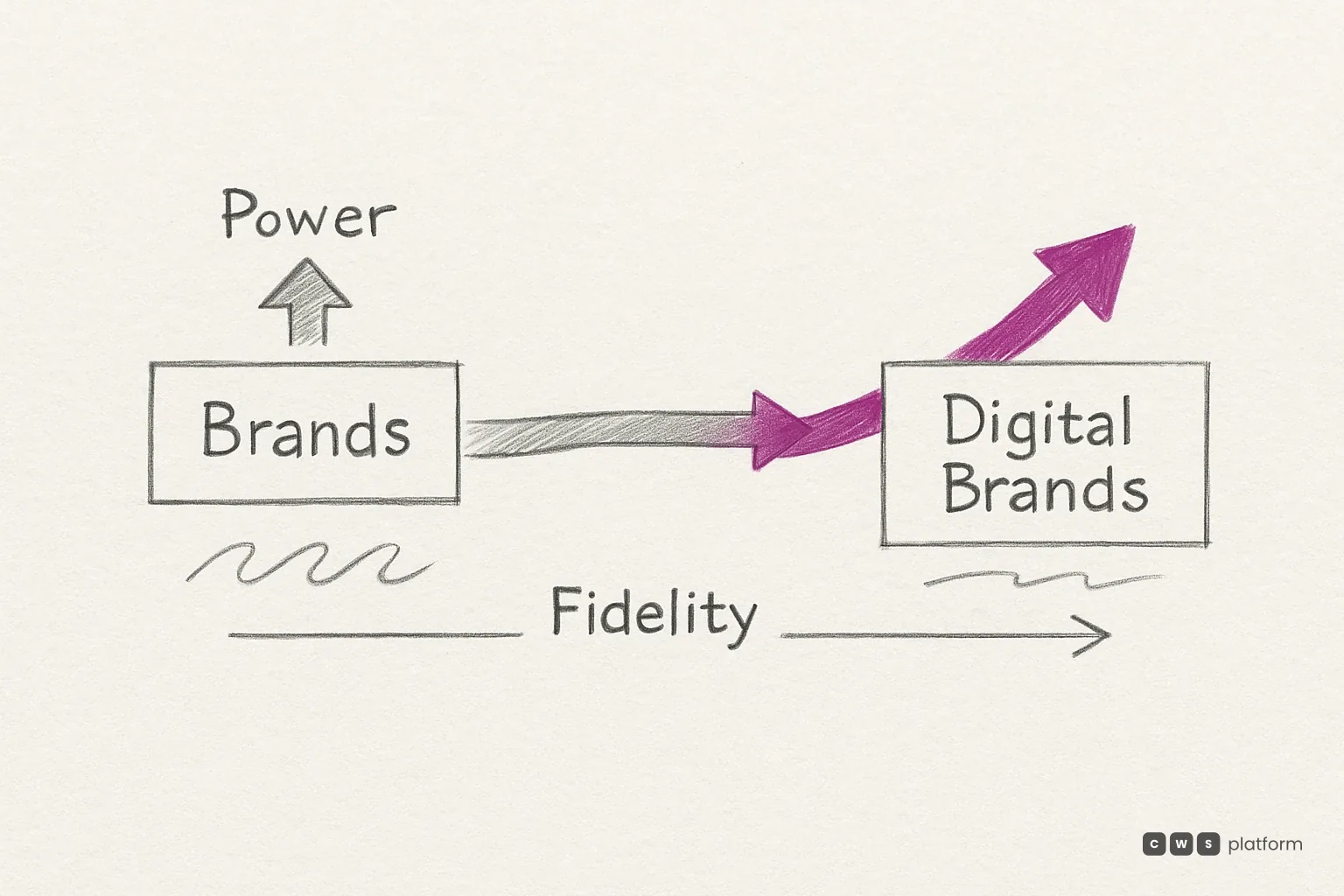
The Evolution of Power and Loyalty (By Decade)
Bargaining power shifted from brands and retailers (2000s) to consumers via marketplaces (2010s), and now to customer-centric digital brands (2020s). Loyalty stopped being a switching barrier and became continuous engagement that lowers transaction costs over time. -
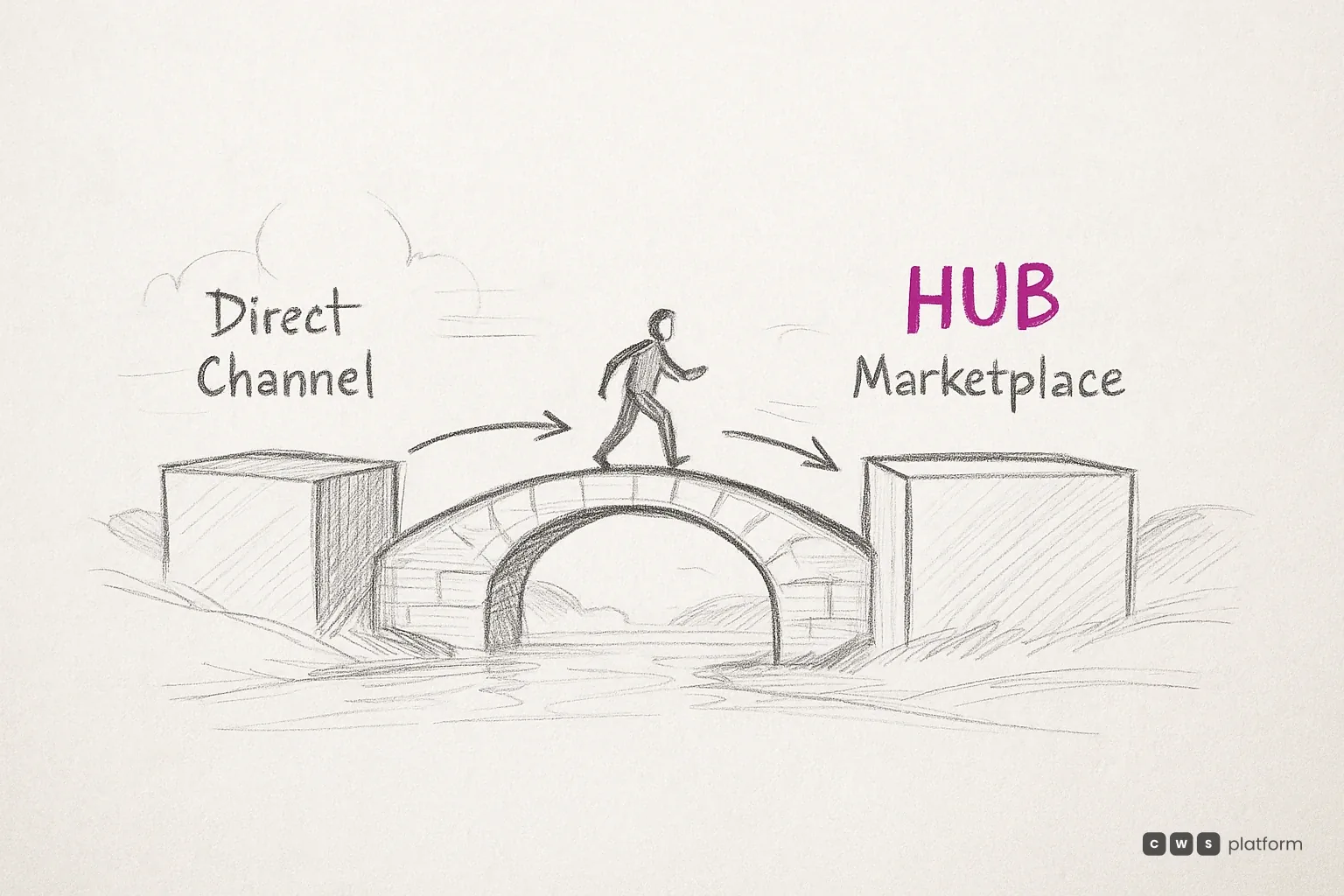
Third-Party Marketplaces as a B2B Demand Channel
Third-party marketplaces concentrate qualified demand you won't recapture by investing more in your own portal. The right thesis isn't 'own channel versus marketplace' — it's using the marketplace as a demand origin and your channel as where margin is built. Without price governance and channel-specific commercial terms, running both simultaneously erodes margin on both sides. -

When the Agent Makes a Mistake, the 10-K Records It: What WESCO Teaches Us About Governance Before Automation
WESCO International, a $22B industrial distributor, named agentic AI as a strategic risk in its annual 10-K filing. The core issue isn't the technology itself — it's the absence of deterministic pricing, credit, and approval-authority rules defined before any agent is allowed to act. Without that governance layer, automation amplifies errors rather than eliminating the cost of sales. -
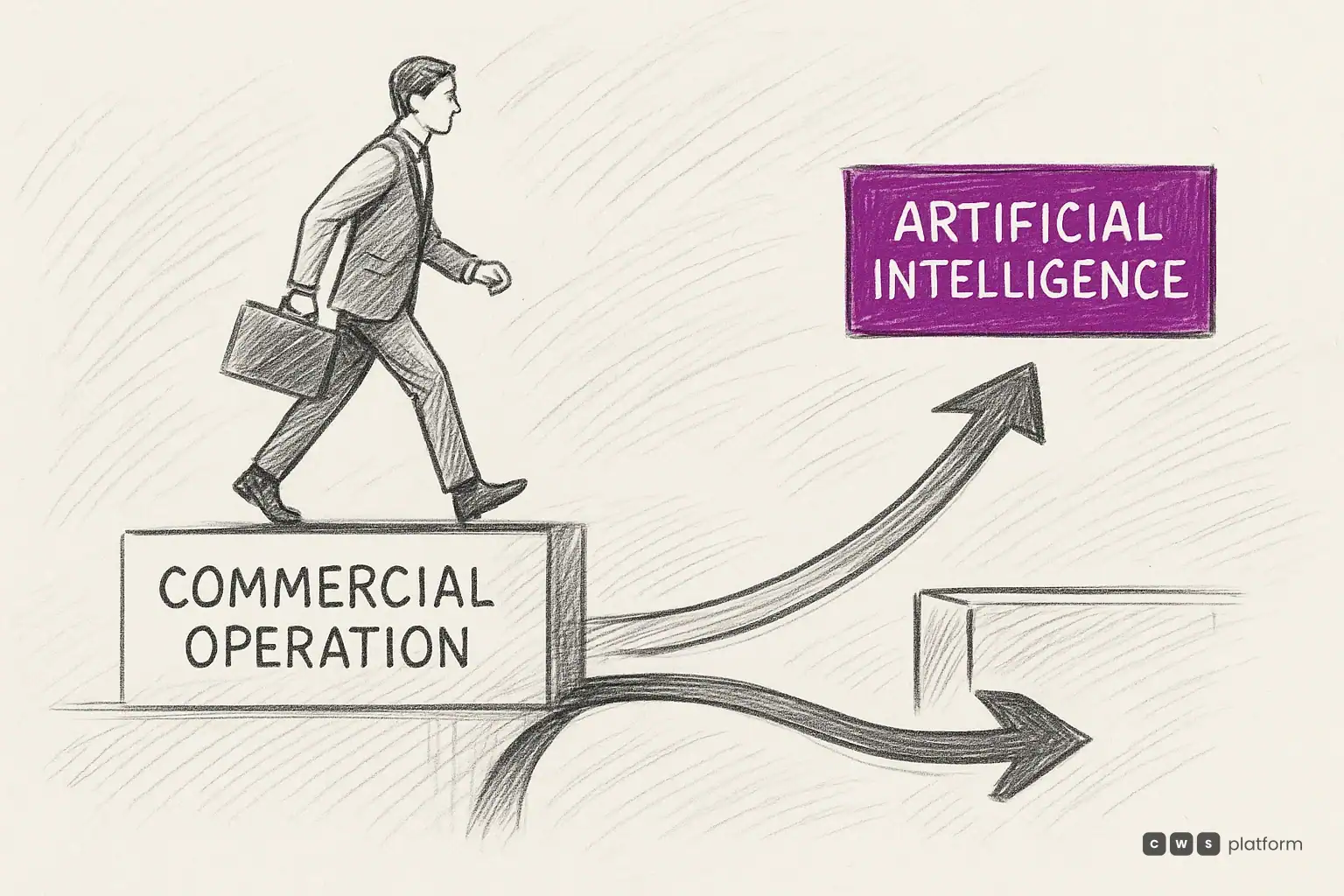
When the AI Model Decides Who Shows Up First, What Does Your Commercial Operation Have to Show?
AI models and AI Overviews are replacing entire qualification steps in the B2B buying process, consuming structured documentation before any human interaction. Vanta's case shows that a governed content base generated an estimated $517K/month in organic traffic value and activated 2,603 keywords in AI Overviews. For B2B operations, the durable advantage lies not in picking the right AI model, but in building the structured, auditable information substrate those models consume. -
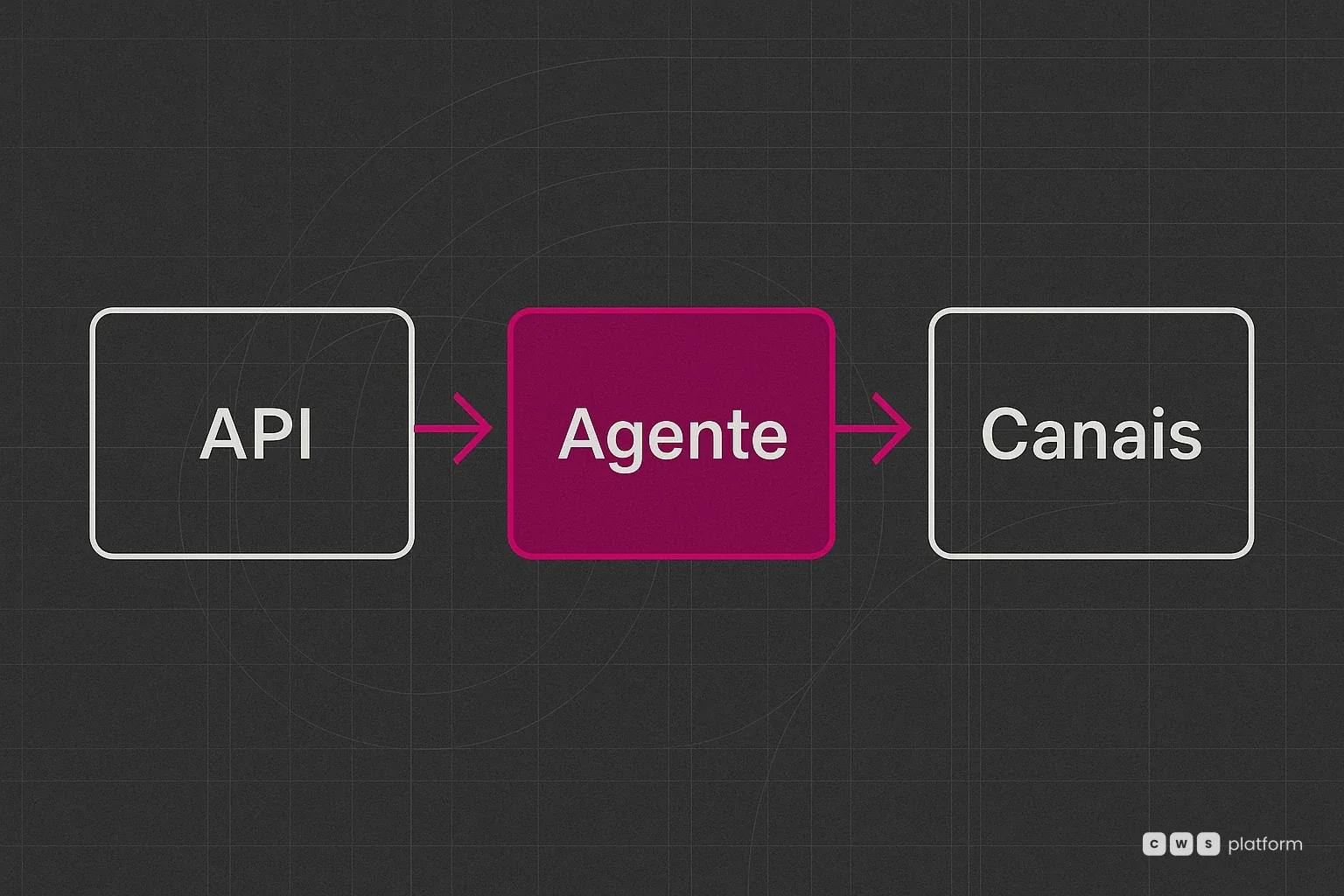
Your AI Agent Will Cut the Same Side Deals Your Sales Reps Already Do
Falling AI inference costs have made conversational agents a short-cycle initiative for B2B commerce leaders. But an agent deployed on top of an ungoverned pricing and exception structure will replicate the same off-system deals reps already make — faster, at scale, and without human judgment as a backstop. The prerequisite isn't channel technology; it's formalizing negotiation rules before any interaction gets automated. -

Your B2B portal accepts orders that will never close
When dealers and service shops can't see their available credit or payment terms before building an order, they submit requests that can't be approved as submitted — wasting sales rep time and eroding trust in the digital channel. Surfacing credit status, payment terms, and limits in real time, for both buyer and seller, is a closing factor, not an operational footnote. -

You're trying to build a marketplace when what you actually need is a sales ecosystem
A B2B marketplace is not a business model — it's a feature that can emerge from a well-structured commercial operation. The right starting point is digitizing the existing sales process, using the sales rep as the demand pivot, and adding third-party inventory only when real demand already exists and your own stock can't fully cover it. Without formalized pricing, credit, and exception rules in the system, the ecosystem won't scale regardless of how many supplier partners are connected. -

When an AI Agent Negotiates on Your Behalf, Who Sets the Limits?
AI agents are being deployed to handle B2B negotiations without human approval at every step, and adoption is accelerating fast. The real risk isn't the technology itself, but the absence of codified margin rules, contextual pricing, and negotiation authority before the agent goes live. In B2B, delegating without structure doesn't mean scaling with intelligence — it means handing improvisation to a machine. -

Your B2B Portal Is Live. The Governance It Needs to Actually Work Isn't.
Launching a B2B portal without structuring commercial governance keeps pricing negotiations in text messages and inside reps' heads, invisible to the ERP and to any meaningful analysis. The right sequence is to formalize pricing rules, credit limits, and exception workflows in the system first — then improve the buyer experience. Operations that followed this order report going live in weeks, not years, with real productivity gains that don't depend on rep availability. -

Your B2B Channel Is Growing. Your Margin Isn't. The Problem Starts Before the Order.
GMV growth paired with declining per-order margin signals that cost-to-serve is outpacing revenue. Manual exceptions, headcount scaling in lockstep with the book of business, and SLAs that depend on who's on duty are the visible symptoms of governance living outside the order flow. Embedding pricing, inventory, credit, and delivery rules as a system layer — not a parallel manual process — is what separates scalable growth from growth that gets slower and more expensive over time. -

The never-ending implementation and the board still waiting for ROI
Agentic AI moves fast — and that only accelerates the moment your operation stalls if pricing, credit, and exception policies aren't codified before deployment. The recurring bottleneck in B2B isn't technology capacity; it's commercial policy living inside your senior reps' heads instead of in the system. The right board question isn't 'when does the system go live?' — it's 'when will our business rules be ready to run without a human in the loop?' -

Your B2B digitization project never goes live because commercial decisions were never mapped
B2B implementation projects stall because no one mapped who approves pricing, credit terms, and exceptions before integration began. Every uncharted business rule becomes a new ticket, a new cycle, and another quarter without production launch. The fix is treating commercial governance as a required deliverable before any architecture decision is made. -

The buyer came, clicked through three systems, and left. Your campaign already paid for that.
True CAC includes opportunities lost to order friction, not just the cost per lead. Every extra system a B2B buyer must navigate to close a purchase acts as a silent tax on conversion. The root cause is rarely a lack of purchase intent — it is operational friction at the exact moment the buyer has already decided to buy. -

The sales rep who approves everything alone is the bottleneck hiding in your P&L
Sales reps aren't leaving the B2B process, but they can't keep being the sole repository of commercial policy. When pricing rules, credit limits, and exception workflows move into the system, average order cost drops and productivity scales without adding headcount. Inaction compounds: the longer an operation grows with informal rules, the more expensive the fix becomes. -

Digitizing an Agricultural Co-op Without Governing the Negotiation Just Trades One Problem for Another
Co-ops modernize crop monitoring and logistics while leaving their core revenue engine — member commercialization — running on spreadsheets, WhatsApp, and tribal knowledge. Digitizing workflows without encoding pricing policy, credit limits, and exception rules into the system creates an illusion of control. Governance of the negotiation, not the technology itself, determines whether digitization drives efficiency or simply relocates the problem. -

Your Operation Scaled. Your Pricing Governance Probably Didn't.
Flat pricing across different customer profiles isn't fairness — it's context-blindness that silently surrenders margin. Informal deal-making without auditability turns discounts into habits and margin into an unmanaged variable. Pricing governance isn't a smarter spreadsheet; it's differentiated logic by segment, channel, and timing, embedded directly into the negotiation workflow. -

The AI Agent Confirmed the Order. The Price Was Wrong.
Agentic AI treats the product catalog as the source of truth; if the catalog shows a list price instead of the negotiated contract price, the agent confirms the wrong order at scale. The follow-up correction call isn't an operational edge case — it's evidence that the data was consumed before it was ready. A governed catalog is the prerequisite for any commercial automation to work. -

Your ERP Is Full of Data and Empty of Decision
ERP and governance are complementary layers: the first stores the record, the second intercepts the commercial flow before invoicing and enforces pricing policy, credit limits, and approval thresholds. Scaling B2B portals without that rail in place amplifies the lack of control. The right sequence is governance before channel. -

Your Sales Rep Is Still Building 100-Line Orders by Hand
When a sales rep spends more than 40% of the day on manual order entry, internal transaction costs are eating the competitive advantage that should live in the customer relationship. Digitizing the order channel without pricing governance only amplifies margin-destroying transactions at scale. The answer is not replacing the rep — it is giving the platform the rote work so the rep can do what only people do. -

The distributor that doesn't die from tech disruption dies from high operating costs
B2B distributors aren't losing ground because manufacturers go direct; they lose ground when their transaction costs exceed those of the competitor down the street. Scaling digital volume without pricing governance doesn't fix fragile margins — it amplifies them at a speed the legacy channel never could. Competitive advantage in distribution is shifting from catalog breadth and rep relationships to operational architecture. -

The Knowledge Stuck in Your Sales Rep's Head Is Your Biggest B2B Bottleneck
The B2B sales rep has become the unintentional repository of the company's commercial rules, turning every transaction into a human-dependent bottleneck. Moving that knowledge into the buyer-facing portal lowers cost per negotiation, enables auditing, and repositions the rep to focus on higher-value work. As long as rules stay implicit, revenue growth requires proportional headcount growth. -

Your sales team runs AI, but the data it needs is still inside the rep's head
AI tools for quoting and sales support are already in use across auto parts distributors and dealers, but output quality depends entirely on a data foundation that most operations haven't built yet. When the standard CRM can't serve as a reliable source for AI agents, teams improvise with spreadsheets and shared drives — creating technical and operational debt that compounds as automation scales. Formalizing commercial governance is a prerequisite for AI to perform well, not a byproduct of running it. -

The Seller Who Joined the Platform and Never Made a Sale
The biggest barrier to SMB seller activation on B2B platforms isn't technology — it's real process adoption. Resistance to catalog uploads, the mistaken belief that the platform drives traffic automatically, and low operational maturity keep sellers registered but idle. The problem is silent, recurring, and almost never shows up in network expansion reports. -

When AI Agents Negotiate Without Rules, Every Mistake Scales
AI agents process commercial decisions at a speed and volume that makes real-time human review impossible, turning one-off errors into systemic losses. Grainger's Endless Assortment model works because catalog, pricing, and deal terms are governed before the agent acts. The strategic question isn't which AI agent to deploy — it's what rule structure the agent will operate within. -

Your AI Agent Will Negotiate Using the Same Rules You Can't Audit Today
Agentic AI executes the commercial rules that exist, not the ones that should exist. In most B2B distribution operations, those rules live in spreadsheets and institutional memory — automating them as-is scales the error. The competitive window belongs to whoever structures governance before flipping the switch on the agent. -

Your AI Agent Is Already Negotiating. Did Anyone Set the Rules?
Autonomous AI agents are active in B2B sales workflows, yet most organizations have not formalized decision rules before deploying them. The lack of verified human authorization is not a technical failure — it is a governance failure. The real risk is not a single wrong move, but errors replicated at machine speed with no auditable trail. -

When B2B Negotiation Becomes a Black Box, the Cost Shows Up in Margin, Not in Reports
Negotiation rules that live in reps' heads, side spreadsheets, or old email threads don't show up as errors — they show up as shrinking margins, longer sales cycles, and digital initiatives that stall. Automating before governing that logic doesn't fix the problem; it accelerates it. Companies that formalize commercial governance before scaling with technology capture efficiency without amplifying the inconsistencies already baked into their process. -

You Digitized the Channel. Why Hasn't Margin Improved?
Digitizing the channel means creating a digital ordering interface; digitizing the decision means integrating pricing, credit, inventory, and product mix into the ERP at the moment of negotiation. Without that integration, discounts keep substituting for visibility and margin stays on the table. -

The Distributor Without an Operational Brain Is Making Decisions in the Dark
Volume growth without a structured cognitive layer fragments pricing, credit, and product mix across spreadsheets and institutional memory. Layering AI on top of that chaos amplifies errors, not efficiency. Distributors that build their operational brain before automating expand revenue and cut costs without adding headcount. -

The B2B Growth Ceiling Isn't the Market. It's the Org Chart.
ERPs record what already happened; they don't govern what occurs between purchase intent and invoicing — and that gap costs margin and velocity. LKQ consolidated its entire European operation onto a single ERP and built the governance layer before scaling its B2B portals. Governance that absorbs operational variability without increasing headcount is the lever that separates real scale from linear growth. -

The Rep Knows the Real Path. The System, Not Always.
The formal quoting process is rarely the workflow sales reps actually follow. Pricing rules and deal terms live in spreadsheets, institutional memory, and off-system calls to finance. Configuring a platform on top of the formal process—without mapping the real one—guarantees low adoption and costly rework. -

Do You Know What Each Manually Processed Order Is Actually Costing You?
The cost of manually processing orders in B2B operations scales with volume and is rarely measured precisely. Automating before systematizing commercial rules only executes the problem faster. Governing pricing logic, credit terms, and customer-specific conditions is the prerequisite — not an optional step. -

Your ERP Isn't the Problem. What Governs Everything on Top of It Is.
ERP is a system of record; orchestration is a system of decision — conflating the two drives migrations that change nothing. LKQ consolidated its entire European operation onto a single ERP and built a governance layer on top of it, not instead of it. Companies that grasp this distinction stop justifying migrations and start justifying governance projects. -

AI Agents Will Run Your B2B Sales Negotiations, and Your Governance Isn't Ready
Agentic AI doesn't create commercial logic — it executes whatever already exists, including undocumented exceptions and deals living in a sales rep's memory. Companies that deploy agents over ambiguous structures don't eliminate inconsistencies; they amplify them faster than any manager can intervene. The right sequence is to formalize decision rules before automating execution. -

You Digitized the Payment. The Purchase Decision Is Still a Black Box.
Digitizing the payment channel solves the final moment of the transaction, not the decision chain that precedes it. In B2B, pricing, credit, and deal terms negotiated without centralized governance erode margin invisibly. Structuring that chain before the payment clears isn't red tape — it's the condition for scaling without destroying profitability. -

You Want AI Agents in Your Operation, but You Haven't Decided Who Decides What
Agentic AI without formalized decision rules replicates errors at scale. The JOKR case shows that building the governance layer before activating agents is what turns automation into real productivity gains. Companies that reverse that order aren't accelerating — they're accelerating the problem. -

Why so many B2B sales AI projects blow the budget
Agentic AI projects in B2B sales start lean and six months later run far over budget. The model is rarely the cause: it is paying for inference, expensive and billed per transaction, to solve what a rule would solve at near-zero marginal cost. The bill grows with the ambiguity of the operation, not the ambition of the project. The way out starts before the AI: draw the boundary between what is a deterministic rule and what is inference. The sharper the boundary, the lower the cost, the lower the risk, and the more faithful the AI stays to the company's negotiation DNA. -

General marketplaces sell more and return less: the math distributors and manufacturers are already doing
The take rate on general marketplaces rises every year, declared in the platforms' own reports: 24.4% at Mercado Livre, 12.7% and climbing at Shopee, 25% to 30% at Amazon. For the manufacturer and the distributor, that means volume growing and margin shrinking in the same move, plus the loss of the customer, the data and the pricing. The right strategy is not to abandon the general marketplace, it is to use the channel for volume and build your own digital ecosystem in parallel, where the customer, the data and the margin stay inside the chain. -

A Quote Is a Proposal Against Your Rules: Why Your Margin Already Leaked by the Time the Rep Names a Price
In B2B, asking for a quote isn't asking for a price. It's submitting a proposal that will be judged against the company's pricing rules. When those rules live scattered across the ERP, the CRM, and the sales manager's head, the judgment happens ad hoc, in the rep's head, one case at a time. That's where margin leaks, at the quote, scattered across thousands of small discounts nobody adds up. It isn't a lack of sales effort. It's the lack of a pricing policy that lives in one place. The fix is to take the rule out of people's heads and put it where the quote happens: declared once, applied always, auditable afterward. -

When the customer doesn't know the supplier's full catalog
In B2B, the pain often isn't a lack of product, it's a lack of visibility. A catalog of thousands of SKUs travels in printed form that shows only a fraction, and the customer buys within what they can see, not within what the company actually carries. The lost sale isn't the one the customer turned down. It's the one they never knew was possible -

The Next Margin Frontier Is in the Decision
Allied grew digital retail +39.2% while retail gross margin fell 4.9pp. Channel is a number; decision is still a promise. The next margin frontier is digitalizing the decision — pricing, credit, mix — under governance. -

Connecting Suppliers and Dealers to Increase Supply Chain Efficiency and Distribution Visibility
Connecting the distribution chain and increasing supply chain efficiency is increasingly strategic for the manufacturer. With that goal, Pirelli Brazil is developing Pirelli Conecta, a B2B ecosystem built on CWS Platform that connects partner supplier inventory with Pirelli's authorized network of dealers and workshops in a single environment. The dealer compares offers in seconds, replenishes stock more frequently and responds to orders with more agility. And Pirelli gains structured visibility into the buying behavior of its network. Suppliers such as Bosch, Shell, Motul and Grupo Moura are already integrated. Groups like Campneus are already buying through the portal. -

The customer who costs too much to win, and why it isn't a marketing problem
The acquisition cost on your spreadsheet — media, leads, sales hours — is half the bill. The other half is the cost to serve that customer for as long as they stay, and that half decides whether a segment can be won at all. When serving a small account costs more than the margin it returns, no cheap campaign makes it viable: the company simply stops chasing it, quietly. Tracbel flipped that math by driving the operational cost per transaction close to marginal — and watched first orders of a few hundred reais compound into structured accounts over five years. The diagnosis: what looks like a marketing problem is almost always a unit-economics problem. -

The B2B Customer Doesn't Leave All at Once. They Stop Coming Back
B2B companies measure acquisition under a microscope and treat retention as a passive consequence — something that happens if the product is good. But the customer rarely leaves in a conscious decision. They erode: every rebuy that's a hassle, every order that needs a phone call, every repeated friction is a small push toward the door. When they finally stop, the cause wasn't a reason, it was the accumulation. Price is rarely the trigger; effort is. Retaining isn't giving a discount to whoever threatens to leave — it's removing, before that, the friction that makes the rebuy cost more than it should. -

When the Customer Already Knows What They Want, the Salesperson in the Middle Is Cost, Not Service
In B2B, two kinds of order coexist in the same operation: the one that needs assisted selling (negotiation, technical question, first purchase) and the recurring one (the customer knows what they want, rebuys the same thing, on a predictable cycle). When both go through the same human channel, the recurring one becomes a bottleneck: it takes up salesperson time that could be opening a new account or recovering a customer, and it makes the buyer wait for something they'd resolve alone in seconds. Self-service isn't cutting the relationship — it's stopping spending relationship where it doesn't add value. The salesperson leaves the recurring order and returns to what only they do. -

B2B Price Isn't a Number: It's a Calculation That Changes With Every Context
In B2B, the price is almost never fixed. It derives from context: who the customer is, the volume, the payment terms, the region, the contract, the active campaign. When that derivation isn't governed in one place, it fragments — and the price reaching the customer comes to depend on who built the quote and how up-to-date their information was. The cost shows up in both directions: too low a price quietly erodes margin; too high a price scares off the sale. The fix isn't more tables — it's deriving the price from a single rule that sees the whole context. -

The Salesperson Closes the Sale, Then Calls the Branch to Ask If They Can Still Sell
In many B2B operations, the field salesperson gets sales information in a batch — an email or spreadsheet at the start of the day with prices and limits. But price and limit change over the course of the day: price tracks the market, the limit gets consumed by other orders. The result: when the salesperson goes to close hours later, the data in hand may be wrong, and they're forced to call the branch to confirm — stopping a manager, delaying the customer, and adding invisible cost to every sale. The problem isn't the salesperson; it's the information arriving stale. The fix is live data, at the moment of decision. -

The Catalog Isn't a Product List: It's What Price, Stock, and the Sale Rest On
In many B2B sectors, the catalog is treated as a repository — a place to store products. But it's actually the semantic infrastructure that price, stock, sales rules, credit, and tax all rest on. When the same product exists duplicated, when the unit of sale is ambiguous, when you sell a generic concept and deliver something else, that ambiguity propagates through every layer. The result is wrong invoices, analytics that don't reconcile, hard returns, and decisions made on dirty data. Fixing the catalog isn't record hygiene — it's the precondition for any gain in pricing, stock, and intelligence. -

Growing Revenue Isn't Growing Margin, and Discount Is Where the Two Split
In B2B operations, discount policy tends to pile up by category, by product, by exception — different ceilings for each line, rules nobody remembers the origin of. The effect is that the salesperson, to close an order mixing several lines, either stacks discounts or escalates everything for director approval. Either way margin suffers: it leaks into the discount, or it stalls in the approval queue. Growing revenue in that scenario doesn't mean growing profit — it means turning more volume at less margin per order. The fix isn't cutting discount; it's governing the discount rule in one place. -

When You Run on Several ERPs, Which One Is Right?
Large B2B operations rarely run on a single ERP. There are several — inherited from acquisitions, from distinct brands, from regions with their own tax rules — each with its own truth about price, stock, and credit. When the customer hits a single portal, those systems have to agree. Integration, in that scenario, isn't technical: it's deciding which is the source of truth when two ERPs disagree. Without that decision, the portal doesn't resolve the conflict — it inherits it. -

When the Manufacturer and the Channel Fight Over the Same Customer
In B2B industry, the end customer increasingly comes straight to the factory — researches the part, finds the brand, asks where to buy. Serving that demand by selling direct looks like easy revenue, but it puts the manufacturer in competition with the distributors and retailers that built its reach. Channel conflict isn't solved by removing the intermediary — it's solved by enabling the channel to sell better. MTE-Thomson fields 1,800 to 2,000 contacts a month from people who want to buy, and routes each one to the nearest partner retailer instead of competing with it. -

When Serving More Customers Demands More Salespeople, and Margin Doesn't Follow
In B2B distribution, salespeople spend most of their time processing orders — looking things up, confirming, keying in. When that's the bottleneck, growing the customer base requires growing the sales headcount in lockstep: selling more doesn't mean earning more, because the cost to serve scales right alongside. The answer isn't to cut salespeople — it's to take the reactive order off their hands so they sell instead of typing. Imdepa activated 153 customers and processed roughly 60,000 orders in three years without inflating its sales team at the same rate. -

Why a Small Order Costs More Than It Earns
In B2B distribution, a R$ 2,000 order and a R$ 400 order run through the same operational cycle: quote, credit check, stock confirmation, ERP entry. Processing cost doesn't shrink with the ticket — it stays roughly fixed per transaction. So the small customer, who ought to be easy revenue, becomes revenue that costs more than it generates. The answer isn't to turn the small order away: it's to make the marginal cost per order stop scaling. Tracbel measured the effect over five years — and the numbers trace a consistent pattern. -

How an industry built a direct channel that protects its distribution
MTE-THOMSON is a Brazilian auto parts manufacturer founded in 1957, with more than 3,000 items and a leading position in lambda sensors across Latin America. The company does not sell directly to end consumers; it relies on a network of distributors and retail partners, yet still receives 1,800–2,000 monthly contacts via WhatsApp, email and phone from customers seeking technical guidance and where to buy. To serve this demand, MTE-THOMSON created its own marketplace, the MTE-THOMSON Store, where partners sell the products and agents share links with technical data and nearby retailers, so customers resolve their questions and complete the purchase in a single flow.
New articles · 6
1 Understand the topic · 28
2 Diagnose the problem · 72
3 Choose the solution · 109
No posts match this combination. Remove a filter.